






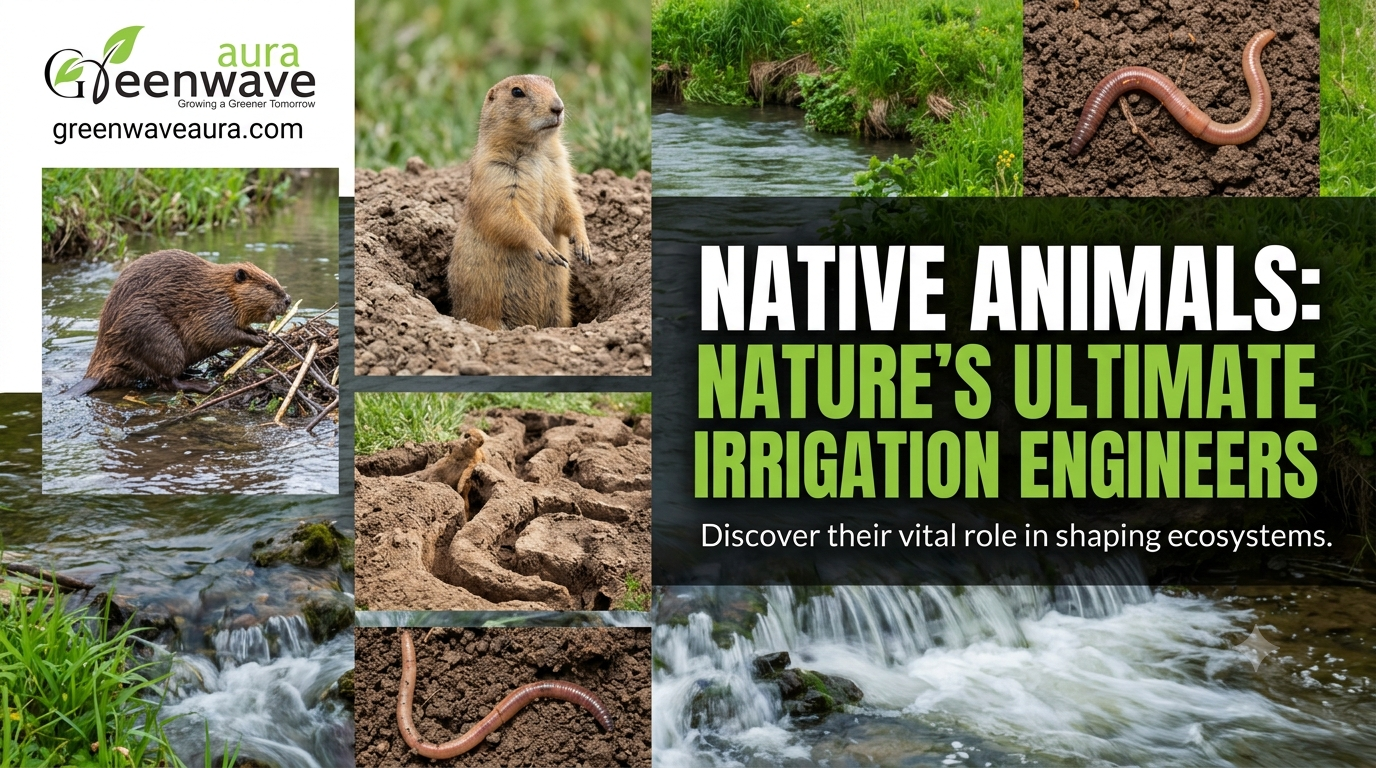
Long before pumps, pipes, and center-pivot sprinklers, wild animals were already managing water across entire landscapes. Beavers, prairie dogs, wombats, and dozens of other native species move soil, slow streams, and open channels for rainwater in ways engineers are only now learning to copy. For farmers and landowners facing rising energy bills and deepening droughts, understanding – and welcoming back – these natural “irrigation engineers” can be one of the most cost-effective water strategies available. This guide walks through ten native animals whose everyday digging, damming, and burrowing quietly keeps water tables higher, soils more absorbent, and land more drought-resilient.
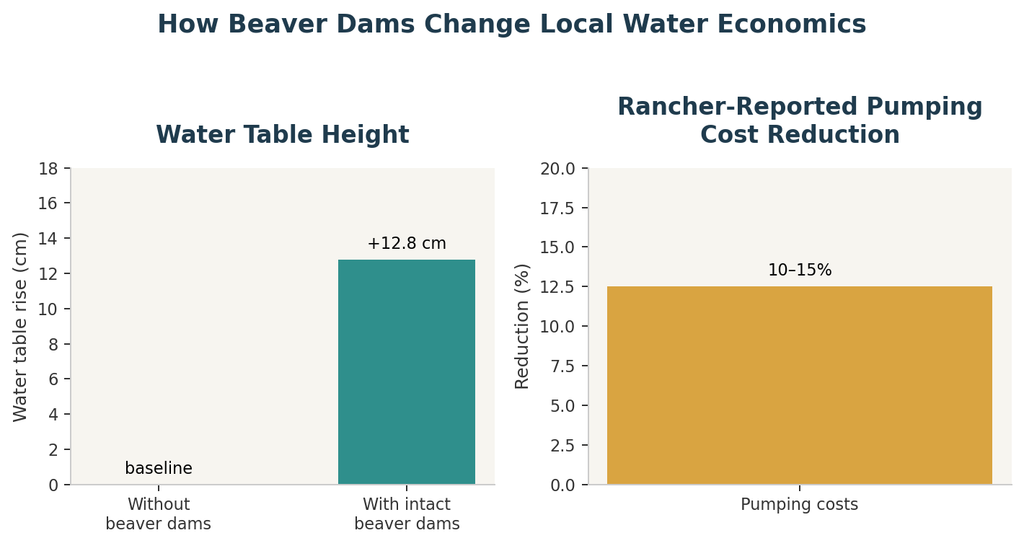
Figure 1: Field research shows intact beaver dams raise local water tables and have been linked to double-digit reductions in ranch pumping costs.
Who Are Nature’s Irrigation Engineers?
“Ecosystem engineers” is the scientific term for animals that physically reshape their habitat in ways that benefit countless other species. Beavers, prairie dogs, wombats, badgers, and even earthworms fall into this category. Instead of fighting these animals as pests, a growing number of ranchers, hydrologists, and restoration ecologists are learning to work alongside them – because their digging and damming solve problems that cost humans millions of dollars a year to manage with concrete, pipes, and diesel pumps.
How Do Beavers Build Natural Dams That Raise Water Tables?
The North American beaver (Castor canadensis) is the best-studied hydrological engineer in the animal kingdom. By felling small trees and packing mud and branches across streams, beavers create ponds that spread water sideways into the floodplain instead of letting it rush downstream. Research from the University of Calgary’s Biogeoscience Institute found that where beaver dams stayed intact, the surrounding water table sat an average of 12.8 cm higher – and was more than twice as stable – compared to areas where dams had broken.
That stored water does not just sit in the pond. It seeps sideways and downward, recharging groundwater that keeps nearby wells, pastures, and crops supplied through the dry months. A Stanford University study along Colorado’s East River found that beaver dams buffered water quality against the effects of drought more strongly than seasonal rainfall swings did. On working ranches, the practical payoff is measurable: Scott River, California rancher Garreth Plank reported a 10–15 percent drop in pumping costs after beavers re-established dams on his land.
What Role Do Burrowing Animals Like Prairie Dogs and Wombats Play?
Underground, a different kind of engineering is happening. Black-tailed prairie dog colonies riddle the ground with tunnels that act as conduits for rainwater, letting it soak deep into the soil instead of running off the surface. USDA Agricultural Research Service studies in South Dakota found that prairie dog activity measurably changes soil bulk density, nutrient “hot spots,” and water infiltration rates compared to untouched prairie. The constant mixing of soil during burrowing also increases aeration and reduces compaction – two of the biggest obstacles to healthy root growth on grazed land.
On the other side of the world, the common wombat of Australia digs equally impressive burrow systems – some stretching over 30 metres – that similarly loosen compacted soils and create pathways for water during the country’s notoriously erratic rainfall. Other burrowers worth watching for are badgers, ground squirrels, and aardvarks, all of which perform a smaller-scale version of the same service: turning hard-packed earth into a sponge.
- Beavers: dam streams, raise water tables, and create wetland ponds
- Prairie dogs: tunnel systems increase rainwater infiltration and soil aeration
- Wombats: deep burrows loosen compacted Australian soils
- Badgers & ground squirrels: smaller tunnels that still boost infiltration
- Earthworms: constant micro-tunneling improves drainage at the root zone
Why Do Wild Animals Reduce the Need for Artificial Irrigation?
Pumped irrigation is expensive – it depends on energy, infrastructure, and a water table that has to be high enough to reach in the first place. When beaver ponds and prairie dog tunnels keep that water table elevated and stable, less energy is needed to pull water to the surface, and natural soil moisture does more of the work a sprinkler system would otherwise have to do. Several U.S. land trusts and ranching cooperatives are now building low-cost “beaver dam analogues” – hand-built structures that mimic real dams – specifically to restore this free hydrological service on land where beavers have not yet returned.
Quick Answers (FAQ)
Do beaver dams really help during a drought?
Yes. Multiple peer-reviewed studies, including research from Stanford University and the University of Calgary, show that beaver dams raise and stabilize local water tables and buffer streams against drought-driven water-quality decline.
Can prairie dogs improve pasture for livestock?
Research summarized by the USDA and regional rangeland programs shows prairie dog colonies can increase water infiltration and, in some studies, improve forage nutrient content, although total forage volume may be lower on active colonies.
Is it legal to encourage beavers on private land?
Rules vary by country and state. In many parts of the U.S. and Europe, landowners can request permits for beaver relocation or install beaver dam analogues; check with your local wildlife agency before taking action.
Sources & Further Reading
Stanford News – “Beaver dams buffer rivers against climate extremes” (2022) – https://news.stanford.edu/2022/11/08/beaver-dams-buffer-rivers-climate-extremes/
University of Calgary Biogeoscience Institute – Beaver-mediated water table dynamics – https://research.ucalgary.ca/sites/default/files/BGI/bgi-beaver-mediated-water-table-dynamics.pdf
Westbrook et al., Water Resources Research (2006), via Bio4Climate – https://bio4climate.org/article/beaver-dams-and-overbank-floods-influence-groundwater-surface-water-interactions-of-a-rocky-mountain-riparian-area-westbrook-et-al-2006/
EARTH Magazine – “Beavers preserve wetlands in water-stressed areas” (AGU) – https://www.earthmagazine.org/article/beavers-preserve-wetlands-water-stressed-areas/
USDA Agricultural Research Service – Soil change induced by prairie dogs across three ecological sites – https://catalog.data.gov/dataset/bdata-from-soil-change-induced-by-prairie-dogs-across-three-ecological-sites-b
Great Plains Restoration Council – Prairie dogs and soil impacts – https://gprc.org/?p=479