






How the BRICS Digital Centre of Excellence for Smart Grids and Energy Storage, launched under India’s 2026 chairship, aims to turn intermittent solar and wind power into round-the-clock reliable electricity across the Global South.
Key Takeaways
- BRICS energy ministers launched the Digital Centre of Excellence for Smart Grids and Energy Storage (BRICS DCoE) in Gurugram, India, in June 2026, under the Energy Research Cooperation Platform (ERCP).
- The centre is meant to standardize grid-scale battery technology, share AI-driven grid-management tools, and run joint pilot projects across member nations.
- India’s own solar build-out – from roughly 3 GW in 2014 to over 154 GW in 2026 – illustrates why storage and smart-grid coordination have become urgent.
- The initiative sits alongside new BRICS Guiding Principles on Smart Grids and a forthcoming Joint Report on Hydrogen Value Chains.
- The long-term goal is to reduce Global South reliance on fossil-fuel backup power while scaling renewables without risking blackouts.
Why Grids, Not Just Generation, Decide the Energy Transition
Solar panels and wind turbines get most of the applause in the clean-energy conversation, but the unglamorous truth is that none of it matters much if the grid underneath cannot absorb, store, and dispatch that power reliably. Renewable output rises and falls with the weather and the clock, and unless a grid has the storage and digital intelligence to smooth those swings, operators fall back on diesel and coal plants to keep the lights on. That is the intermittency problem, and it is the single biggest technical obstacle standing between the Global South and a genuinely low-carbon power system.
It is also exactly the gap the newly launched BRICS Digital Centre of Excellence for Smart Grids and Energy Storage (BRICS DCoE) is designed to close. The centre was unveiled at the 11th BRICS Energy Ministers’ Meeting in Gurugram, Haryana, in June 2026, as one of the flagship outcomes of India’s year-long BRICS chairship, and it was folded into the bloc’s Energy Research Cooperation Platform (ERCP) so that it has an institutional home rather than existing as a one-off announcement.
The Intermittency Bottleneck in Fast-Growing Economies
India, China, and South Africa have each added renewable capacity at a pace that would have seemed unrealistic a decade ago. India’s own numbers make the point vividly: installed solar capacity has jumped from roughly 3 gigawatts in 2014 to more than 154 gigawatts in 2026, according to figures shared by the Ministry of Power at the Gurugram meeting. That is genuinely remarkable growth, but it has also exposed how far transmission and distribution infrastructure has lagged behind generation capacity.
The practical symptoms show up as curtailment – grid operators literally telling solar and wind farms to power down because the network cannot absorb the electricity they are producing – plus voltage instability and a continued dependence on fossil-fuel plants to fill evening and low-wind gaps. Legacy transmission networks built for a handful of large, predictable coal or gas plants were never designed for thousands of small, weather-dependent generation sources feeding in at once, which is precisely why smart-grid digitisation has become a policy priority rather than a nice-to-have.
What the Digital Centre of Excellence Actually Does
According to India’s Union Power Minister Manohar Lal Khattar, who chaired the Gurugram meeting, the centre reflects a shared commitment among BRICS nations to strengthen cooperation, encourage innovation, and build energy systems that can be trusted for the long run. In practice, that translates into three operational tracks: AI-driven load forecasting and predictive monitoring so grid operators can anticipate demand and generation swings before they cause instability; a push to standardize next-generation storage technologies, including grid-scale lithium-ion, emerging solid-state batteries, and flow batteries, so member countries are not locked into incompatible or unproven systems; and a framework for regulatory coordination and open data-sharing so lessons learned in one country’s pilot project do not stay siloed there.
The centre was launched alongside a companion set of BRICS Guiding Principles on Smart Grids, and ministers used the same meeting to advance a Joint Report on Hydrogen Value Chains, signalling that storage cooperation is being built as part of a wider energy-technology agenda rather than a standalone project. The updated Terms of Reference for the ERCP itself were also endorsed, giving the research-cooperation architecture more institutional weight going into the New Delhi leaders’ summit in September 2026.
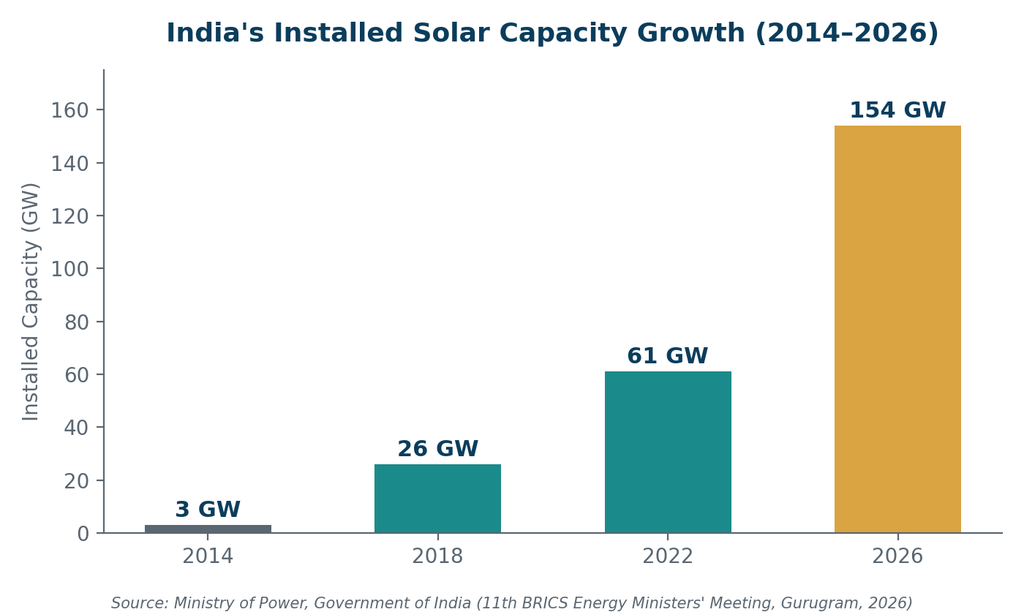
India’s installed solar capacity has grown roughly 50-fold since 2014, intensifying the case for smart-grid and storage coordination.
The Bigger Economic and Environmental Payoff
The economic logic behind the centre is straightforward: every kilowatt-hour of renewable energy that a smarter grid can store and dispatch reliably is a kilowatt-hour that does not need a diesel generator or a coal peaker plant standing by as backup. For import-dependent economies, that reduces exposure to volatile fuel prices; for grid operators, it reduces blackout risk during the exact demand peaks – hot afternoons, cold evenings – when reliability matters most to households and industry alike.
India has paired this cooperation push with its own ambitious domestic targets, including a plan to reach more than 400 gigawatt-hours of energy storage capacity by 2032 and 100 gigawatts of nuclear capacity by 2047, alongside achieving 20 percent ethanol blending ahead of schedule. Those targets, combined with India’s role in the International Solar Alliance and the Global Biofuels Alliance, give the BRICS smart-grid initiative a credible anchor rather than leaving it as an aspirational statement.
Conclusion
Smart grids do not generate a single extra watt of clean power, but they are what turns renewable energy from a fair-weather ideal into something a hospital, a factory, or a household can actually depend on every single day. By pooling research, standardizing storage technology, and building shared digital tools through the BRICS DCoE, member nations are tackling the part of the energy transition that rarely makes headlines but ultimately decides whether it succeeds. Keep an eye on the BRICS Energy Secretariat’s pilot-project announcements over the coming year – that is where this framework will either prove itself in practice or reveal how much work remains.
Frequently Asked Questions
What is the BRICS Digital Centre of Excellence for Smart Grids and Energy Storage?
It is a cooperation platform launched by BRICS energy ministers in Gurugram, India, in June 2026, designed to help member countries share research, standardize energy-storage technology, and run joint smart-grid pilot projects under the bloc’s Energy Research Cooperation Platform.
Why does the Global South need smart grids specifically?
Rapid solar and wind deployment in countries like India, China, and South Africa has outpaced transmission and storage infrastructure, causing curtailment and instability. Smart, digitally managed grids with adequate storage let these countries use more of the renewable power they already generate.
What storage technologies does the initiative cover?
The centre’s work spans grid-scale lithium-ion batteries, emerging solid-state battery technology, and flow batteries, alongside AI tools for load forecasting and predictive grid monitoring.
References
- Ghana News Agency / TV BRICS – “BRICS launches digital platform for cooperation on smart grids and energy storage,” June 26, 2026.
- Sarkaritel.com – “India Hosts 11th BRICS Energy Ministers’ Meeting, Launches Digital Energy Centre,” June 26, 2026.
- NewKerala.com – “India-chaired BRICS meet launches Digital Centre of Excellence for smart grids, energy storage,” June 25, 2026.
- Business Standard – “Brics 2026: Energy industry seeks easier cross-border investments,” September 2026.
- The Tribune – “BRICS Summit 2026: Key likely outcomes as India drives a transformative global agenda in New Delhi,” September 2026.
- Ministry of Power, Government of India – remarks at the 11th BRICS Energy Ministers’ Meeting, Gurugram, June 2026.