






The New Development Bank is scaling up local-currency lending for green infrastructure – a shift that could remove one of the biggest hidden costs slowing down solar, wind, and hydrogen projects across the Global South.
Key Takeaways
- The New Development Bank (NDB) is raising the share of its lending denominated in members’ local currencies from roughly 25 percent in 2025 to a targeted 30 percent in 2026.
- Local-currency lending directly addresses foreign-exchange risk, a major hidden cost that inflates debt-servicing for renewable infrastructure funded in foreign currencies.
- NDB President Dilma Rousseff has said around 40 percent of the bank’s current financing is dedicated entirely to sustainable projects.
- The New Delhi Declaration reaffirmed support for reforming Bretton Woods institutions and scaling concessional climate finance for developing economies.
- NDB membership has grown steadily, with Egypt, Algeria, and Uzbekistan among recent additions, broadening the pool of countries that can access this financing model.
The Hidden Cost That Stalls Green Projects: Currency Risk
A solar park or green-hydrogen plant can pencil out perfectly on paper and still struggle to get built, and the reason often has nothing to do with engineering. When a developing country borrows in US dollars or euros to fund a domestic infrastructure project, but earns revenue in its own currency, any depreciation of that local currency instantly inflates the real cost of repaying the loan. That currency mismatch – known as foreign-exchange or FX risk – has quietly derailed or delayed clean-energy projects across the Global South for years, on top of the already-high borrowing costs many developing nations face.
This is precisely the problem the New Development Bank (NDB), the multilateral lender founded by BRICS countries in 2015, has been trying to address by steadily increasing the share of its lending issued in the local currencies of its borrowing members rather than in dollars.
What the NDB Has Actually Done in 2026
NDB President Dilma Rousseff has confirmed that approximately 25 percent of the bank’s lending portfolio was already denominated in BRICS members’ local currencies, with that figure set to climb to roughly 30 percent in 2026 under the bank’s General Strategy for 2022–2026. Rousseff has also said that around 40 percent of the NDB’s current financing is devoted entirely to sustainable projects, developed in partnership with national development institutions in member countries – a sign that the local-currency push and the green-finance mandate are being pursued together rather than as separate priorities.
Rousseff has repeatedly framed this shift as being about more than convenience: using local currencies reduces exposure to a single dominant currency and better supports long-term infrastructure and energy financing in emerging economies, a priority she has called especially urgent for the Global South. The bank has continued to expand its membership base in parallel, with Egypt, Algeria, and Uzbekistan joining in recent years, which widens the pool of countries able to tap this financing model for their own renewable-energy and adaptation projects.
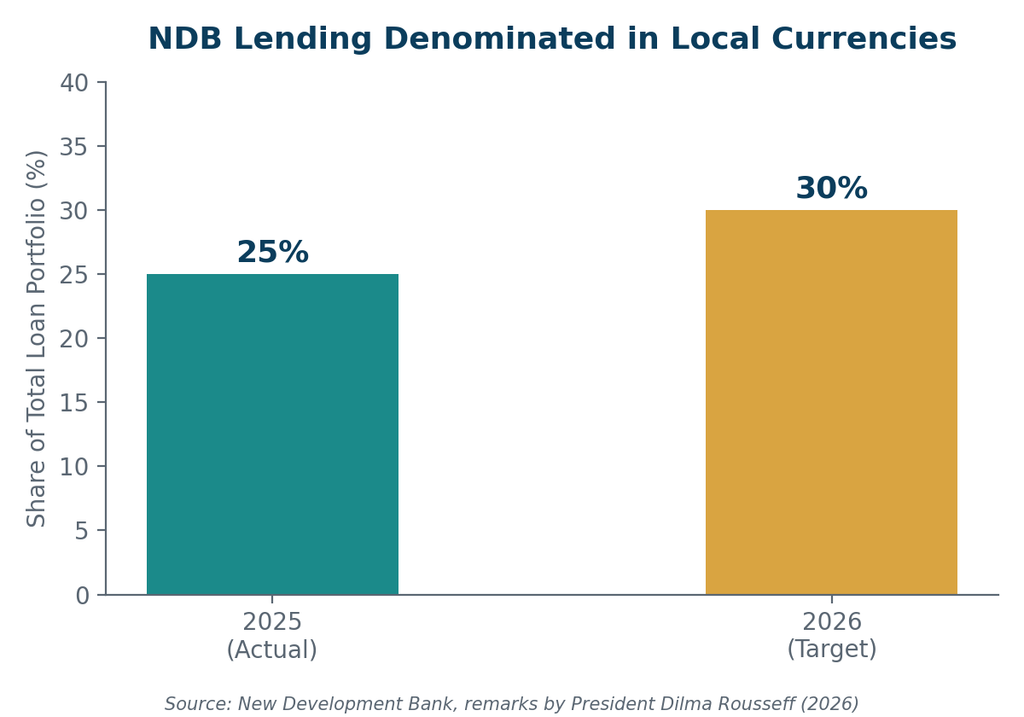
The NDB is raising the share of its total loan book issued in members’ own currencies, cutting foreign-exchange risk on green infrastructure loans.
The New Delhi Summit’s Climate-Finance Agenda
Climate and development finance featured prominently in the discussions around the 18th BRICS Summit, with leaders emphasising the need to scale concessional funding and push for reform of the Bretton Woods institutions – the World Bank and International Monetary Fund – so that developing countries have a stronger voice and better access to affordable capital. The New Delhi Declaration reaffirmed the importance of the 2025 World Bank capital framework as a tool to strengthen multilateralism and improve the legitimacy of the World Bank Group as a development-finance institution, while calling for increased voice and representation for developing countries in global financial governance.
For everyday climate-finance mechanics, that translates into a few concrete asks that BRICS countries have pushed for: specialised funding windows for adaptation projects and low-emission hydrogen, and a reduction in the administrative barriers that make it disproportionately hard for small and medium-sized green enterprises to access financing in the first place.
Why This Matters Beyond BRICS Members
Because the NDB lends to member and partner countries across the developing world, not just to BRICS founding members, its local-currency model has implications well beyond the bloc itself. Analysts covering the bank’s expansion note that its appeal for borrowers rests on speed and fewer governance conditions compared with some Western-led multilateral lenders, along with the growing share of loans available in local rather than dollar-denominated terms – a combination that has already drawn interest from infrastructure projects in the African Union’s water-security programme and energy and transport financing across Latin America.
Conclusion
Equitable climate action needs equitable financial plumbing behind it, and currency risk is one of the least visible but most consequential parts of that plumbing. By pushing local-currency lending toward 30 percent of its portfolio and pairing that with a dedicated sustainability mandate, the NDB is attacking a structural barrier that has quietly inflated the cost of clean-energy projects across the Global South for years. The open question heading out of New Delhi is whether this model can scale fast enough to meet the financing gap climate adaptation and renewable buildouts still face.
Frequently Asked Questions
What percentage of NDB lending is now in local currencies?
Around 25 percent of the New Development Bank’s loan portfolio was denominated in members’ local currencies as of 2025, with a target of roughly 30 percent for 2026 under the bank’s current strategic plan.
Why does local-currency lending help green energy projects specifically?
Renewable-energy and adaptation infrastructure is typically financed over long timeframes and earns revenue in local currency. Borrowing in that same currency removes the risk that a depreciating exchange rate will inflate real debt-servicing costs over the life of the project.
What share of NDB financing goes to sustainable projects?
NDB President Dilma Rousseff has said roughly 40 percent of the bank’s current financing is dedicated entirely to sustainable development projects.
References
- TV BRICS – “BRICS New Development Bank expands local currency lending and green finance,” July 11, 2025.
- ESI-Africa.com – “BRICS bank pushes for increase in local currency for green loans,” September 2, 2024.
- Rio Times Online – “New Development Bank: Members and Joining Rules 2026,” September 2026.
- Insights on India – “The BRICS New Development Bank (NDB): History, Members & Functions,” August 19, 2026.
- Prime Minister of India (pmindia.gov.in) – “BRICS New Delhi Declaration: Building for Resilience, Innovation, Cooperation and Sustainability,” September 12, 2026.
- New Development Bank (ndb.int) – official website and public statements, 2026.