






India’s BRICS chairship has launched a Network on Digital Agriculture, the BRICS AGRIN seed-sharing initiative, and new agroecology centres – a coordinated bet that AI and traditional farming knowledge together can climate-proof Global South food systems.
Key Takeaways
- BRICS launched a Network on Digital Agriculture, coordinated initially by India, to bring AI, geospatial tools, and digital public infrastructure into farming.
- BRICS AGRIN – the Agro-Inputs, Genetic Resources and Information Network – was agreed to strengthen cooperation on seeds, germplasm, and agricultural inputs.
- A Global Forum on Farmers’ Rights in Seed Systems was endorsed to document and protect traditional agricultural knowledge.
- The New Delhi Declaration also established a BRICS Network of Centres of Excellence on Agroecology and Regenerative Agriculture.
- These initiatives are designed to be collaborative, non-binding, and farmer-centric rather than top-down regulatory mandates.
Farming on a Changing Climate’s Terms
Climate change is not an abstract future risk for the world’s smallholder farmers – it already shows up as unpredictable monsoons, prolonged droughts, and soil that degrades faster than it can be replenished. Because so much of the Global South’s food security still runs through smallholder agriculture, these disruptions carry outsized consequences for rural livelihoods and national food supplies alike, which is why agriculture has become one of the more concrete, action-oriented tracks of India’s 2026 BRICS chairship.
Rather than a single flagship program, BRICS members have built a small cluster of complementary initiatives – a digital agriculture network, a seed and genetic-resource sharing platform, a farmers’-rights forum, and a regenerative-agriculture research network – that together sketch out a model for climate-resilient food production across very different farming systems.
The BRICS Network on Digital Agriculture
The centrepiece is the BRICS Network on Digital Agriculture, with India coordinating its initial phase. The network’s purpose is to bring artificial intelligence, geospatial mapping, and digital public infrastructure into everyday farming decisions – think precision irrigation guided by satellite soil-moisture data, AI models that flag crop disease before it spreads, and shared digital platforms that let smallholder farmers access the kind of data-driven tools that were once available only to large commercial operations.
This digital layer is deliberately being built alongside, not instead of, older forms of agricultural knowledge. That balance shows up clearly in a second initiative agreed at the summit: BRICS AGRIN, short for the Agro-Inputs, Genetic Resources and Information Network, which is meant to deepen cooperation on seeds, germplasm, and agricultural inputs across member countries. The New Delhi Declaration describes the network as collaborative, non-binding, and farmer-centric, drawing on relevant national, regional, and international practices rather than imposing a single standardised model.
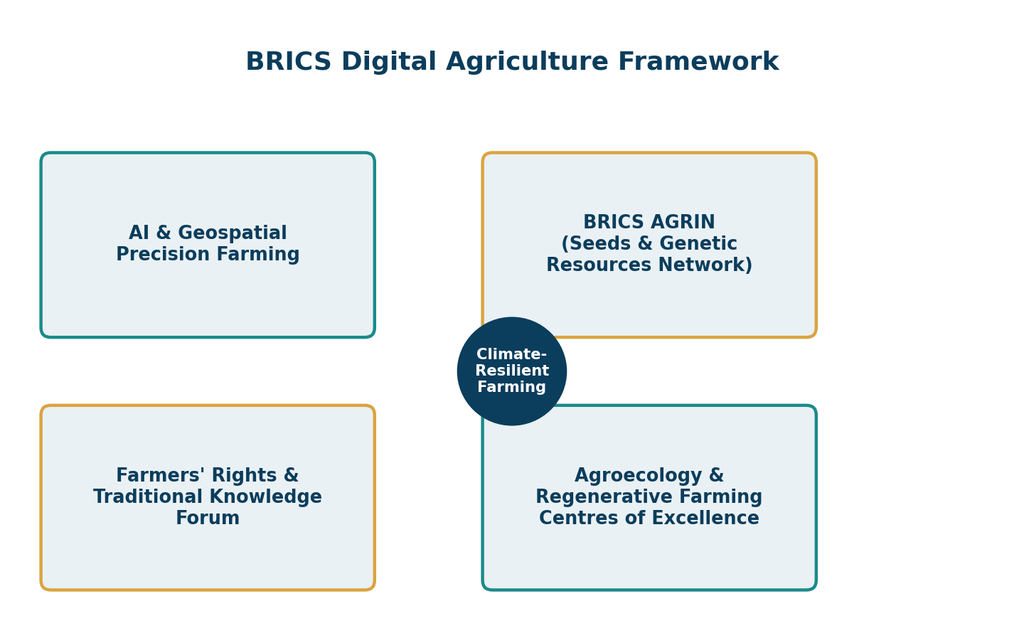
Four connected pillars – digital tools, seed-sharing, farmers’ rights, and regenerative agriculture research – anchor the BRICS approach to climate-resilient farming.
Protecting Farmers’ Rights and Traditional Knowledge
Alongside AGRIN, BRICS leaders endorsed the launch of a Global Forum on Farmers’ Rights in Seed Systems, aimed at addressing shared challenges, promoting effective policy, and facilitating the documentation and exchange of traditional knowledge tied to agriculture and seed systems. India has offered to take the first turn coordinating this forum through its Protection of Plant Varieties and Farmers’ Rights Authority, giving the initiative an institutional anchor rather than leaving it as a purely symbolic gesture.
This is a meaningful design choice: seed-sharing and genetic-resource networks can easily tip into arrangements that favour large agribusiness interests over the smallholder farmers who have preserved crop diversity for generations. By pairing AGRIN with an explicit farmers’-rights forum, the declaration signals an intent to keep indigenous and traditional seed knowledge protected and properly credited as these networks scale up.
Soil Health, Carbon, and Regenerative Agriculture
The fourth piece of the framework is the newly established BRICS Network of Centres of Excellence on Agroecology and Regenerative Agriculture for Climate Resilience and Productivity, aimed at strengthening cooperation and knowledge-sharing around sustainable, climate-resilient farming practices. Regenerative techniques – reduced tillage, cover cropping, and organic soil amendments among them – do double duty environmentally: they tend to improve a soil’s capacity to retain carbon while also making it more resilient to the droughts and heat spikes that climate change is making more frequent.
That dual benefit is a large part of why regenerative agriculture keeps coming up in climate-policy conversations, not just agricultural ones: it is one of the few interventions that functions simultaneously as a mitigation tool, through soil carbon sequestration, and an adaptation tool, through improved drought resistance for the farmers relying on that land.
Conclusion
Sustainable farming sits at the intersection of two problems BRICS nations cannot afford to get wrong: feeding a still-growing population and doing it in a way that survives an increasingly unstable climate. By threading together digital precision-farming tools, a dedicated seed and genetic-resource network, a farmers’-rights forum, and regenerative-agriculture research centres, the bloc’s 2026 agriculture agenda tries to treat those two problems as one and the same challenge rather than trading one off against the other.
Frequently Asked Questions
What is the BRICS Network on Digital Agriculture?
It is a cooperation initiative, with India coordinating its initial phase, that integrates artificial intelligence, geospatial technology, and digital public infrastructure into farming to support precision irrigation, crop-health monitoring, and data-driven decisions for smallholder and commercial farmers alike.
What does BRICS AGRIN stand for?
BRICS AGRIN stands for the Agro-Inputs, Genetic Resources and Information Network. It is a collaborative, non-binding, farmer-centric platform for sharing seeds, germplasm, and agricultural inputs among member countries.
How does BRICS protect traditional farming knowledge?
Through the Global Forum on Farmers’ Rights in Seed Systems, which documents and shares traditional and indigenous agricultural knowledge and is being coordinated in its first phase by India’s Protection of Plant Varieties and Farmers’ Rights Authority.
References
- Business Standard – “Delhi Declaration endorses Russia-backed plan for Brics Grain Exchange,” September 12, 2026.
- Business Standard – “Brics nations propose deeper information sharing on farm genetic resources,” September 11, 2026.
- The Tribune – “BRICS Summit 2026: Key likely outcomes as India drives a transformative global agenda in New Delhi,” September 2026.
- Channel iAM – “India Gives BRICS a New Push,” late August 2026.
- Food and Agriculture Organization of the United Nations (fao.org) – “FAO at Two Major Artificial Intelligence and Digital Agriculture Events in India,” February 2026.