





A deep dive into AI energy consumption, data center power demand, and the carbon footprint of AI – and what green computing can realistically fix.
Somewhere in the time it takes you to read this sentence, generative AI tools around the world have processed thousands of prompts. Multiply that by every minute of every day, and you get a number that is hard to picture: billions of AI interactions daily, each one quietly drawing electricity from a power grid that was never designed to handle this kind of load. Most users never think about it. They type a question, get an answer in seconds, and move on. But behind that instant reply sits a chain of GPUs, cooling systems, and power plants working together to make it happen.
The problem is scale. According to the International Energy Agency (IEA), global electricity consumption from data centers is projected to more than double by 2030, reaching roughly 945 terawatt-hours a year – a figure close to Japan’s entire current electricity use. AI-optimized data centers, the ones running large language models and generative tools, are growing even faster than the industry average, with their share of electricity demand expected to triple over the same period. This is not a distant, theoretical concern. It is already reshaping how utilities plan power grids, how tech companies choose real estate, and how governments write energy policy.
This surge sits at an uncomfortable intersection with global climate goals. AI energy consumption is rising just as the world needs to be cutting emissions, and that tension cannot be wished away by clever marketing or a single efficiency breakthrough. To keep tech innovation from quietly undoing years of climate progress, the AI sector has to pursue several strategies at once: locking in nuclear power and small modular reactors (SMRs) for reliable, carbon-free electricity, pushing hardware and software efficiency far beyond where it sits today, and signing renewable power purchase agreements (PPAs) that fund new clean generation rather than just repackaging existing green power. This article walks through the real scale of AI’s power and water footprint, what leading tech companies are actually doing about it, and where regulation is heading next.
II. Understanding the Scale of AI’s Power and Water Footprint
To understand why AI energy consumption has become an industry-wide worry, it helps to look past the headlines and into the mechanics of how these systems actually run.
High-Density GPU Clusters vs. Traditional Cloud Servers
Traditional cloud computing – the kind that powers email, websites, and basic business software – runs on general-purpose servers that sip power compared to what AI now demands. A rack built for training or running large language models is a different animal entirely. It is packed with specialized GPUs (graphics processing units) that were originally designed for video games and are now the workhorses of AI, each one drawing far more power per chip than a standard CPU server. A single modern AI-focused data center can now require up to 80 megawatts of continuous power – more than double what a typical hyperscale facility needed just a few years ago. This is the core reason data center power demand is climbing so fast: it is not just that companies are building more data centers, it is that each one is becoming dramatically more power-hungry.
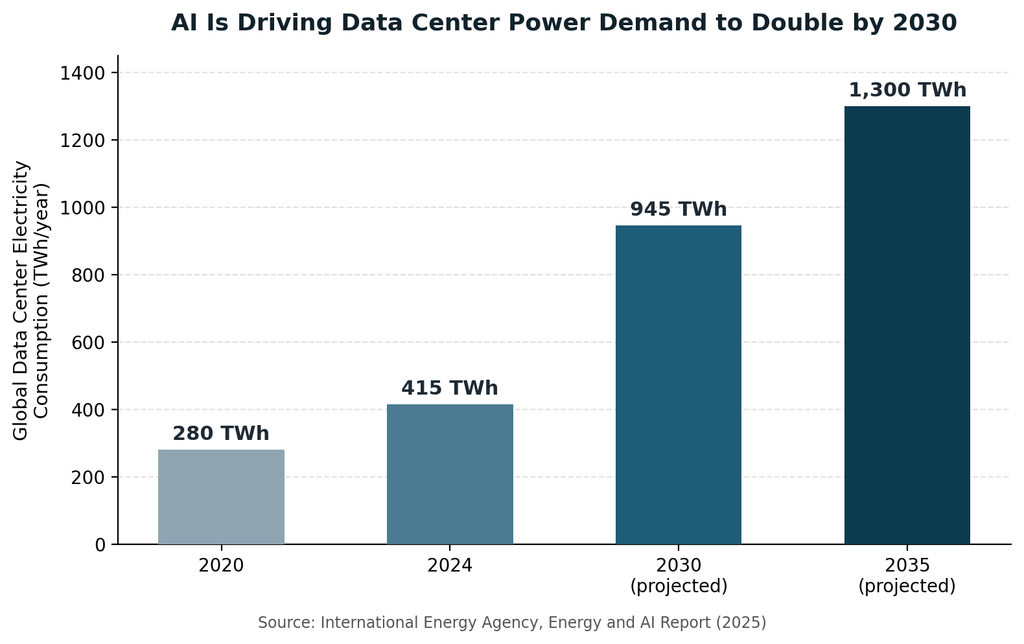
Global data center electricity demand is on track to more than double between 2024 and 2030, driven largely by AI workloads. Source: IEA, Energy and AI (2025).
The Hidden Water Footprint of Hyperscale Facilities
Electricity is only half the story. AI data centers also depend heavily on water, mostly for cooling. Densely packed GPU racks generate enormous heat, and many facilities still rely on evaporative cooling towers to keep temperatures safe – essentially large-scale industrial sweating. A single hyperscale data center can consume up to five million gallons of water a day, roughly the same draw as a town of tens of thousands of people. Researchers led by Shaolei Ren at the University of California, Riverside, have studied this closely, and their per-query estimates have shifted as models and cooling systems evolve: early 2023-2024 estimates suggested a short AI conversation could involve several hundred milliliters of water once you count both on-site cooling and the water used to generate electricity at the power plant. More recent, narrower estimates for current-generation models put a single query closer to 5 to 15 milliliters – still real, but far smaller once isolated to a single interaction. The bigger concern is not any one prompt; it is that so many new data centers are being sited in regions already under water stress.
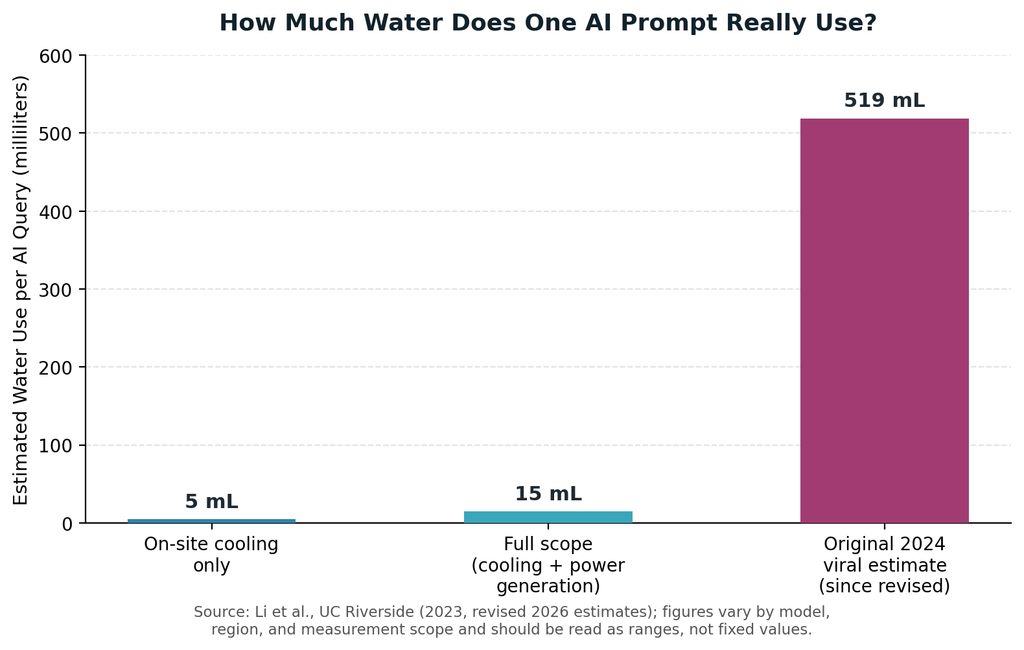
Per-query water estimates vary widely depending on what is measured. On-site cooling alone is small; adding power-plant water use raises the number considerably. Source: Li et al., UC Riverside (2023, updated estimates through 2026).
Direct Emissions vs. Scope 2 and Scope 3 Supply Chain Emissions
When companies talk about their carbon footprint of AI, the numbers can look deceptively small if you only count direct, on-site emissions (Scope 1). The bigger story is in Scope 2 emissions, which come from the electricity a data center pulls from the grid, and Scope 3 emissions, which cover everything upstream and downstream – chip manufacturing, server hardware, construction materials, and transportation. Google’s 2026 environmental report found that its total greenhouse gas emissions were 81% higher than its 2019 baseline, with the increase driven largely by growing supply-chain activity tied to its AI buildout. Microsoft has reported a comparable pattern, with total emissions up nearly 30% since 2020 due largely to data center construction. Both companies remain nominally committed to net-zero targets, but both have publicly acknowledged that AI growth is making those targets harder to hit on schedule.
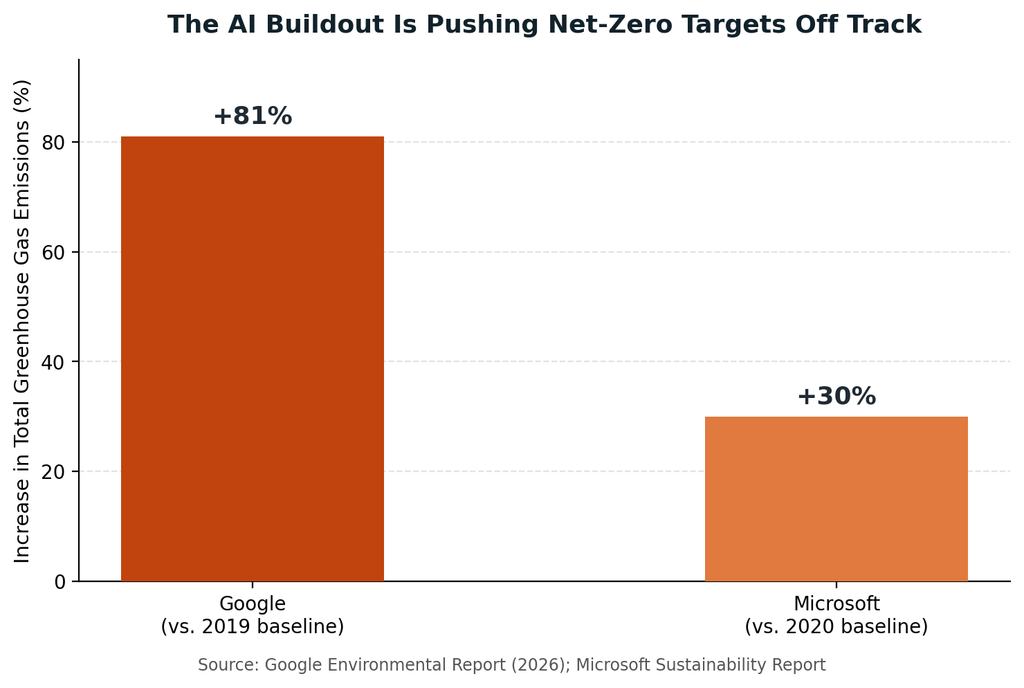
AI infrastructure buildout has become the single biggest factor pushing corporate emissions upward, even at companies with long-standing sustainability commitments. Source: Google and Microsoft annual environmental/sustainability reports.
III. Modern Solutions: How Tech Giants Are Mitigating the Impact
The encouraging part of this story is that the same companies driving up AI energy consumption are also pouring billions of dollars into fixing it. Three strategies stand out.
Alternative Energy Sources: Nuclear, SMRs, and Geothermal
Renewable power purchase agreements alone cannot solve the reliability problem, because solar and wind are intermittent while AI data centers need power around the clock. That gap is why nuclear energy has made a sudden comeback in corporate energy strategy. Microsoft signed a 20-year deal to help restart the Three Mile Island plant (rebranded the Crane Clean Energy Center), targeting around 835 megawatts of power by 2027. Google struck a deal with Kairos Power to develop up to 500 megawatts of small modular reactors, with its first unit targeted for around 2030. Amazon has committed roughly 1.92 gigawatts through a power purchase agreement with Talen Energy, and Meta’s nuclear commitments now total the largest of any tech company, at more than 5 gigawatts. Altogether, the four major hyperscalers had committed close to 9.8 gigawatts of nuclear and SMR capacity as of mid-2026 – more capital flowing into nuclear power than in any prior decade. Alongside nuclear, companies are also exploring advanced geothermal energy, which offers similarly steady, round-the-clock output without the long build times of a new reactor.
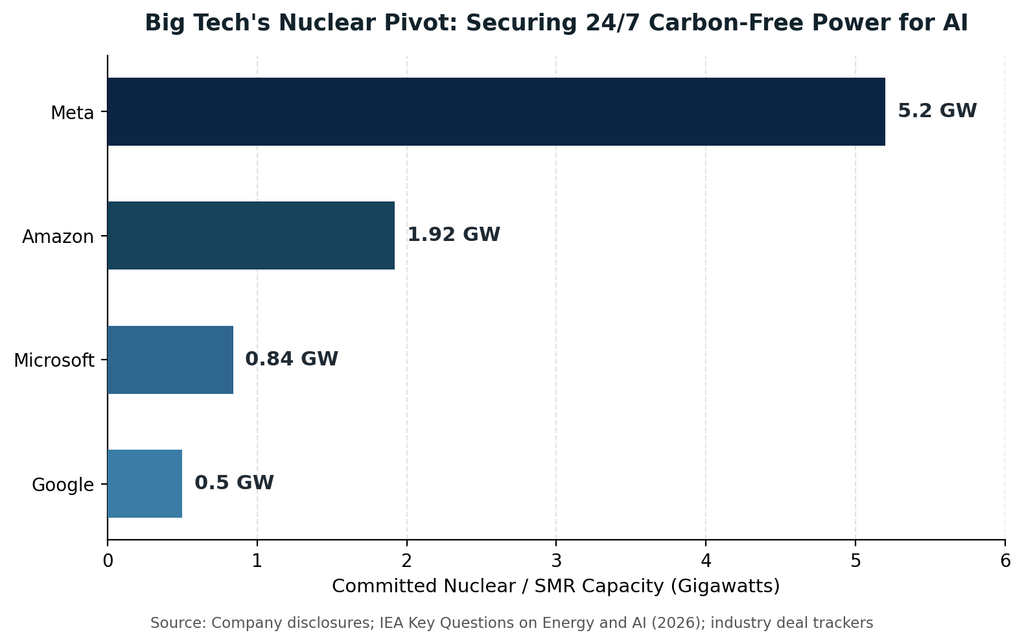
Big Tech’s nuclear commitments have accelerated sharply since 2024, reflecting a search for reliable, carbon-free baseload power. Source: company disclosures; IEA (2026); industry deal trackers.
Algorithmic Efficiency: Quantization, Speculative Decoding, and Leaner Software
Not every fix requires a new power plant. A growing body of research shows that smarter software can cut energy use dramatically without a new watt of generation capacity. Model quantization – reducing the numerical precision a model uses for its calculations – has been shown in peer-reviewed studies to cut inference energy consumption by roughly 30% to 55%, depending on the technique and model size, often with only a small trade-off in accuracy. Speculative decoding, a technique where a smaller, faster model drafts likely next tokens for a larger model to verify, speeds up response generation and reduces the compute cycles burned per answer. Combined with pruning, knowledge distillation, and hardware-aware architecture design, these techniques form the backbone of what researchers now call “Green AI” – building smaller, leaner models that do more with less, rather than assuming bigger is always better.
Site Selection Strategy: Cold Climates and Renewable-Rich Regions
Where a data center is built matters almost as much as how it is run. Cooler climates cut cooling costs dramatically, since outside air can handle more of the thermal load without mechanical refrigeration. That is part of why the Nordic countries, the Pacific Northwest, and parts of Canada have become popular data center hubs. Companies are also chasing regions with abundant renewable generation – hydropower in Scandinavia, wind in the US Great Plains, geothermal in Iceland – so that new AI capacity can be matched with genuinely additional clean power rather than pulling harder on an already strained, fossil-fuel-heavy grid.
IV. Regulatory Pressures & ESG Standards
Governments are no longer treating data center energy use as a private matter between a company and its utility bill. Regulation is catching up quickly, and it is reshaping how operators plan, build, and report.
Mandatory Energy Reporting and Transparency Metrics
The European Union’s Energy Efficiency Directive now requires data center operators with at least 500 kW of installed IT capacity to report detailed energy and sustainability metrics to a public European database every year, with the first reports filed in 2024. The EU is also finalizing an EU-wide rating scheme for data center sustainability, expected in 2026, which will make efficiency comparisons far more visible to investors and regulators alike. In the United States, California’s SB 253 will require large companies – those with more than $1 billion in annual revenue – to report Scope 1 and Scope 2 emissions starting in 2026, with Scope 3 disclosures following in 2027.
Grid-Decarbonization Requirements and Clean Energy Mandates
Beyond reporting, the broader Corporate Sustainability Reporting Directive (CSRD) in the EU is pushing thousands of companies – including many data center operators and their major tenants – to disclose detailed greenhouse gas data audited to a consistent standard. This is combined with policy pressure to decarbonize the grids that data centers draw from in the first place, since even the most efficient AI hardware still runs dirty if the local electricity mix is dominated by coal or natural gas. For ESG officers and sustainability analysts, this regulatory shift means AI energy consumption is quickly moving from a voluntary sustainability talking point to a mandatory, audited line item.
V. Conclusion & Actionable Takeaways
AI is not going away, and neither is its appetite for electricity and water. The real question is not whether AI deployment will keep growing – it will – but whether the energy behind it can be decarbonized fast enough to keep global climate targets within reach. The evidence so far is mixed. On one hand, tech giants are underwriting a genuine nuclear renaissance, funding real efficiency research, and signing the largest clean energy purchase agreements in history. On the other, several of the very same companies have watched their own emissions rise by double-digit or even triple-digit percentages over just a few years, showing that voluntary commitments alone have not kept pace with the scale of AI’s buildout.
For tech professionals, ESG officers, sustainability analysts, and conscious consumers alike, the practical takeaway is the same: AI deployment cannot come at the expense of global decarbonization goals, and closing that gap will take a combination of reliable clean power (nuclear, geothermal, and firm renewables), leaner and more efficient models, smarter data center siting, and regulation with real teeth. Green computing is no longer a nice-to-have. It is fast becoming a basic condition for AI to keep scaling responsibly.
References & Sources
- International Energy Agency (IEA). “Energy and AI” and “Key Questions on Energy and AI.” iea.org/reports/energy-and-ai
- International Energy Agency (IEA) News. “Data centre electricity use surged in 2025.” iea.org/news
- Li, P., Yang, J., Islam, M. A., & Ren, S. (2023). “Making AI Less Thirsty: Uncovering and Addressing the Secret Water Footprint of AI Models.” University of California, Riverside (arXiv).
- Environmental and Energy Study Institute (EESI). “Data Centers and Water Consumption.” eesi.org
- Google. 2026 Environmental Report. sustainability.google
- Microsoft. 2025 Environmental Sustainability Report. microsoft.com/sustainability
- CNBC, Axios, ESG Dive, Data Center Dynamics – coverage of Google and Microsoft emissions reports (2024–2026).
- European Commission, Directorate-General for Energy. Energy Efficiency Directive – Data Centre Reporting Requirements. energy.ec.europa.eu
- White & Case LLP. “Data centres and energy consumption: evolving EU regulatory landscape and outlook for 2026.”
- California Air Resources Board (CARB). SB 253 Climate Corporate Data Accountability Act reporting requirements.
- Forbes. “The AI Boom Is Making Nuclear Power Bankable Again.” (2026).
- Company disclosures and industry trackers on nuclear/SMR power purchase agreements: Microsoft–Constellation (Crane Clean Energy Center), Google–Kairos Power, Amazon–Talen Energy, Meta–Vistra/Constellation.
- Springer Nature, ACM, ScienceDirect, and arXiv peer-reviewed studies on model quantization, pruning, and Green AI energy efficiency (2025–2026).