







The New Delhi Declaration puts critical minerals at the centre of BRICS climate strategy, warning against the weaponisation of technology and pushing Global South nations up the clean-energy value chain.
Key Takeaways
- BRICS leaders unanimously adopted the New Delhi Declaration on September 12, 2026, which warns against the weaponisation of technology and critical minerals.
- The declaration calls for reliable, diversified, and fair critical-mineral supply chains that respect resource-rich countries’ sovereign rights over their own minerals.
- A core BRICS strategy is moving Global South nations from raw mineral export toward higher-value refining, battery, and panel manufacturing.
- A BRICS Photovoltaic Industry Action Plan was adopted alongside the declaration to strengthen clean-tech manufacturing.
- Prime Minister Narendra Modi specifically linked mineral security to inclusive technology access during the summit’s second-day session.
Sun and Wind Are Not the Only Inputs the Energy Transition Needs
It is easy to think of the clean-energy transition purely in terms of sunlight and wind speed, but every solar panel, wind turbine, and electric-vehicle battery is also a physical object built from lithium, cobalt, nickel, and rare-earth elements that have to be mined, refined, and turned into components somewhere. Whoever controls those steps effectively controls the pace at which the rest of the world can decarbonize, which is why critical-mineral supply chains have become as geopolitically sensitive as oil pipelines once were.
That sensitivity was on full display at the 18th BRICS Summit in New Delhi on September 12–13, 2026, where the New Delhi Declaration – adopted unanimously by the bloc’s eleven members – devoted significant attention to protecting mineral supply chains from being used as leverage in trade disputes.
What the New Delhi Declaration Actually Says
Addressing the summit’s session on Resilience, Innovation, Cooperation and Sustainability, Prime Minister Narendra Modi warned that the weaponisation of technology and critical minerals could hinder the shared progress of BRICS countries, and called for greater inclusivity in how technology is adopted and shared. The declaration itself affirms the need for supply chains of critical minerals that are, in its words, reliable, responsible, diversified, resilient, fair, sustainable, and just – language chosen specifically to guarantee benefit-sharing, value addition, and economic diversification for the resource-rich countries that actually hold these minerals in the ground.
Just as importantly, the declaration preserves what it calls the sovereign rights of resource-rich nations over their own mineral resources, including their right to adopt and enforce policy measures in pursuit of legitimate national objectives. It also explicitly recognises the role critical minerals play in developing zero- and low-emission energy technologies and in strengthening the resilience of energy supply chains more broadly – tying the mineral question directly to climate goals rather than treating it as a separate trade issue.
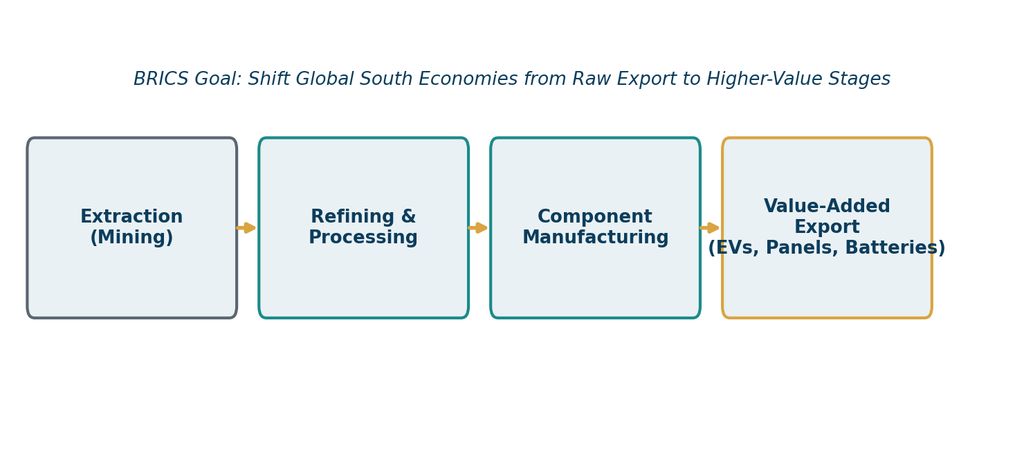
BRICS strategy centres on moving resource-rich Global South economies up the value chain rather than exporting raw minerals.
Moving Up the Value Chain: From Raw Export to Manufacturing
The central strategic idea BRICS is pushing is deceptively simple: a country that only exports raw ore captures a fraction of the economic value compared to one that also refines that ore and manufactures finished batteries or solar cells. Shifting Global South economies further along this value chain – from extraction, to refining, to component manufacturing, to finished clean-technology exports – is the throughline connecting the mineral-security language in the declaration to the summit’s parallel adoption of a Terms of Reference and Action Plan for the BRICS Photovoltaic Industry Working Group.
That plan explicitly calls for value addition and economic diversification in resource-rich countries as part of a broader push to build resilient clean-technology manufacturing and supply chains across the Global South. In practical terms, this points toward joint ventures in refining and processing technology, longer-term supply agreements between mineral-rich and manufacturing-heavy member states, and coordinated opposition to unilateral trade barriers – including carbon border adjustment mechanisms that critics argue can disadvantage developing-country exporters.
What This Means for Regional Economies
For mineral-rich BRICS members and partner countries, the declaration’s emphasis on local value addition is ultimately about jobs and industrial policy as much as it is about climate diplomacy – refining and manufacturing capacity generates far more domestic employment than mining alone. For manufacturing-heavy economies, meanwhile, diversified and transparent mineral supply chains reduce the risk that a single point of geopolitical friction can stall an entire clean-energy infrastructure pipeline, whether that is a battery gigafactory or a national solar rollout.
Conclusion
The clean-energy transition was always going to be a story about physical materials as much as ideals, and the New Delhi Declaration makes that explicit. By pairing language on fair, diversified mineral supply chains with concrete instruments like the BRICS Photovoltaic Industry Action Plan, the bloc is trying to ensure that the next stage of the energy transition is not derailed by the same kind of supply shocks and geopolitical leverage that have periodically disrupted oil markets. Whether these commitments translate into signed joint ventures and financing will be the real test in the year ahead.
Frequently Asked Questions
What did the New Delhi Declaration say about critical minerals?
It called for critical-mineral supply chains to be reliable, diversified, fair, and transparent, affirmed resource-rich countries’ sovereign rights over their own minerals, and linked mineral security directly to clean-energy technology and energy-supply resilience.
Why does ‘weaponisation of technology and critical minerals’ matter?
Prime Minister Modi used this phrase to warn that concentrating mineral processing or technology access in a few countries creates leverage that can be used to disrupt other nations’ development, undermining shared progress on clean energy and inclusive growth.
What is the BRICS Photovoltaic Industry Action Plan?
It is a Terms of Reference and action plan adopted at the New Delhi Summit to strengthen clean-technology manufacturing and supply-chain resilience, with a specific focus on value addition and economic diversification in resource-rich countries.
References
- The Tribune – “Weaponisation of technology, critical minerals can hinder our shared progress: PM Modi at BRICS Summit,” September 13, 2026.
- Business Standard – “Weaponising critical minerals can hinder common growth: PM Modi at Brics,” September 13, 2026.
- The Quint – “BRICS Summit Day 2: Modi Warns Against Tech, Critical Mineral ‘Weaponisation’,” September 2026.
- Down To Earth – “BRICS New Delhi Summit Adopts Photovoltaic Industry Action Plan, Boosts Clean Tech and Critical Minerals Value Addition,” September 2026.
- Prime Minister of India (pmindia.gov.in) – “BRICS New Delhi Declaration: Building for Resilience, Innovation, Cooperation and Sustainability,” September 12, 2026.