









With over 70 percent of global emissions tied to cities, the new BRICS Urban Mobility Hub and Voluntary Principles for Climate-Resilient Urban Infrastructure aim to help fast-growing Global South cities electrify transit and flood-proof their infrastructure together.
Key Takeaways
- The New Delhi Declaration announced the BRICS Urban Mobility Hub for cooperation on accessible, affordable, and smart urban transport.
- BRICS also adopted Voluntary Principles for Climate-Resilient Urban Infrastructure and proposed an Urban Research and Knowledge Network for peer learning.
- These urban initiatives sit alongside a BRICS Logistics Supply-Chain Cooperation Framework and ongoing discussion of a proposed Railway Research Network.
- The declaration also commits member nations to disaster risk reduction cooperation, coming shortly after severe glacier-triggered floods in Nepal.
- Analysts note that much of this urban architecture remains voluntary and non-binding, with financing the key unresolved question.
Cities Are Where the Climate Fight Is Actually Won or Lost
More than 70 percent of global greenhouse-gas emissions trace back to cities, and urban transport is one of the biggest single contributors – fuelled by rapid urbanisation across Asia, Africa, and Latin America that has consistently outpaced public-transit capacity. That imbalance shows up on the ground as clogged roads, worsening air pollution, and rising municipal energy demand, all compounding just as many of these same cities face growing exposure to flooding and other climate-driven disasters.
It is this combination – explosive urban growth colliding with climate risk – that the 18th BRICS Summit in New Delhi addressed through a cluster of new urban-focused commitments, most notably the BRICS Urban Mobility Hub and a parallel set of Voluntary Principles for Climate-Resilient Urban Infrastructure.
What the Urban Mobility Hub Is Meant to Do
The New Delhi Declaration formally announced the BRICS Urban Mobility Hub as a platform for cooperation on accessible, affordable, and smart urban transport across member cities. In practice, that is expected to mean peer-to-peer learning on mass-transit electrification – sharing what has worked and what has not in rolling out electric buses and urban rail – alongside efforts to build more standardised electric-vehicle charging infrastructure so that EV adoption is not held back by fragmented, incompatible charging networks from city to city.
The hub does not stand alone. It was introduced together with an Urban Research and Knowledge Network, intended to support institutional research and peer learning on city planning, and it complements the previously announced Voluntary Principles for Climate-Resilient Urban Infrastructure, which push member cities to build flood-proofing and other climate-adaptive design principles directly into new infrastructure projects rather than retrofitting them after a disaster.
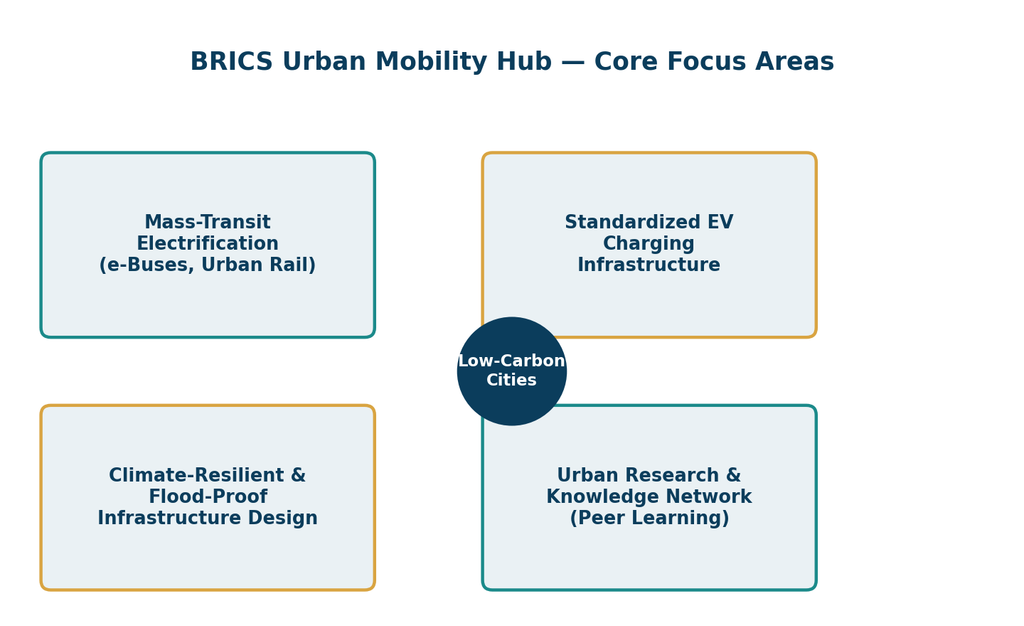
The BRICS Urban Mobility Hub links transit electrification, EV charging standards, resilient design, and peer research into one framework.
Part of a Larger Resilient-Infrastructure and Logistics Push
These urban commitments were folded into the New Delhi Declaration alongside a BRICS Logistics Supply-Chain Cooperation Framework and continued discussion of a proposed Railway Research Network, reflecting a broader effort to treat transport, logistics, and urban resilience as interconnected priorities rather than separate silos. Member nations also agreed to deepen cooperation on transport policy, investment, technology, and capacity-building specifically aimed at developing more sustainable and resilient transport infrastructure.
The timing carried extra weight: the declaration’s disaster-resilience language arrived just weeks after glacier-triggered floods in Nepal killed close to 1,400 people, a tragedy that sharpened the summit’s focus on integrating climate risk into infrastructure planning from the outset. Ulka Kelkar, Executive Director for Climate, Economics and Finance at the World Resources Institute India, described the declaration’s disaster risk reduction provisions as introducing timely ideas for international collaboration and community-led resilience-building at a moment when extreme weather events are growing more frequent and severe.
Environmental and Economic Payoffs for Fast-Growing Cities
The direct environmental case for electrifying mass transit and standardising EV charging is straightforward: fewer tailpipe emissions mean measurably better urban air quality, which carries its own public-health dividend well beyond the climate accounting. The economic case is just as compelling for many BRICS and partner economies – every diesel bus fleet or private vehicle converted to electric power is one less draw on imported fuel, reducing municipal exposure to volatile global oil prices.
Layering climate-resilient design principles on top of that electrification push, rather than treating resilience as an afterthought, is meant to ensure that new transit and energy infrastructure survives the floods, heatwaves, and storms that are becoming more common rather than needing to be rebuilt after the first major climate event.
Conclusion
Sustainable urban development has quietly become the frontline of global climate resilience, simply because so much of the world’s population, emissions, and economic activity is concentrated in fast-growing cities. The BRICS Urban Mobility Hub and its companion resilience principles offer a genuinely practical framework for tackling that challenge – but as several analysts covering the summit have pointed out, much of this architecture remains voluntary and unfunded for now. Whether New Delhi’s urban commitments turn into financed, on-the-ground transit and infrastructure projects is the detail city planners and sustainability professionals should be watching closely.
Frequently Asked Questions
What is the BRICS Urban Mobility Hub?
It is a cooperation platform announced in the New Delhi Declaration for accessible, affordable, and smart urban transport, focused on peer learning around mass-transit electrification and building standardised EV charging infrastructure across member cities.
What are the Voluntary Principles for Climate-Resilient Urban Infrastructure?
They are a set of non-binding BRICS principles that encourage member cities to build climate-adaptive and flood-resistant design directly into new infrastructure projects, rather than retrofitting resilience measures after a disaster occurs.
Why do cities matter so much for climate policy?
Cities account for more than 70 percent of global greenhouse-gas emissions, largely driven by transport and energy demand, making urban transit electrification and resilient infrastructure design some of the highest-leverage climate interventions available.
References
- ANI News – “BRICS Summit 2026: Key likely outcomes as India drives a transformative global agenda in New Delhi,” September 8, 2026.
- Business Standard – “Brics 2026: India advances cooperation on MSMEs, startups, supply chains,” September 9, 2026.
- Business Standard – “Brics declaration eyes deeper cooperation on sustainable transport systems,” September 12, 2026.
- East Mojo – “India’s BRICS moment: Building the bloc, funding the future,” September 12, 2026.
- The Wire – “Climate Finance, Adaptation and Disaster Resilience Feature Prominently In BRICS Declaration,” September 2026.
- Down To Earth – “BRICS New Delhi Summit Adopts Photovoltaic Industry Action Plan, Boosts Clean Tech and Critical Minerals Value Addition,” September 2026.