







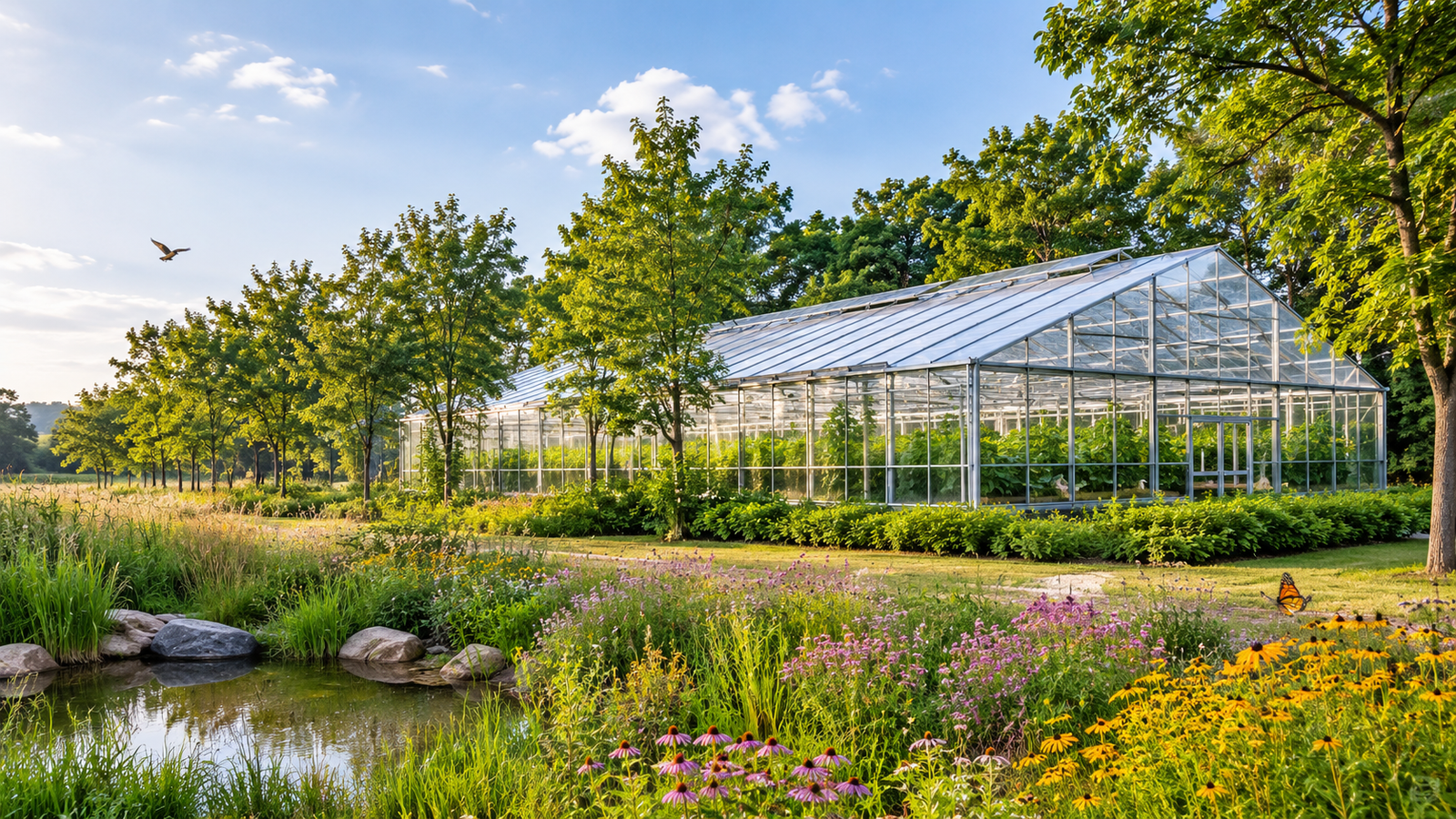
Controlled Environment Agriculture (CEA) promises precision: exact temperature, exact humidity, exact light. But precision costs energy, and energy is usually the single largest line item in a commercial greenhouse budget. What if the landscape around your greenhouse could do part of that climate-control work for free? Decades of forestry and agricultural extension research confirm that strategically placed native vegetation – not ornamental hedges, but real windbreaks of native trees and shrubs – can meaningfully cut a facility’s heating, cooling, and water-pumping costs.
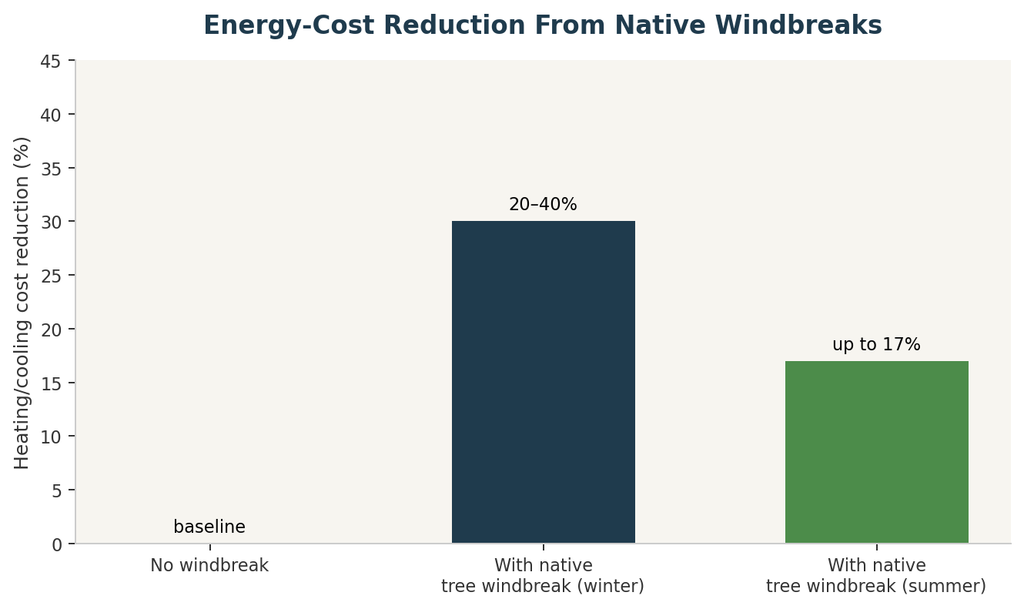
Figure 1: University extension and U.S. Forest Service research consistently finds 20–40% winter heating savings and double-digit summer cooling savings behind well-designed windbreaks.
How Do Native Tree Lines Act as Windbreaks and Microclimate Regulators?
A windbreak works by converting the directed force of wind into harmless turbulence before it reaches a building. U.S. Forest Service research (Shelterbelts and Microclimate, Caborn) and university extension studies going back decades confirm that tree crowns disrupt the pressure gradient that otherwise drives cold air into gaps, seams, and vents – the single biggest source of unwanted heat loss in greenhouse structures.
Beyond wind, a mature native tree line changes humidity and temperature in its lee. Trees release water vapor through transpiration, which cools the surrounding air in summer and raises local humidity – reducing how hard evaporative cooling or misting systems need to work. North Dakota State University Extension data shows relative humidity in sheltered zones can run 2–4 percent higher than in open areas, directly lowering a greenhouse’s water demand for cooling.
How Much Can Windbreaks Reduce Greenhouse Heating, Cooling, and Water-Pumping Costs?
University of Nebraska–Lincoln Extension and USDA-NRCS data report that well-designed windbreaks reduce winter heating costs on farmsteads by 20 to 40 percent, largely by cutting cold-air infiltration rather than by blocking conductive heat loss. A classic Pennsylvania field study found a single-row white pine windbreak reduced air infiltration into a structure by as much as 54 percent and cut space-heating energy needs by around 18 percent in winter conditions.
The U.S. Department of Energy has estimated that correctly placed trees around a structure can save a household $100–$250 a year in energy costs on their own – and the effect scales with the size and quality of the greenhouse’s thermal envelope. For water, denser humidity in the greenhouse’s immediate surroundings reduces evapotranspiration losses from vents and cuts the frequency of supplemental irrigation cycles, trimming pumping energy alongside heating and cooling.
- Plant two to three rows: a dense evergreen inner row for winter wind-blocking, a mixed native outer row for wildlife value
- Position windbreaks on the prevailing winter wind side, typically north or northwest in the Northern Hemisphere
- Leave gaps for summer airflow where passive cooling is needed
- Use regionally native species – they require no irrigation once established and support local pollinators and birds
Why Balance High-Tech CEA With Surrounding Native Biodiversity?
Controlled Environment Agriculture and rewilded field margins are often treated as opposites – one engineered, one wild. In practice, they’re complementary systems. The greenhouse handles precision tasks (light scheduling, CO2 enrichment, irrigation timing) while the surrounding native buffer absorbs the variable, expensive-to-control inputs: wind shear, temperature swings, and excess humidity loss. SARE-funded (Sustainable Agriculture Research and Education) windbreak trials on commercial vegetable and citrus operations have also found a secondary benefit: windbreaks slow the aerial spread of some plant pathogens, reducing disease pressure on the crop itself.
For ag-tech startups designing new facilities, factoring in a native buffer zone from day one is typically far cheaper than retrofitting mechanical wind protection or oversized HVAC capacity after construction.
Quick Answers (FAQ)
How far from a greenhouse should a windbreak be planted?
General guidance from forestry extension programs suggests the sheltered zone extends roughly 10–20 times the windbreak’s height downwind, so windbreaks are typically placed close enough to shield the structure while leaving room for the trees’ mature canopy.
Do windbreaks help in summer as well as winter?
Yes, though differently – in summer they add shade and humidity rather than blocking cold wind, which reduces cooling-system and irrigation demand.
What tree species work best for greenhouse windbreaks?
Regionally native evergreens are generally recommended for year-round wind protection, paired with native deciduous species for summer shade and biodiversity; a local extension office or native plant society can recommend exact species for your climate.
Sources & Further Reading
University of Nebraska–Lincoln Extension / USDA-NRCS – Windbreaks (EC1767) – https://extensionpubs.unl.edu/publication/ec1767/2007/pdf/view/ec1767-2007.pdf
University of Minnesota Extension – Windbreaks in agricultural systems – https://extension.umn.edu/agroforestry/windbreaks
North Dakota State University – Windbreaks and microclimate humidity effects – https://ndsu.edu/pubweb/chiwonlee/plsc211/student papers/articles01/mshervey/windbreaks.htm
U.S. Forest Service – Shelterbelts and Microclimate (Caborn, Bulletin No. 29) – https://fs.usda.gov/nac/documents/shelterbelts/complete.pdf
Mass.gov / U.S. Department of Energy – Landscaping for Energy Efficiency – https://www.mass.gov/doc/landscapeeepdf/download
SARE – Windbreak microclimate modification project overview – https://projects.sare.org/?p=481642