









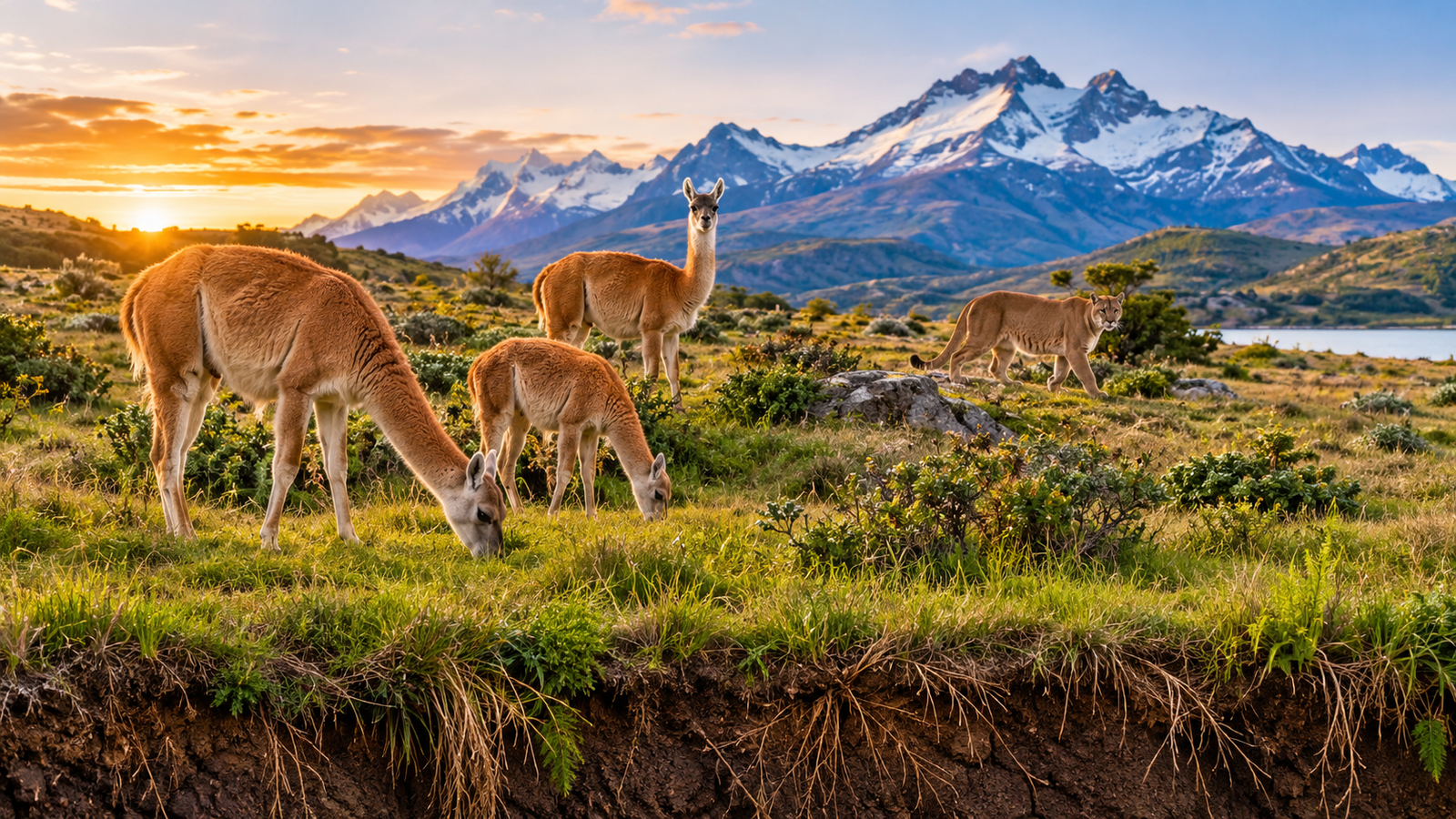
When people picture climate solutions, they usually picture solar panels, electric cars, or newly planted forests. Few picture a herd of guanaco grazing a Patagonian grassland, or a wombat digging a burrow in the Australian outback. Yet a growing field of science called zoogeochemistry is showing that wild animals are active engineers of the global carbon cycle – and that protecting them may be one of the most underused climate tools available.
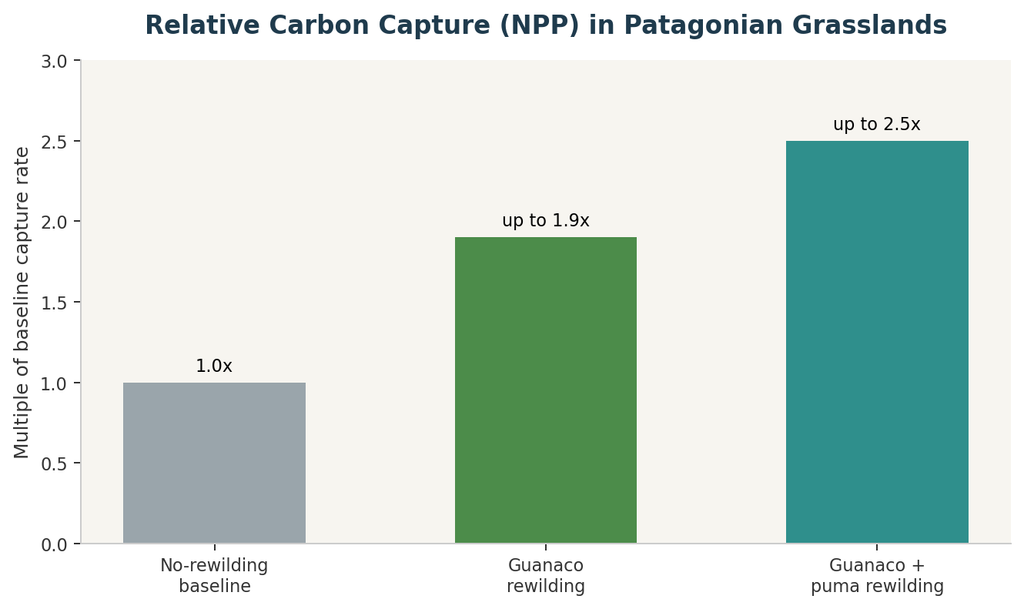
Figure 1: A 2024–2026 modeling study of Patagonian grasslands estimated that rewilding guanaco and puma populations could boost carbon capture up to 2.5 times above a no-rewilding baseline.
What Is Zoogeochemistry?
Zoogeochemistry is the study of how animals – through grazing, trampling, burrowing, defecating, and even dying – influence the chemical cycles of an ecosystem, especially the movement of carbon and nutrients through soil. For decades, soil science focused almost entirely on plants, fungi, and microbes. Researchers at Yale School of the Environment, through a research initiative called “Animating the Carbon Cycle,” have helped shift that view, showing that large and small animals alike measurably change how much carbon a landscape locks away.
Soil holds roughly three times more carbon than the atmosphere and about as much as, or more than, all the world’s forests combined – making it one of the planet’s most important carbon sinks. How that carbon is managed below ground depends heavily on which animals are present above it.
How Do Wild Animal Movement, Grazing, and Waste Trap Carbon in Soil?
Grazing animals clip grass in a way that stimulates root growth, and root turnover is one of the main ways carbon gets pulled underground and stored. Hooves and paws trample plant litter into the soil surface, speeding up decomposition and incorporation of organic matter. Dung and urine act as natural, slow-release fertilizer that soil microbes can process far more efficiently than they process synthetic fertilizer.
A long-running study referenced by Yale researchers found that every increase of 100,000 wild animals in the Serengeti ecosystem raised the amount of carbon sequestered in that landscape by roughly 15 percent. In the Arctic, herds of caribou and other large grazers compact snow in winter, which research suggests helps slow the thawing of permafrost – itself one of the largest carbon reservoirs on the planet.
What’s the Difference Between Healthy Wild Soils and Depleted Agricultural Land?
Soil beneath a healthy, animal-rich ecosystem is porous, microbially active, and rich in stable organic carbon. Compacted agricultural soil – stripped of large grazers, tilled repeatedly, and dosed with synthetic nitrogen – loses that structure. Research from the Kalahari Desert’s Tswalu Kalahari Reserve, reported by Mongabay, found an important nuance: the fertilizing effect of dung only benefits soil microbes when it comes from wild animals. Antibiotics commonly used in livestock pass through the animal and into the soil, where they can kill off the very microbes that build stable, carbon-rich soil. In other words, not all grazing animals offer the same climate benefit – wild, antibiotic-free herds appear to do more good for soil carbon than conventionally raised livestock on the same land.
Where Has Rewilding Measurably Reduced Net Soil Carbon Loss?
A peer-reviewed modeling study of guanaco and puma rewilding in Chile’s Patagonia National Park found that reintroducing both species could capture up to 2.5 times more carbon through net primary productivity than a landscape without them, with soil carbon stocks potentially rising as well, though researchers noted this estimate carries wider uncertainty. A 2023 Nature Climate Change-linked synthesis, covered by Inside Climate News, similarly concluded that restoring populations of large land and marine animals could meaningfully accelerate natural carbon removal – a process the study’s authors termed “animating the carbon cycle.”
It’s worth noting the science isn’t uniformly positive for every species. Research from King’s College London and the Zoological Society of London found that reintroduced wild boar in Scotland’s Bunloit Rewilding Project actually reduced soil organic carbon in some areas, by favoring fast-growing plants that decompose quickly. The honest takeaway for readers: rewilding is a powerful climate tool, but – like any ecological intervention – it works best when species choices are guided by evidence, not assumptions.
Quick Answers (FAQ)
Can wild animals really affect global carbon dioxide levels?
Not on their own at atmospheric scale, but research shows they significantly influence how much carbon is captured and retained in soils and vegetation regionally, which adds up across large rewilded landscapes.
Is rewilding better than tree planting for carbon storage?
They’re complementary. Soil carbon storage driven by animals is more stable and less vulnerable to fire than some forest carbon, but trees and animals both play important, different roles.
Do all reintroduced animals increase soil carbon?
No – studies on wild boar reintroduction found they can decrease it in some contexts, which is why ecologists stress evidence-based species selection in rewilding projects.
Sources & Further Reading
Yale School of the Environment – Zoogeochemistry research overview, via Odonata – https://www.odonata.org.au/the-dirt/zoogeochemistry
Inside Climate News – “‘Rewilding’ Parts of the Planet Could Have Big Climate Benefits” (2023) – https://insideclimatenews.org/news/27032023/rewilding-animals-carbon-storage/
bioRxiv – Trophic rewilding of pumas and guanacos, Patagonian grassland carbon modeling study – https://www.biorxiv.org/content/10.64898/2026.07.28.740956.full.pdf
Mongabay – “Restoring land with wildlife, earning carbon credits in the Kalahari Desert” – https://news.mongabay.com/short-article/2026/04/restoring-land-with-wildlife-earning-carbon-credits-in-the-kalahari-desert/
King’s College London – “Reintroducing wild boar could reduce soil carbon storage” – https://www.kcl.ac.uk/news/reintroducing-wild-boar-could-reduce-soil-carbon-storage