







Quick answer: Microplastics travel from rivers into farmland mainly through irrigation water, floods, and the reuse of treated wastewater or sewage sludge. Wind can add more. Once in soil, they can stay for a long time and may change soil health. Whether they move into crops and food depends on particle size and conditions, and research is still growing.
How Does Plastic Pollution Move From Rivers Into the Food We Grow?
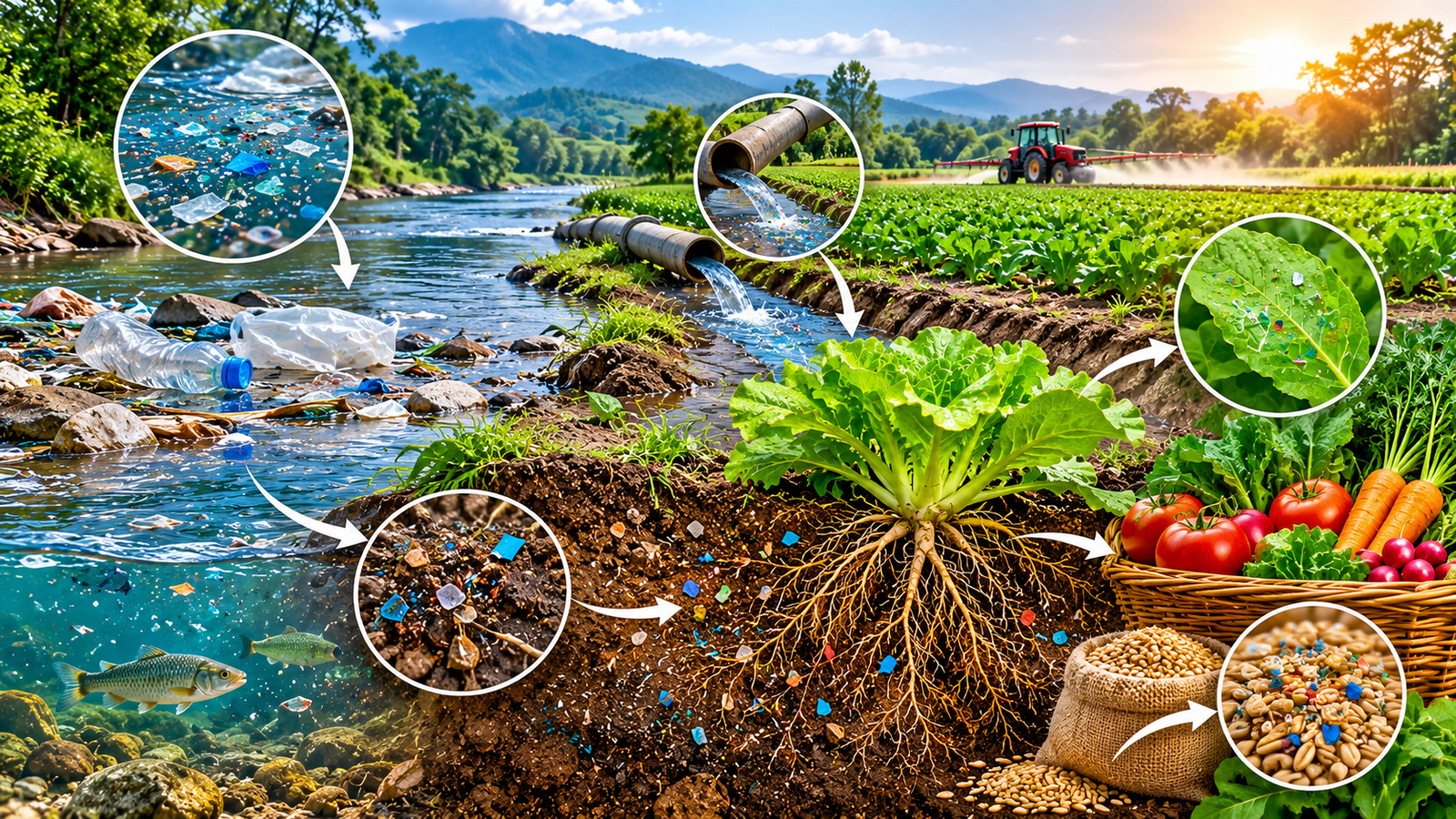
Plastic pollution moves from rivers into food in steps. Plastic waste breaks into tiny pieces. Rivers carry those pieces to farms. Irrigation, floods, and wastewater reuse then leave them in the soil, where crops grow. This hidden journey is why microplastics in soil now get so much attention.
The scale is large. A 2025 review in Environmental Sciences Europe estimates that about 110,000 to 730,000 tonnes of microplastics enter agricultural soils each year across Europe and North America. Estimates like this are uncertain, but they show why microplastics in agriculture deserve a closer look.
Why Do Microplastics in Agriculture Deserve More Attention?
- Soils keep them. A 2026 review of wheat-growing soils says microplastics leave farm soil slowly, so soils act as long-term sinks.
- Soil is hard to replace. Researchers writing in Cambridge Prisms: Plastics note that fertile soil takes hundreds to thousands of years to form.
- Many farmers use river water. In Dar es Salaam, farmers irrigate vegetable gardens year-round with water from the polluted Msimbazi River, according to a 2025 study.
In this guide, we follow the journey step by step and ask one central question: how does plastic pollution move from rivers into the food we grow and eat? We also separate what is well proven from what is still uncertain.
What Are Microplastics and Where Do They Come From?
Microplastics are plastic particles generally smaller than 5 millimeters. Nanoplastics are even smaller, under 1 micrometer. They come from many everyday sources, including broken-down bags and bottles, clothing fibers, tires, industry, and farm plastics.
What Types of Microplastics Are There?
Primary microplastics are made small on purpose, such as industrial plastic pellets. Secondary microplastics form when larger plastic breaks apart in sunlight, heat, and wear. Many microplastics in the environment are secondary.
| Polymer | Common sources |
|---|---|
| Polyethylene (PE) | Bags, films, mulch sheets |
| Polypropylene (PP) | Packaging, caps, ropes |
| PET | Bottles, polyester clothing fibers |
| Polystyrene (PS) | Foam trays and food containers |
What Are the Common Sources of Microplastic Pollution?
- Plastic litter: bags, bottles, and packaging that break down over time.
- Textile fibers: tiny threads released when synthetic clothes are washed.
- Tire wear: particles from road traffic. A 2025 review notes that tire particles can travel from roads to farm soils.
- Industry and wastewater: factory waste and treated or untreated sewage.
- Farm plastics: mulch films and greenhouse covers are major sources, according to a 2024 review. Irrigation pipes and other equipment can also shed particles.
Why Do Rivers Become Major Pathways for Microplastics?
Rivers collect water from whole landscapes. Every drain, stream, and discharge pipe adds to the load. That makes rivers a natural “conveyor belt” for plastic pollution.
- Urban runoff and stormwater wash litter and road dust into drains.
- Wastewater that is untreated, or only partly treated, adds fibers and fragments.
- Industrial discharge and poor waste disposal add more.
- Tributaries and drainage networks move plastic litter downstream.
Wastewater plants receive a mix of stormwater, household, and industrial water, as explained in the Discover Environment review. Many of the same particles then reach rivers and farms.
How Do Microplastics Travel From Rivers Into Agricultural Soil?
Microplastics travel from rivers into farm soil mainly through irrigation water, floodwater and sediment, and the reuse of treated wastewater or sewage sludge. Wind and dust add more. Each route can be repeated every season, so particles can build up.
How Does River Water Used for Irrigation Bring Microplastics to Farms?
When a farmer waters a field with river water, any plastic in the water stays behind in the soil. This can happen again and again.
Studies show it is real. In a Yellow River irrigation area, researchers reported that river water irrigation caused secondary microplastic pollution in the soil. They also report that fibers in soil showed higher vertical mobility than fibers in water. Near the Msimbazi River in Tanzania, a 2025 study measured microplastics in irrigation water and nearby vegetable garden soils. It also notes that Tanzania has no rules on microplastic levels in irrigation water or farm soil.
Do Floods and Riverbank Sediment Spread Microplastics?
Yes, they can. Floods carry water and sediment onto fields, and reviews list flooding as a route for plastic into farmland. A 2022 review names flooding events alongside atmospheric deposition, tire wear, and sewage sludge. Microplastics settle with sediment, so floodplain soils can collect them. Floodwater can then spread that contamination to new places.
Healthy riverside wetlands slow water and let sediment settle. Learn more in our post on how native wetlands save water. How well they trap microplastics is still being studied.
Can Wastewater and Sewage Sludge Add Microplastics to Farmland?
Yes. Treated wastewater and sewage sludge are used on farms for water and nutrients. They can also carry plastic.
- Treatment helps, but not fully. A 2025 risk assessment notes that most plants with at least secondary treatment remove the majority (over 78%) of microplastics from incoming water.
- The plastic moves into sludge. Much of the removed plastic is captured in sludge. If that sludge is spread on land, the plastic goes back into the environment.
- Numbers can be high. A 2025 study of two municipal plants found averages of about 13,700 and 116,300 microplastic particles per kilogram of dry sludge, as listed in the FAO AGRIS record.
- Wastewater irrigation adds more. A 2025 study from Türkiye points to wastewater irrigation as a major source and says conventional treatment plants are not good enough at removing microplastics.
What Other Pathways Bring Microplastics to Farm Fields?
Rivers are only part of the story. Wind carries particles from roads, cities, and waste sites onto fields. Farm machinery sheds tire particles. Mulch films, greenhouse covers, plastic-coated seeds, and some compost also leave plastic behind. This is why cleaning rivers alone will not solve soil contamination.
How Do Microplastics Affect Agricultural Soil Health?
Microplastics can change soil in physical, chemical, and biological ways. The 2025 Environmental Sciences Europe review says they can alter water movement, water holding, and porosity, shift the carbon-to-nitrogen ratio, and affect microbial diversity and soil animals. Effects depend on plastic type, size, shape, and amount.
Do Microplastics Change Soil Structure and Water Retention?
They can. Plastic particles sit between soil grains and can change how soil clumps and how many pores it has. This may change how fast water moves through the soil and how much it holds. That matters for soil quality and crop yields, but results differ between soils and plastics.
How Do Microplastics Affect Soil Microorganisms and Biodiversity?
Soil is full of life, including bacteria, fungi, worms, and tiny animals called nematodes. The same review describes work showing that microplastics can have cascading effects on nematodes and soil food webs, changing microbial activity and nutrient cycling. Changes in microbial diversity could alter how soil works over time.
Can Microplastics Disrupt Nutrient Cycling?
Possibly. Microbes drive the cycling of carbon, nitrogen, and phosphorus. If microplastics change microbial life, they may change how nutrients are stored and released. Some experiments suggest this, but long-term effects on soil fertility are still being studied.
Can Microplastics Carry Other Pollutants?
Yes, that is a concern. A recent review notes that microplastics often occur with heavy metals, pesticides, and antibiotics, which they can adsorb and carry through soil and plants. Researchers have also raised the idea that plastic surfaces can host microbes. A 2023 perspective suggests this could help move human pathogens onto crops, but this is still a hypothesis.
Can Microplastics Enter Plants and Agricultural Food Crops?
Yes, but mostly for very small particles, and mostly in controlled studies. The 2026 wheat review concludes that evidence for root entry and transport inside plants is strongest for nanoplastics under lab conditions. It also says direct field evidence of larger microplastics in mature wheat grain is limited.
How Do Plant Roots Interact With Microplastics?
Roots meet plastic wherever it is in the soil. Two things can happen. Particles can stick to the outside of roots, or very small particles can get inside. These are not the same thing, and many studies do not separate them well. Particle size matters a lot.
Can Microplastics Move From Roots Into Stems and Leaves?
Some lab studies say yes for the smallest particles. Real farm conditions are different. In one study described in the wheat review, plants reduced the leaching of particles, and only aged nanoplastics, not new ones, were taken up. This shows that lab results do not always match the field.
Which Food Crops Could Be Exposed to Microplastics?
Any crop grown in contaminated soil or irrigated with contaminated water could be exposed. The way it happens differs.
| Crop group | Possible exposure | What to know |
|---|---|---|
| Leafy vegetables (lettuce, spinach) | Irrigation water, splash, dust | The 2023 perspective says microplastics are hard to remove from leaves, even by washing. |
| Root vegetables (carrots, radishes) | Direct contact with soil | Surface contact is likely. Uptake into the edible root is less clear. |
| Grains (wheat, rice) | Roots in soil; seeds develop above ground | Field evidence of larger microplastics in wheat grain is limited. |
| Fruits and other products | Irrigation, dust, sometimes soil splash | Little direct evidence so far. |
Can Microplastics Enter the Human Food Chain?
Possible routes exist. Plastic can go from soil, water, or sludge into crops, and from crops into food. Washing and processing may change how much is left, but that is not well measured. A 2025 article in Communications Earth & Environment reports that micro- and nanoplastics have been found in human tissues, blood, and placentas. It adds that the full health effects are not yet known.
It is also not clear how much of that comes from farm soil. Food packaging, air, and drinking water are other routes. The size of dietary exposure is still being investigated.
What Are the Environmental and Food Security Implications?
Microplastics may harm farm productivity and food safety over the long term, but the full picture is not yet clear. Soil contamination is well documented. Crop effects and human health effects are still active research areas, so careful wording matters.
Could Microplastics Reduce Agricultural Productivity?
Lab and pot experiments have reported effects on seed germination, root growth, and photosynthesis. A review of soil-plant dynamics reports that microplastics can affect crop roots and seeds and cause oxidative stress in plants. The effects vary by plastic type, particle size, dose, and crop. Long-term effects on yields in real fields remain uncertain. A 2026 review on productivity and supply chains notes that the Food and Agriculture Organization counts plastic pollution among the main risks to food production.
What Does This Mean for Food Safety and Human Exposure?
The firm findings are that microplastics are widespread in agricultural environments and that humans are exposed to them in several ways. The emerging concern is whether plastic from soil adds meaningfully to dietary exposure and what that does to health. Better exposure studies and long-term research are needed. Claims that contaminated food causes specific diseases are not yet supported.
How Does Microplastic Pollution Threaten Sustainable Agriculture?
Sustainable farming depends on healthy soil, and plastic builds up slowly in soil. Because it is so hard to remove, prevention matters most. Rivers and farmland belong to one water-and-soil system, so protecting them must be one plan. Read more in our guide to water conservation.
How Can We Detect and Monitor Microplastics in Agricultural Soil?
Scientists detect microplastics in farm soil by taking samples, separating the plastic from soil, and identifying it with tools such as FTIR and Raman spectroscopy. It is difficult work, and no single method is yet the standard.
How Are Soil Samples Collected and Checked?
A 2025 review in Frontiers in Soil Science lists common steps: sieving, filtration, density separation, chemical digestion, and spectroscopic analysis. Researchers then identify particles by shape, size, color, and polymer type.
What Advanced Technologies Detect Microplastics?
- FTIR spectroscopy: reads the chemical “fingerprint” of each particle.
- Raman spectroscopy: also identifies plastic type, and can look at smaller particles.
- Scanning electron microscopy (SEM): shows fine surface detail.
- Emerging methods such as pyrolysis-based tests are being developed, especially for nanoplastics.
A comparative review of agricultural methods explains the strengths and limits of FTIR, Raman, and SEM, and notes that combining tools can help.
Why Is Monitoring Microplastic Pollution Challenging?
- Particles are very small, and nanoplastics are hardest to see.
- Labs use different methods, so results are hard to compare.
- There are no standard rules for sampling and reporting.
- Particles from lab air, clothing, or equipment can get into samples by mistake.
The Frontiers review found major method differences between studies. It calls for standard protocols and strict quality checks so results can be compared fairly.
What Practical Solutions Can Keep Microplastics Out of Farm Soil?
The best way to protect farmland is to stop plastic before it reaches the soil. That means less plastic waste, cleaner rivers, better water treatment, and careful use of farm plastics. Cleanup after contamination is much harder.
How Can We Improve River Water Quality Before Irrigation?
- Treat wastewater better and cut untreated municipal and industrial discharge.
- Test irrigation water, especially from rivers near cities.
- Install litter traps and other river interception systems where they fit.
Can Better Wastewater Treatment Technologies Help?
Yes, in part. Advanced filtration and membrane technologies can remove more small particles. The risk assessment above found that sludge is where much of the plastic ends up, so sludge needs careful management. That study argues that limits on microplastics in sludge applied to land should be urgently considered. The Discover Environment review also says manufacturers can add filters to washing machines to catch microfibers before they enter wastewater.
See also our look at water technology for modern agribusiness.
How Can Farms Reduce Plastic Use?
- Collect mulch films fully after use, and do not leave scraps in fields.
- Handle plastic pipes and equipment so they do not break up in the field.
- Test biodegradable materials before use. The Cambridge Prisms authors point out that both conventional and biodegradable or biobased plastics can leach into soil.
- Consider options such as using crop residues in place of plastic mulch, which a soil-plant review lists as one strategy.
Can Soil Management and Remediation Remove Microplastics?
Not yet at scale. Ideas being studied include soil washing and physical separation, plant-based approaches, microbial and enzyme breakdown, and biochar. Each needs proof that it works, is safe, and is affordable. Until then, prevention is the more reliable tool.
Why Does Plastic Waste Management at the Source Matter?
Every piece of litter that is collected is one less piece that can end up in a river. Good municipal waste collection, keeping litter out of storm drains, producer responsibility programs, and local river protection all help. Read about nature’s own water managers in our post on native animals and irrigation.
What Can Governments, Farmers, and Communities Do?
Everyone has a part. Governments set rules and fund research. Farmers manage water and farm plastics. Communities keep litter out of rivers and drains.
What Government Policies Can Protect Rivers and Soil?
- Stronger plastic waste rules and better monitoring of industrial and wastewater discharge.
- Research funding for detection and cleanup methods.
- International cooperation. Researchers writing in Cambridge Prisms: Plastics call for a strong global plastics treaty that includes plastic production cuts, better product design, and regulation of plastic chemicals.
What Role Do Farmers Play in Preventing Soil Contamination?
- Know where your irrigation water comes from, and test it when you can.
- Dispose of agricultural plastics properly, and cut unneeded plastic.
- Ask for plastic test data before using sludge or compost.
- Use sustainable practices that build healthy soil. See our post on native crops and sustainable food.
How Can Communities Help Reduce River Plastic Pollution?
- Join local river and waterway cleanups.
- Dispose of household plastic responsibly and support community waste collection.
- Wash synthetic clothes less often and use a microfiber filter where possible.
- Share the story: clean rivers mean clean soil and safer food.
What Is the Future of Microplastic Research and Sustainable Food Systems?
The future depends on better data, better tools, and cooperation. Researchers need standard test methods, long-term field studies, and solutions that are proven safe. A 2025 paper in Communications Earth & Environment calls for shared indicators to track plastics in food systems. The 2025 Environmental Sciences Europe review points to a gap in standard risk assessments and rules.
Can Advanced Filtration Stop Microplastics Before They Reach Farmland?
It can reduce them. Better membranes and filters in wastewater plants can catch smaller particles. But the filtered plastic still has to go somewhere, so sludge and filter waste need safe handling.
Could Biological Solutions Help Remove Microplastics From Soil?
Maybe. Scientists are testing plants, microbes, and enzymes that could break down or trap plastic. These ideas are early-stage. They must be tested for safety and for how well they work in real farm soil.
How Can AI and Environmental Monitoring Track Microplastic Movement?
Researchers are exploring sensors, satellite data, and machine learning to map where plastic collects and to speed up particle identification. These tools could help farmers and regulators see problems early. Our post on the BRICS Digital Agriculture Initiative shows how data tools are reaching farms.
Why Is Long-Term Research Essential for Safer Food Production?
Plastic stays in soil for a long time, so effects may take years to show. Joined-up monitoring, standard testing, better wastewater treatment, and teamwork between farm and environmental scientists will give clearer answers and better protection.
Conclusion: Does Protecting Rivers Protect Our Soil and Food Future?
Yes. Microplastics can move from rivers onto farmland through irrigation, floods, and the reuse of wastewater and sludge. Once there, they can stay for a long time and may affect soil health. Whether they reach food in meaningful amounts, and what that does to health, still needs more research.
What is clear is that clean waterways, healthy soil, and safe food are linked. Stopping plastic at the source is better than relying on cleanup. It will take action from governments, industry, farmers, researchers, and communities together. For more, browse our Environment and Agriculture coverage.
Frequently Asked Questions
What are microplastics in soil?
Microplastics in soil are tiny pieces of plastic, generally smaller than 5 millimeters, that mix into the ground. They come from broken-down litter, farm plastics, tire wear, textile fibers, compost, and sewage sludge. They break down very slowly, so they build up over time.
How do microplastics from rivers enter agricultural land?
The main routes are irrigation with river water, floods that leave sediment on fields, and the reuse of treated wastewater or sewage sludge. Wind and dust can add more particles. Rivers are one pathway among several.
Can irrigation water contaminate farmland with microplastics?
Yes. If irrigation water carries plastic particles, they are left in the soil each time a field is watered. A study in a Yellow River irrigation area found that river water irrigation caused secondary microplastic pollution in soil.
Can plants absorb microplastics through their roots?
Possibly, but it depends on particle size. A 2026 review found that evidence for particles entering roots and moving through the plant is strongest for nanoplastics in controlled lab studies. Direct field evidence for larger microplastics in edible parts is limited.
Which agricultural crops are most vulnerable to microplastic contamination?
No crop can yet be ranked with confidence. Leafy vegetables may be exposed through irrigation water and dust. Root vegetables and grains grow in direct contact with soil. Uptake depends on particle size, plastic type, crop species, and growing conditions.
Do microplastics affect soil fertility and crop growth?
They can change soil porosity, water movement, microbial life, and nutrient cycling. Some experiments show effects on seed germination and plant growth. Results vary by plastic type, particle size, amount, and soil, and long-term field effects are still being studied.
Can microplastics enter the human food chain?
Contaminated soil, irrigation water, and sludge are possible routes into crops and food. Microplastics have been found in human tissues, but how much comes from farm soil, and what health effects result, is not yet known.
Can wastewater treatment plants remove microplastics?
Partly. Plants with at least secondary treatment typically remove the majority of microplastics, with one review citing more than 78 percent. Most of that plastic ends up in sewage sludge, and smaller particles can still pass through into treated water.
How can farmers prevent microplastic contamination in agricultural soil?
Farmers can check irrigation water sources, collect and dispose of mulch films and pipes properly, reduce unneeded plastic, and ask for test data before using sludge or compost. Keeping plastic from entering fields is easier than removing it later.
What are the most effective ways to remove microplastics from soil?
No method is proven at large scale yet. Ideas under study include soil washing, biochar, plant and microbe-based approaches, and enzymes. Prevention at the source is currently the most reliable way to protect farmland.
Sources and Further Reading
- Environmental Sciences Europe (2025): Microplastics and nanoplastics: fate, transport, and governance from agricultural soil to food webs and humans
- Frontiers in Plant Science (2026): Fate, transport, and biological impacts of microplastics in agricultural soil-wheat systems
- Cambridge Prisms: Plastics (2025): Why a strong global plastics treaty is essential for agricultural systems, food safety, food security and human health
- Discover Environment (2024): Soil contamination with microplastics from treated wastewater and sewage sludge
- Frontiers in Soil Science (2025): Microplastics in soil: a comprehensive review of analytical techniques
- A Quantitative Environmental Risk Assessment for Microplastics in Sewage Sludge Applied to Land
- Communications Earth & Environment (2025): Plastics matter in the food system
- Microplastics in irrigation water and vegetable garden soils adjacent to the Msimbazi River, Tanzania (2025)
- Microplastics in Irrigation Systems: A Growing Threat to Agriculture Soil and Crop Plant (2025)
- Microplastics in Soil–Plant Systems: Current Knowledge, Research Gaps, and Future Directions for Agricultural Sustainability (2025)
- Sources, environmental fate, and impacts of microplastic contamination in agricultural soils (2024)