





Water is quietly becoming the most consequential input on the modern farm – more decisive to next season’s yield than fertilizer, seed genetics, or even labor. Agriculture accounts for roughly 72% of all freshwater withdrawn globally, according to the Food and Agriculture Organization of the United Nations (FAO) AQUASTAT 2025 snapshot, and renewable freshwater availability per person has fallen 7% in just the last decade. For agribusiness operators – from row-crop growers to vertically integrated food companies – the question is no longer whether to invest in water conservation technology, but which systems deliver the best return on water, capital, and labor. This guide walks through the core categories of smart irrigation and agricultural water management technology available today, backed by data from the FAO, World Bank, USDA, and peer-reviewed agricultural research.
The Water Crisis Facing Global Agriculture
Before evaluating specific tools, it helps to understand the scale of the problem agribusinesses are solving for. Per FAO’s 2025 AQUASTAT Water Data Snapshot, agriculture remains the dominant water-consuming sector in 66 countries, which allocate 76% or more of their total freshwater withdrawals to farming. Irrigated cropland covers only about 23% of the world’s cultivated land, yet produces nearly half of global crop value – underscoring how disproportionately important efficient water use has become to food security.
Regional disparities are widening the pressure further. North Africa’s agricultural water withdrawals rose 16% over the past decade, while Western Asia and Sub-Saharan Africa saw increases of 13% and 12% respectively, even as per-capita freshwater availability keeps shrinking. FAO’s Director-General has warned that meeting the food needs of a growing population by 2050 could require 35% more freshwater than is used today – a target that simply cannot be met by expanding withdrawals. It has to come from efficiency.
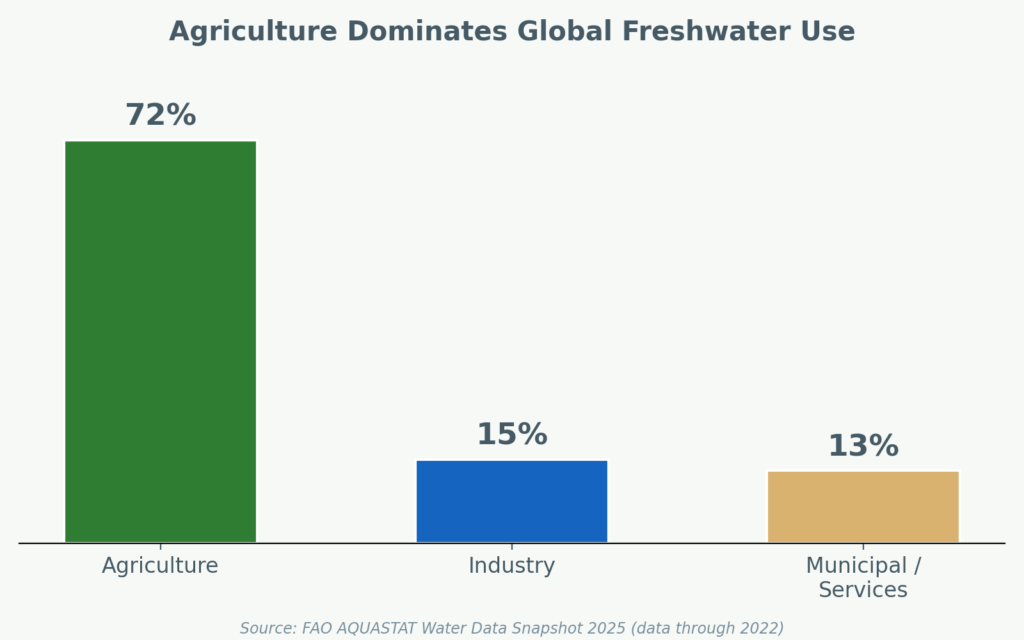
Figure 1: Agriculture’s share of global freshwater withdrawals dwarfs industry and municipal use. Source: FAO AQUASTAT 2025.
1. Precision Irrigation Systems: The Foundation of Smart Water Management
Precision irrigation – sometimes called micro-irrigation – is the technology base that every other tool in this guide builds on. Rather than flooding a field or running a sprinkler on a fixed schedule, precision systems deliver water directly to the crop root zone in the exact quantity needed, guided by soil moisture, evapotranspiration, and weather data.
Drip and Micro-Irrigation
Drip irrigation is the most mature and widely validated form of precision watering. A frequently cited World Bank analysis found that drip systems use 30–50% less water than surface (flood) irrigation and can reach up to 95% irrigation efficiency. Field research backs this up: a University of California Cooperative Extension study on desert-grown sweet corn recorded a 37% reduction in water use alongside a 5% yield increase when switching from furrow to drip irrigation, while also cutting fertilizer costs by roughly 25% because nutrients moved with the water instead of leaching away. A separate meta-analysis of Chinese wheat production found optimized drip and micro-sprinkler irrigation cut irrigation water use by 35.1% while improving water-use efficiency by nearly 19%, with no yield penalty.
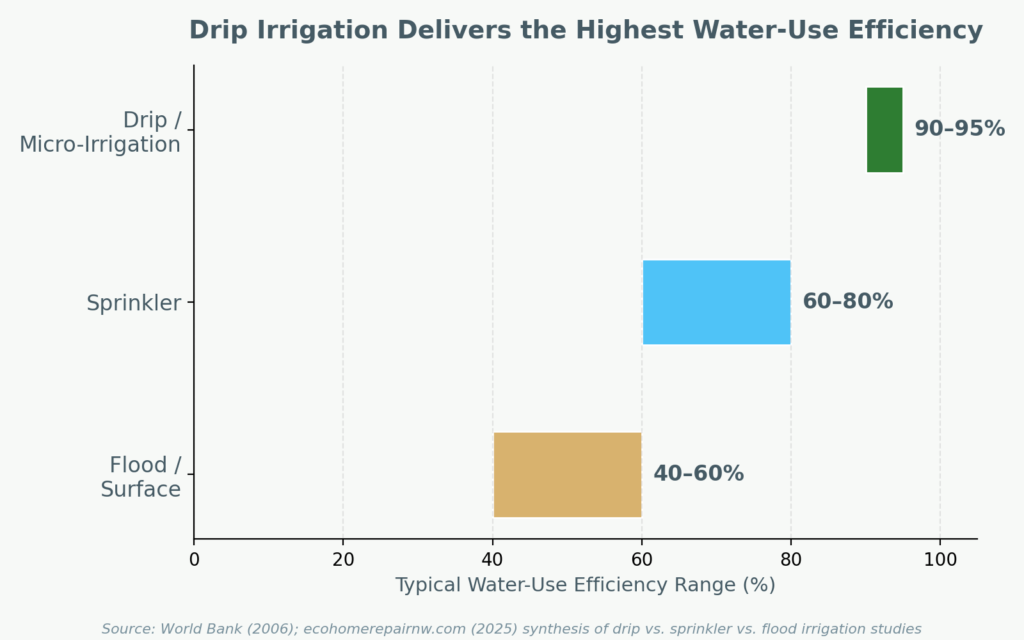
Figure 2: Typical water-use efficiency ranges by irrigation method. Sources: World Bank (2006); irrigation efficiency literature synthesis (2025).
Variable-Rate and Subsurface Drip Irrigation (SDI)
Variable-rate irrigation (VRI) takes precision a step further by adjusting water output zone by zone within a single field, based on soil type, slope, and crop stress mapped from GPS and sensor data. Multi-year research on subsurface drip irrigation (SDI) in Great Plains corn production documented water savings of 35% to 55% compared with traditional methods, making SDI one of the highest-performing options for row-crop agribusiness operating in water-stressed regions.
2. IoT Soil Moisture Sensors and Real-Time Field Data
A precision irrigation system is only as good as the data driving it. IoT soil moisture sensors – buried at multiple root-zone depths across a field – feed continuous readings to a central controller or cloud dashboard, replacing guesswork with measurement. Despite the clear benefits, adoption still has runway: recent USDA survey data shows that only a small share of U.S. farms currently rely on soil or plant moisture sensors for irrigation scheduling, with many operations still depending on visual crop observation or the traditional “hand-feel” method. That gap represents one of the single largest efficiency opportunities left in American agribusiness.
On the research side, low-cost edge-AI and TinyML sensor networks are pushing this technology further downmarket. Recent work on ESP32-class microcontrollers has produced quantized on-device models as small as 6.2 KB, enabling real-time anomaly detection in irrigation networks without expensive cloud compute – while LoRa-based distributed sensor architectures allow coordinated monitoring across large or fragmented farmland at a fraction of legacy SCADA costs.
3. Satellite and Drone-Based Remote Sensing
Where sensors measure a single point, satellite and drone remote sensing measure an entire field or region at once. Multispectral and NDVI (Normalized Difference Vegetation Index) imagery detects crop stress, canopy vigor, and localized moisture deficits days before they’re visible to the human eye, letting agribusiness teams intervene before yield is affected. Integrating satellite and drone imagery with AI algorithms is one of the fastest-growing trends in the sector heading into 2026, as it allows irrigation decisions to be made at the micro-field level rather than treating an entire parcel as uniform.
This matters most in large, consolidated agribusiness operations where physically walking or scouting every acre is impractical. Combined with historical yield maps and soil survey data, remote sensing lets operators build variable-rate irrigation and fertigation plans that would be impossible to construct manually.
4. AI and Machine Learning for Irrigation Scheduling
Artificial intelligence is increasingly the layer that ties sensing, weather, and satellite data together into a single, actionable recommendation. AI-assisted irrigation platforms track seasonal water budgets and help growers plan in-season and late-season applications – a capability described by agricultural researchers as particularly valuable “during dry years” for groundwater-dependent farming regions. As one water-stewardship researcher put it in recent industry commentary, giving farmers precise, data-driven irrigation tools is central to helping groundwater-dependent states meet long-term conservation targets.
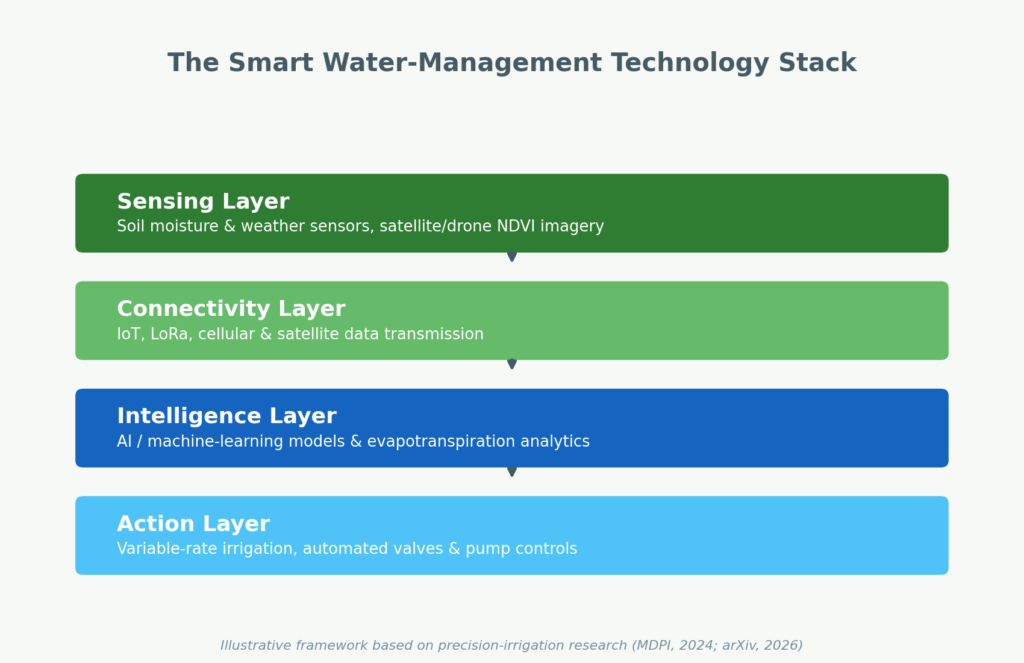
Figure 3: A typical smart water-management stack layers sensing, connectivity, AI-driven analytics, and automated action.
It’s worth noting an important nuance for agribusiness sustainability teams: the AI infrastructure powering these tools has its own water footprint, since data centers require water for cooling. Choosing vendors that report transparently on their own resource use is becoming part of a genuinely holistic water strategy.
5. Water Recycling and Reuse Systems
Water conservation isn’t only about applying less water – it’s also about reusing what’s already been applied. On-farm water recycling captures irrigation runoff, treats livestock wastewater, and – in an increasing number of regions – incorporates treated municipal wastewater for non-food or food-crop irrigation under tiered treatment standards. A 2024 review in Nature Reviews Earth & Environment notes that of the roughly 400 cubic kilometers of wastewater generated globally each year, less than 20% is treated, and only 2–15% of that treated water is currently reused for irrigation – a substantial untapped resource, especially in regions like California and Israel that have built mature reuse infrastructure.
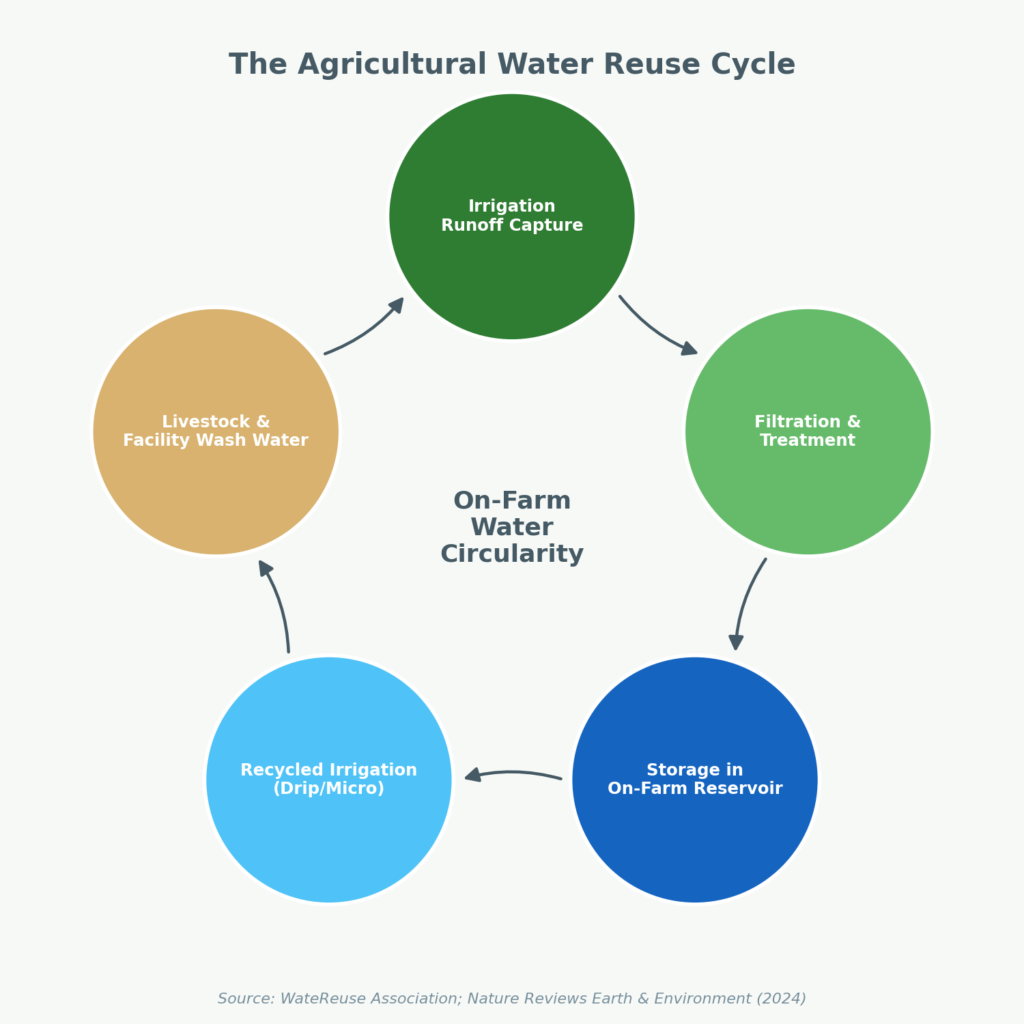
Figure 4: A closed-loop, on-farm water reuse cycle reduces dependence on external freshwater sources.
Real-world examples show the scale of impact available: the Eastern Municipal Water District’s agricultural reuse program in California and Oregon’s Metropolitan Wastewater Management Commission (which recycles 50–100 million gallons annually into a commercial poplar plantation) both demonstrate that treated water reuse can be a reliable, revenue-generating part of an agribusiness’s water portfolio rather than a compliance afterthought, per the WateReuse Association.
6. Weather Stations and Evapotranspiration (ET)-Based Scheduling
On-farm weather stations calculate reference evapotranspiration (ET₀) – the rate at which water is lost from soil and plants to the atmosphere – and combine it with crop coefficients to determine exactly how much water a field needs to replace on a given day. ET-based scheduling is one of the lowest-cost entry points into precision water management, and it pairs naturally with soil moisture sensors and drip systems to close the loop between how much water a crop is losing and how much it’s being given.
Market Momentum: Why Agribusiness Investment Is Accelerating
Capital is following the efficiency opportunity. The global precision irrigation market is projected to grow from USD 6.1 billion in 2025 to USD 14.4 billion by 2035, a compound annual growth rate of roughly 9.0%, according to Market.us industry research. Asia-Pacific currently leads regional adoption, holding more than 41% of global market share, while government subsidies and water-conservation mandates in North America, Europe, and the Middle East continue to lower the adoption barrier for mid-sized agribusiness operations.
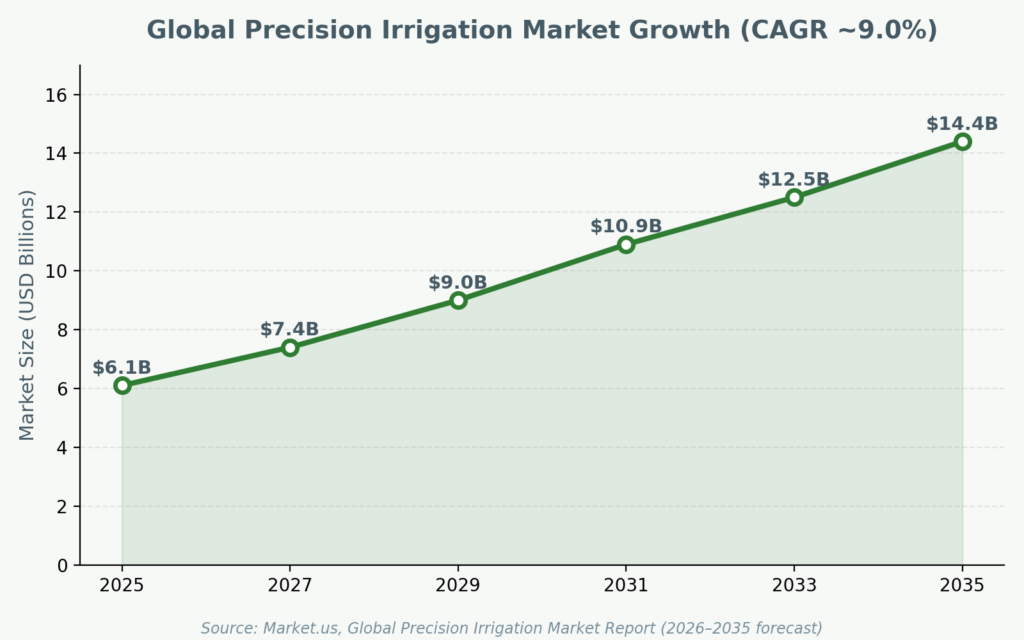
Figure 5: Projected growth of the global precision irrigation market, 2025–2035. Source: Market.us.
Choosing the Right Water Conservation Technology for Your Operation
There is no single “best” system – the right stack depends on crop type, field size, soil variability, capital budget, and local water regulation. A few practical starting points for agribusiness decision-makers:
- Start with measurement: soil moisture sensors and ET-based scheduling typically deliver the fastest payback and require the least infrastructure change.
- Prioritize high-water-cost crops and fields first: convert the acreage with the highest water bills or greatest drought exposure to drip or SDI before scaling farm-wide.
- Treat remote sensing as a scouting multiplier, not a replacement: satellite/drone NDVI data is most valuable when paired with ground-truth soil sensors.
- Evaluate water reuse early in regions facing allocation limits: recycled and treated wastewater programs often require longer regulatory lead times than on-farm hardware.
- Factor in vendor transparency: ask AI and cloud-based irrigation platform vendors how their own infrastructure’s water and energy footprint is managed.
Frequently Asked Questions
What percentage of global freshwater does agriculture use?
According to FAO’s 2025 AQUASTAT Water Data Snapshot, agriculture accounts for approximately 72% of global freshwater withdrawals, making it the largest water-consuming sector worldwide – well ahead of industry (about 15%) and municipal/service use (about 13%).
How much water does drip irrigation actually save?
Documented savings vary by crop, soil, and baseline method, but studies generally show 30–70% water savings versus flood or furrow irrigation, with efficiency rates of 90–95% versus 60–80% for conventional sprinklers, per World Bank and university field research.
What is the most cost-effective water conservation technology for a small or mid-sized farm?
Soil moisture sensors combined with evapotranspiration-based irrigation scheduling generally offer the lowest-cost entry point, since they can be layered onto existing sprinkler or drip infrastructure without a full system overhaul.
Can treated wastewater safely be used to irrigate food crops?
Yes, when treated to the appropriate tier – primary treatment is generally sufficient for non-food crops, while secondary and tertiary treatment (removing more contaminants) is required for irrigation of crops consumed directly by humans, per EPA and WateReuse Association guidelines.
How does AI improve irrigation efficiency?
AI models combine soil sensor data, satellite/drone imagery, and weather forecasts to recommend precise, field-specific irrigation timing and volume – reducing both over- and under-watering compared with fixed schedules or manual observation.
The Bottom Line
Water conservation technology has moved from a sustainability nice-to-have to a core agribusiness competitiveness issue. With agriculture responsible for nearly three-quarters of global freshwater withdrawals and per-capita water availability falling steadily, the operations that adopt precision irrigation, IoT sensing, remote sensing, AI-driven scheduling, and water reuse earliest will be the ones best positioned to protect yield, margin, and water access as regulatory and climate pressure both continue to intensify.
References
1. FAO. 2025 AQUASTAT Water Data Snapshot – cited via UN-Water. https://www.unwater.org/news/fao-2025-aquastat-water-data
2. FAO Newsroom. Renewable water availability per person plunges 7 percent in a decade as global scarcity deepens. https://www.fao.org/newsroom/detail/renewable-water-availability-per-person-plunges-7-percent-in-a-decade-as-global-scarcity-deepens–fao-data-shows/en
3. FAO. The State of the World’s Land and Water Resources for Food and Agriculture 2025. https://openknowledge.fao.org/server/api/core/bitstreams/889f7d6d-4d61-40eb-88f9-fddfc44bc817/content/state-of-the-worlds-land-and-water-resources-for-food-and-agriculture-2025-2025/scenarios-offer-insights-assumptions.html
4. Smart Water Magazine. Global water under pressure: what AQUASTAT 2025 reveals about agriculture, efficiency and stress. https://smartwatermagazine.com/news/smart-water-magazine/global-water-under-pressure-what-aquastat-2025-reveals-about-agriculture
5. Market.us. Precision Irrigation Market Size, Share (2026–2035 forecast). https://market.us/report/global-precision-irrigation-market/
6. TSLN.com. Where artificial intelligence meets water stewardship in agriculture (2026 Spring Homeland). https://www.tsln.com/news/2026-spring-homeland-where-artificial-intelligence-meets-water-stewardship-in-agriculture/
7. Affordable Precision Agriculture: A Deployment-Oriented Review of Low-Cost, Low-Power Edge AI and TinyML for Resource-Constrained Farming Systems. https://arxiv.org/pdf/2603.15085
8. MDPI Agriculture. A Review of Precision Irrigation Water-Saving Technology under Changing Climate. https://www.mdpi.com/2077-0472/14/7/1141
9. ScienceDirect. The efficiency of drip irrigation unpacked (citing World Bank, 2006). https://www.sciencedirect.com/science/article/abs/pii/S0378377413000759
10. CDFA Planting Seeds Blog. Drip-irrigation study sees 37 percent reduction in water use and five percent increase in yield. https://plantingseedsblog.cdfa.ca.gov/wordpress/?p=24557
11. ecohomerepairnw.com. How Drip Irrigation Saves Water in Drought Conditions. https://ecohomerepairnw.com/blog/how-drip-irrigation-saves-water-in-drought-conditions
12. PMC/NCBI. Evaluating the Effectiveness of Water-Saving Irrigation on Wheat Production in China: A Meta-Analytical Approach. https://www.ncbi.nlm.nih.gov/pmc/articles/PMC12473444/
13. CALWEP. Evaluation of Potential Best Management Practices – Drip Irrigation (citing Lamm & Trooien, 2002). https://calwep.org/wp-content/uploads/2021/03/Drip-Irrigation-PBMP-2014.pdf
14. Nature Reviews Earth & Environment. Sustainable wastewater reuse for agriculture (2024). https://www.nature.com/articles/s43017-024-00560-y
15. WateReuse Association. Agricultural Reuse. https://watereuse.org/educate/types-of-reuse/agricultural-reuse/
16. US EPA. Reusing Water for Agricultural Activities Resources. https://www.epa.gov/waterreuse/reusing-water-agricultural-activities-resources
17. World Bank. Annual freshwater withdrawals, agriculture (% of total freshwater withdrawal). https://data.worldbank.org/indicator/ER.H2O.FWAG.ZS?locations=1W