




Quick answer: Amazon deforestation reduces the water vapor that trees release into the air. This weakens moisture recycling, shortens and dries the rainy season, and raises drought risk across the Amazon basin and connected parts of South America. Effects on rivers, farms, and water supplies can follow. Global effects are less certain and mostly work through the wider climate system.
Why Is Amazon Deforestation a Global Water Security Concern?
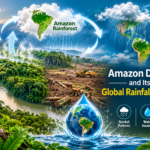
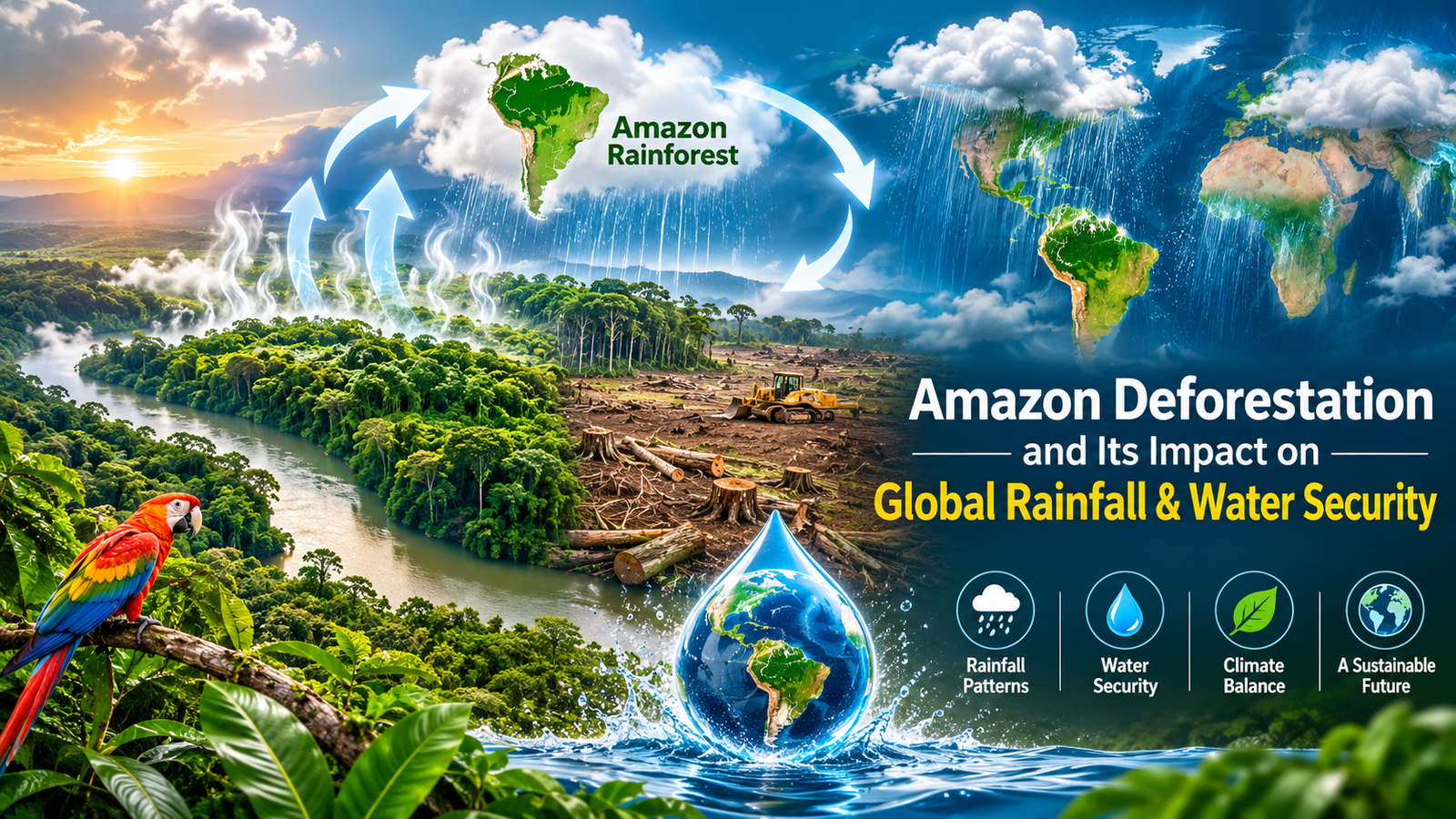
The Amazon is the world’s largest tropical forest. Most people know it for its wildlife and the carbon it stores. But it also works as a giant water pump. Its trees pull water from the soil and release it into the air as vapor. This process is called evapotranspiration.
That vapor forms clouds and falls again as rain. When large areas of forest are cleared, this system weakens. Rain can drop, dry seasons can grow longer, and rivers and farms can suffer. So Amazon deforestation effects reach beyond the forest. They touch climate, food, and freshwater. This is why the topic matters for global water security. For the wider climate picture, see our guide on how rising global temperatures are reshaping ecosystems.
How Does the Amazon Rainforest Help Regulate the Global Water Cycle?
The Amazon helps run the regional water cycle by moving water from the ground to the sky. The forest keeps air moist and rain steady across a huge area.
What Is Evapotranspiration and Forest Moisture Recycling?
Trees take in water through their roots. They release most of it as vapor through tiny pores in their leaves. This is transpiration. Water also evaporates from wet leaves, soil, and rivers. Together, these two processes are called evapotranspiration.
The vapor rises, cools, and forms clouds. Clouds then bring rain. This is forest moisture recycling.
Why Is the Amazon Known for Natural Moisture Recycling?
Winds bring moist air from the Atlantic Ocean. It rains over the forest. Trees send much of that water back into the air, and the air moves on. The same water can fall as rain several times as it crosses the basin. Amazon Conservation says the forest makes around half of its own rain and can recycle moisture up to six times, according to its tipping point report.
This only works when the forest stays connected. Gaps in forest cover break the chain. Learn how other natural systems manage water in our post on how native wetlands save water.
How Does Amazon Deforestation Change Regional Rainfall Patterns?
Cutting forest lowers the amount of vapor in the air. It also changes how much rain falls and when.
Does Less Tree Cover Mean Less Atmospheric Moisture?
Yes. Cleared land has fewer deep roots and fewer leaves. Less water returns to the air. The ground also heats up faster than forest ground, and the air becomes drier. Less humidity means fewer clouds.
How Does Deforestation Change Cloud Formation and Seasonal Rainfall?
With less moisture, clouds form less often. The rainy season can start later, and the dry season can grow longer. A 2026 study in Nature Communications found that deforestation explains about 52% to 72% of the rainfall decline in the southern Amazon between 1980 and 2019, as reported by Mongabay.
Scale matters. A press release from the American Geophysical Union on a May 2026 study explains that small clearings can sometimes raise local rain. Large clearings cut rain, and warming lowers the amount of clearing the system can take.
Can Deforestation Make Extreme Drought Worse?
It can. Drought is driven by natural climate swings, such as El Niño, and by heat. Forest loss adds to both. Drier air and hotter land make a dry spell harsher. Our post on emergency water strategies for extreme heat in agriculture shows how farms cope when dry spells hit.
How Does Amazon Moisture Travel Beyond the Forest?
What Are Atmospheric Rivers and Flying Rivers?
An atmospheric river is a narrow band of air that carries a lot of water vapor. In South America, people use the term flying rivers for moisture that moves from the Amazon toward other regions. They are not real rivers. They are streams of vapor in the sky.
How Does the Amazon Supply Moisture to Other Regions?
Trade winds push moist air west across the basin. The Andes Mountains then block and turn this air. Some moisture falls on the mountains. Some turns south toward central and southeastern South America. An Amazon Conservation white paper reports that forests in the southwestern Amazon, in Peru and Bolivia, rely on flying rivers for more than 70% of their yearly rain.
Could Amazon Deforestation Affect Weather Far Beyond the Forest?
Downwind regions can be affected. Less recycling upwind means less moisture for farms, reservoirs, and towns downwind. Research cited by Down To Earth links moisture from Brazilian forests to farmland in countries that supply nearly 10% of global crop exports.
What is well supported: forest loss reduces rain in the Amazon basin and connected regions. What is less certain: direct rainfall changes on other continents. Those links go through the wider climate system and need more research.
How Strong Is the Evidence for Each Effect?
| Effect | Where | Evidence level |
|---|---|---|
| Less rain after large-scale forest loss | Amazon basin, especially the south | Strong |
| Less moisture reaching downwind forests | Southwestern Amazon (Peru, Bolivia) | Strong and growing |
| Rain and drought risk for farmland | Connected parts of South America | Moderate |
| Direct rainfall change on other continents | Outside South America | Uncertain, still studied |
How Does Amazon Deforestation Affect Agriculture and Food Security?
Why Does Rainfall Stability Matter for Farming?
Crops need water at the right time. A late rainy season or a long dry spell can cut yields. Even if total yearly rain stays the same, poor timing can hurt planting and harvests. Read how traditional growers manage this in our piece on Indigenous farming practices.
Which South American Farm Regions Are at Risk?
Soybean, maize, and cattle regions in Brazil and nearby countries depend on seasonal rain. Much of that rain is tied to forest moisture. Ironically, clearing forest for farms can weaken the rain those farms need. This is one reason scientists warn about the southern Amazon, where rain is already falling.
How Can Regional Water Problems Affect Global Food Supply?
South America is a major exporter of soybeans, maize, and beef. A poor harvest there can tighten global supply and push prices up. Importing countries then feel the change. This is one clear way that Amazon rainfall can matter far from the forest. Our post on native crops and sustainable food production explores how diverse crops add resilience.
How Does Forest Loss Threaten Freshwater and Water Security?
What Happens to Rivers, Watersheds, and Groundwater?
Forest soil acts like a sponge. It lets rain soak in and feeds rivers and groundwater slowly. Without trees, more rain runs off at once. Soil washes into streams. Rivers get muddy and carry more sediment, which harms fish and water quality.
Who Feels the Pressure on Water Supplies First?
Rural and Indigenous communities often rely on rivers and rain for drinking water, fishing, and crops. Changing rain also affects reservoirs, hydropower dams, and city water systems that depend on steady river flow.
Why Is Water Security an International Issue?
Water supports food, energy, health, and jobs. When water becomes less reliable, economies and public services feel it. Protecting tropical forests is a low-cost way to protect that supply. Our complete guide to water conservation covers practical steps that complement forest protection.
What Role Does Climate Change Play in Amazon Water Cycle Disruption?
How Do Rising Temperatures Raise Water Stress?
Warm air pulls more water from soil and leaves. Trees then face more stress, especially in heat waves. Droughts become more severe when high heat meets low rain.
How Do Deforestation and Climate Change Reinforce Each Other?
Forest loss reduces moisture recycling. Less rain and more heat then stress the remaining trees. Weak, dry forests burn more easily and die back. This loss adds more carbon to the air and speeds up warming. It is a feedback loop.
Could the Amazon Reach an Ecological Tipping Point?
A tipping point means a change that is hard to reverse. Some scientists warn that parts of the Amazon could turn into drier, more open vegetation. One hypothesis puts the risk near 20% to 25% forest loss. Amazon Conservation estimates that about 15% of the original forest was lost through 2025. A May 2026 study led by the Potsdam Institute for Climate Impact Research, reported by Down To Earth, found that about a third of the Amazon could shift to degraded forest if deforestation reaches roughly 22% to 28% along with 1.5 to 1.9°C of warming.
Scientists agree that the risk is real. They still disagree on exact thresholds, and these differ across regions. The southern and southeastern Amazon appear more at risk. Our post on protecting wildlife to lower greenhouse gases shows how ecosystems and climate are linked.
How Can Protecting the Amazon Strengthen Global Water Security?
How Can Deforestation Be Reduced?
- Enforce forest laws and stop illegal logging.
- Prevent illegal land clearing and uncontrolled burning.
- Use satellite alerts to act fast. Tools like Global Forest Watch show forest loss in near real time.
Why Do Indigenous Communities and Sustainable Land Use Matter?
Indigenous territories often have lower deforestation rates. Recognizing land rights and funding community-led protection works. Agroforestry, which mixes trees with crops, gives farmers income without clearing more forest.
Can Forest Restoration Bring Rain Back?
It can help. Restoring forest raises evapotranspiration and soil health. A modeling study cited by Mongabay found that rainfall rose in restored areas, as shown in its coverage of the 2026 rainfall study. Restoration works best where forests are close together. Native species and natural regrowth usually do better than single-species plantations. For small-scale examples, see how native animals act as irrigation engineers.
What Is the Role of International Cooperation and Climate Finance?
The Amazon spans nine countries. Shared rules, funding for conservation, and deforestation-free supply chains help. Groups such as the Amazon Cooperation Treaty Organization (ACTO) support cooperation across borders. Importing countries can also check that soy, beef, and timber are not tied to illegal clearing.
Which Solution Does What for Water?
| Solution | How it helps water security | Who leads it |
|---|---|---|
| Stronger forest protection | Keeps moisture recycling and rivers intact | Governments |
| Indigenous land rights | Keeps forests standing and watersheds healthy | Communities and governments |
| Agroforestry | Protects soil and adds income without new clearing | Farmers |
| Forest restoration | Brings back vapor, soil health, and rain recycling | Governments, NGOs, landowners |
| Deforestation-free supply chains | Cuts demand for illegal clearing | Buyers and traders |
What Could the Future Look Like?
If degradation continues: rain becomes less reliable. Droughts and fires grow. Crop yields, river flow, and hydropower become less stable. Biodiversity drops, and more carbon is released.
If protection works: moisture recycling stays strong. Rain stays steadier for farms and cities. Biodiversity is safer, and the forest keeps storing carbon. Climate and water policy should treat forests as water infrastructure, not only as carbon stores.
Conclusion: Protecting the Amazon Means Protecting More Than Trees
The link is simple. Forest cover drives evapotranspiration. Evapotranspiration feeds atmospheric moisture. That moisture travels on flying rivers and falls as rain. Rain fills rivers, grows crops, and supplies cities. Cut the forest, and the chain weakens.
The strongest evidence is for the Amazon basin and connected regions. Wider effects are still being studied, but the risks are serious enough to act now. Protecting the Amazon is a shared global responsibility, and it is one of the most direct ways to protect water, food, and climate resilience. Browse more in our Climate and Water Conservation categories.
Frequently Asked Questions (FAQs)
How does Amazon deforestation affect global rainfall patterns?
Amazon deforestation cuts the water vapor that trees release into the air. Less vapor means less rain over and downwind of cleared areas. The clearest effects are in the Amazon basin and nearby parts of South America. Wider global effects come through climate-system links and are less certain.
Why is the Amazon Rainforest important for the global water cycle?
The Amazon moves huge amounts of water from soil to air through its trees. Researchers estimate that about half of the basin’s rain is recycled by the forest. This steady supply of moisture feeds clouds, rivers, and rain across much of South America.
What are flying rivers, and how do they influence rainfall?
Flying rivers are streams of water vapor that travel through the air. They carry moisture from the Atlantic Ocean across the Amazon and toward the Andes. They are not real rivers. They support rainfall, farming, and water supplies in Peru, Bolivia, and other regions.
Can Amazon deforestation cause droughts in other countries?
It can raise drought risk in connected regions. Less moisture recycling can mean less rain downwind, in places such as the southwestern Amazon and farming areas of South America. Droughts far outside the continent cannot be tied directly to Amazon forest loss with current evidence.
How does deforestation affect freshwater availability?
Forests help rain soak into the soil and feed rivers and groundwater. When forests are cleared, more water runs off quickly, soil erodes, and rivers carry more sediment. Water quality can fall, and supplies can become less steady for towns, farms, and hydropower.
What is the relationship between Amazon deforestation and climate change?
They make each other worse. Forest loss releases carbon and reduces moisture recycling. Warmer, drier conditions then stress the remaining trees, which raises fire and dieback risk. Scientists warn that this loop could push parts of the Amazon toward a tipping point.
How can protecting the Amazon improve global water security?
Protecting forests keeps moisture recycling working. This helps keep rainfall steadier for farms, rivers, reservoirs, and cities. Restoring cleared land can bring back some of that moisture. Strong rules, Indigenous land rights, and climate finance all support this goal.
Trusted Sources and Further Reading
- NASA Earth Observatory: satellite views of Amazon forest cover, rainfall, and drought.
- Global Forest Watch: forest loss data and land-use change.
- IPCC: climate science on drought and water cycle impacts.
- Amazon Cooperation Treaty Organization (ACTO): regional Amazon conservation work.
- MAAP #250: Amazon Tipping Point (2026 Update): forest loss estimates and flying river analysis.
Note: figures come from the studies named above and may change as new data arrives.


One thought on “How Amazon Deforestation Is Changing Global Rainfall Patterns and Water Security”