



Water covers roughly 71 percent of the Earth’s surface, yet less than 1 percent of it is fresh, accessible, and fit for drinking, farming, or industry. We call it “liquid gold” for good reason: it is the one resource nothing else can substitute. Every glass we drink, every crop we grow, and every product we manufacture depends on a freshwater supply that is shrinking faster than nature can replenish it. Water conservation – the practice of using water efficiently and reducing unnecessary waste – has moved from an environmental talking point to a survival strategy. This guide breaks down why water conservation matters, where the world’s water actually goes, and the practical water-saving tips that individuals, farmers, businesses, and cities can put to work today.
| Key Takeaways: – Around 4 billion people already face severe water scarcity for at least one month every year (UN-Water/UNU-INWEH, 2026). – Agriculture consumes roughly 69% of global freshwater withdrawals, industry 19%, and municipal use 12% (FAO AQUASTAT). – The average U.S. household uses 300+ gallons of water a day, and household leaks alone waste about 9,000 gallons a year (EPA WaterSense). – Simple upgrades – low-flow fixtures, leak repairs, and smarter irrigation – can cut household water use by 20% or more. – Rainwater harvesting and greywater recycling can reduce a home’s potable water demand by 25-42% (peer-reviewed case studies). |
Why Water Conservation Matters More Than Ever
The numbers behind today’s global water crisis are sobering. According to the United Nations World Water Development Report 2026, roughly 2.1 billion people still lack safely managed drinking water, and women and girls collectively spend an estimated 250 million hours every single day just collecting it. A companion report from the UN University’s Institute for Water, Environment and Health (UNU-INWEH) goes further, warning that the world has entered an era of “global water bankruptcy” – a state in which many river basins and aquifers can no longer return to their historical baselines. Nearly three-quarters of the global population now lives in water-insecure or critically water-insecure countries, and around 4 billion people experience severe water scarcity for at least one month each year, with droughts alone costing the global economy an estimated $307 billion annually.
This isn’t a distant problem reserved for arid regions. Climate change is intensifying droughts and floods alike, aquifers are being pumped faster than rainfall can refill them, and population growth keeps raising demand. Practicing sustainable water use at every level – household, farm, factory, and city – is one of the few levers we can pull immediately, without waiting on new infrastructure or policy. That’s exactly what makes water conservation such high-leverage action: the water saved today is water available tomorrow.
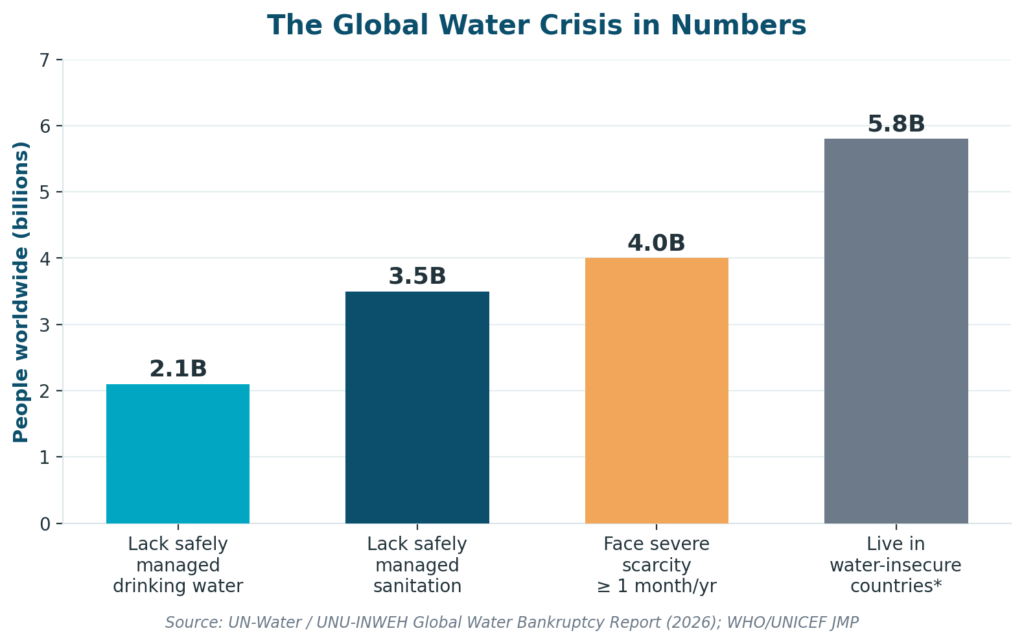
Figure 1: The scale of global water insecurity today. Source: UN-Water / UNU-INWEH Global Water Bankruptcy Report (2026); WHO/UNICEF JMP.
Where Does the World’s Water Actually Go?
Before we can conserve water effectively, it helps to understand who is using it. According to the Food and Agriculture Organization’s AQUASTAT global water database, agriculture accounts for roughly 69 percent of global freshwater withdrawals, industry for about 19 percent, and municipal or household use for the remaining 12 percent. In low-income and agrarian economies, farming’s share can climb above 90 percent. It’s worth noting that a 2025 peer-reviewed analysis in PNAS Nexus found that the frequently repeated “70% for agriculture” figure has been passed along through the literature with surprisingly thin sourcing, and that the real range – depending on region and methodology – could plausibly run anywhere from 45% to 90%. The direction of the data is consistent even if the exact percentage varies by source, which is a useful reminder to treat any single water statistic as an estimate rather than gospel.
What this breakdown tells us is that household conservation, while genuinely important, is only one piece of the puzzle. Meaningful, lasting change also requires water-efficient irrigation in agriculture and smarter water management in industry – topics we’ll return to later in this guide.
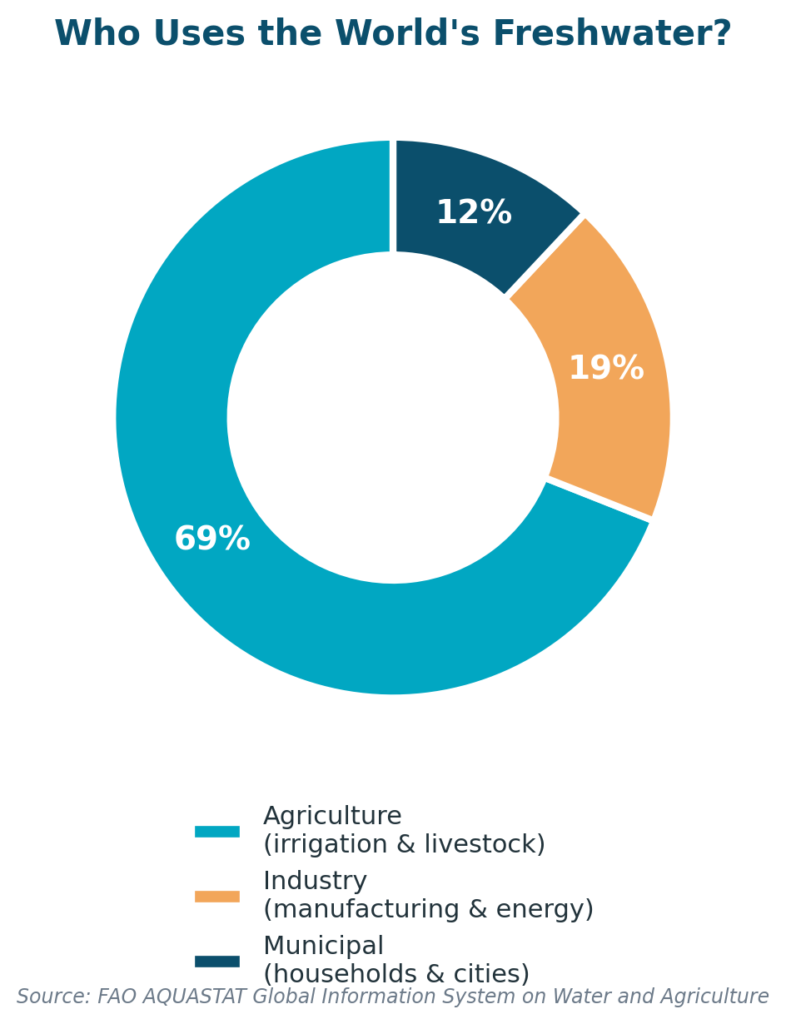
Figure 2: Global freshwater withdrawal by sector. Source: FAO AQUASTAT.
The Hidden Cost of Water Waste at Home
Household water use adds up faster than most people realize. The U.S. Environmental Protection Agency (EPA) WaterSense program reports that the average American family uses more than 300 gallons of water per day, and roughly 70 percent of that is used indoors. Break it down by fixture and the picture becomes clear: toilets, showers, and faucets together account for the majority of indoor use, with leaks alone wasting an estimated 9,000 gallons per household every year – enough to fill a small backyard swimming pool. A single running toilet can silently waste up to 200 gallons a day without anyone noticing.
Outdoor water use tells its own story. Landscape irrigation can account for 30 percent of household water use nationally, and up to 60 percent in arid regions, with as much as half of that lost to evaporation, wind, and runoff from inefficient sprinkler systems. In other words, a large share of the water we “use” never actually reaches a plant’s roots or serves any real purpose at all.
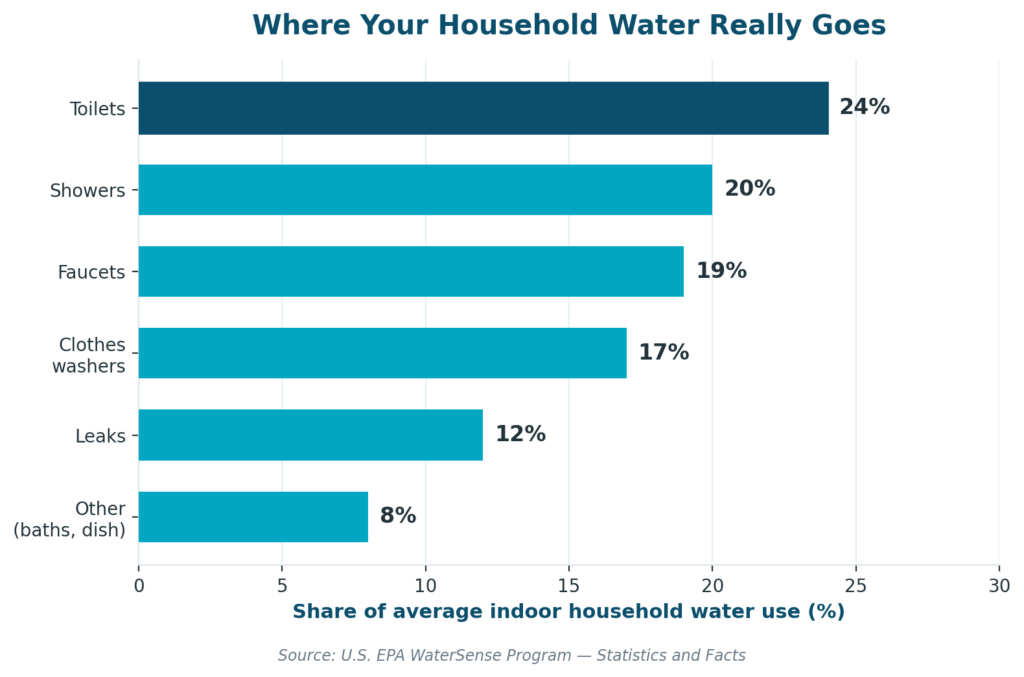
Figure 3: Average breakdown of indoor household water use. Source: U.S. EPA WaterSense – Statistics and Facts.
Everyday Water Conservation Tips That Actually Work
The good news is that water conservation at home doesn’t require an expensive renovation. Most of the highest-impact changes are inexpensive, quick to make, and pay for themselves within a year through lower water and energy bills.
Smart Habits in the Bathroom and Kitchen
- Turn off the tap while brushing your teeth or shaving – this alone saves more than 200 gallons per person, per month.
- Take shorter showers. Standard showerheads use about 2.5 gallons per minute, so trimming even two minutes off a daily shower adds up quickly over a year.
- Install WaterSense-labeled showerheads (2.0 gallons per minute or less) to cut shower water use by roughly 20% without sacrificing pressure.
- Replace older, inefficient toilets with WaterSense-labeled models; the average family can save around 13,000 gallons and $130 a year.
- Only run dishwashers with a full load – this eliminates roughly one load of hand-washing per week and saves close to 320 gallons annually.
Laundry and Everyday Appliance Efficiency
- Choose ENERGY STAR-certified washing machines, which typically use about 30% less water per load than standard models.
- Wash full loads of laundry rather than several smaller ones, and match the water-level setting to the load size.
- Upgrade old faucets and aerators to WaterSense-labeled versions, saving up to 700 gallons a year with virtually no change in daily routine.
Fix the Silent Water Wasters: Leaks
A faucet dripping at just one drop per second can waste nearly 17 gallons a day, and undetected leaks cost the average household 180 gallons a week. The EPA’s free 10-minute leak-detection checklist is a simple starting point: check the water meter before and after a two-hour period when no water is being used – if it moves, there’s a leak somewhere in the system.
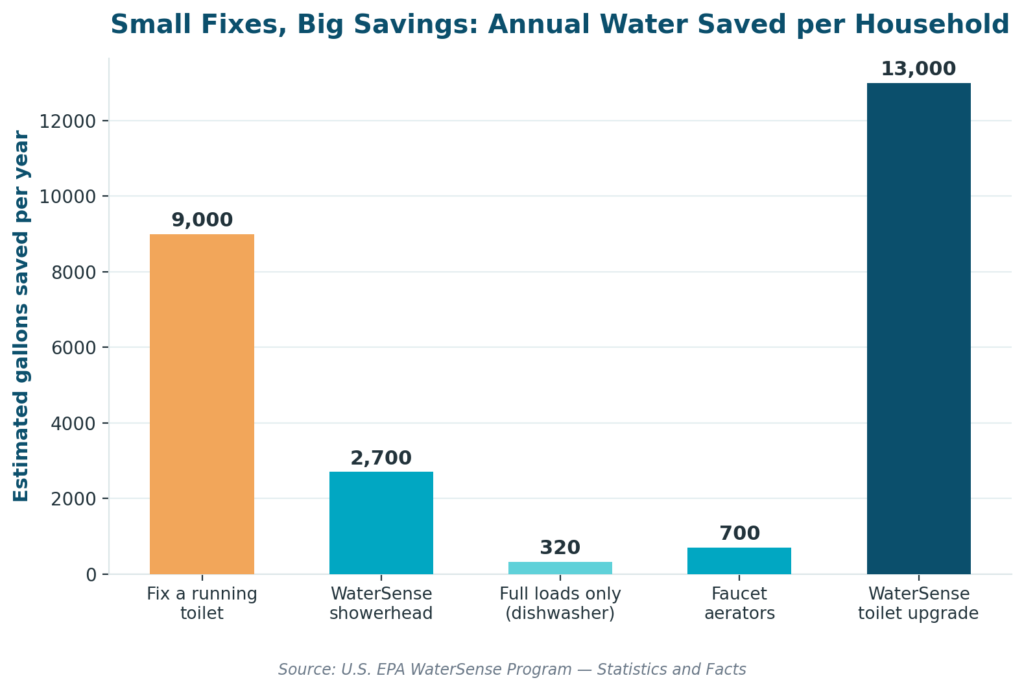
Figure 4: Estimated annual water savings from common household upgrades. Source: U.S. EPA WaterSense – Statistics and Facts.
Outdoor Water Conservation: Xeriscaping and Smart Irrigation
Because outdoor watering is one of the least efficient uses of household water, it’s also one of the biggest opportunities. Xeriscaping – landscaping with drought-tolerant, native plants that need little or no supplemental irrigation – can dramatically cut outdoor water demand while still creating an attractive yard. Pairing that with smart irrigation controllers, drip irrigation, and properly scheduled watering (early morning or evening, to reduce evaporation) can reduce irrigation water use by roughly 15 percent, or about 7,600 gallons a year for a typical home – equivalent to the water used in 480 showers.
A few outdoor habits worth adopting: water lawns only when they need it (a lawn that springs back after you step on it doesn’t need watering yet), raise the mower blade to promote deeper, more drought-resilient roots, and use mulch around garden beds to slow evaporation and suppress weeds.
Advanced Water-Saving Technologies: Rainwater Harvesting and Greywater Recycling
For households and businesses ready to go further, rainwater harvesting and greywater recycling are two of the most well-studied advanced conservation methods. Rainwater harvesting captures runoff from roofs for uses like irrigation, toilet flushing, or laundry, while greywater systems recycle lightly used water from showers, sinks, and washing machines – which can represent 43 to 70 percent of a household’s total wastewater volume – for similar non-drinking purposes.
Peer-reviewed research backs up the impact. A published case study of a high-water-use household in Colombia found that a hybrid rainwater-harvesting and greywater-reuse system cut potable water consumption by 42.5 percent while reducing flows to the local wastewater treatment plant by 20 percent. Broader reviews estimate that using rainwater or treated greywater for toilet flushing and laundry alone can reduce drinking-water demand by 20 to 30 percent. One important caveat from a Netherlands-based microbial risk assessment: untreated rainwater and greywater can carry pathogens, so basic filtration or treatment is recommended before reuse, particularly for anything beyond toilet flushing or subsurface irrigation.
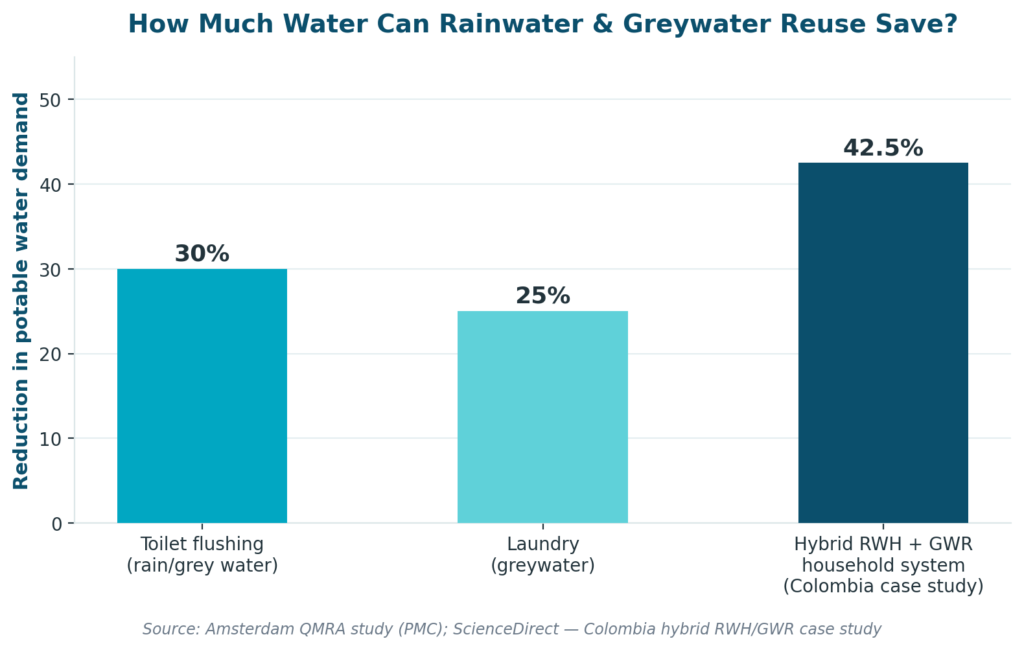
Figure 5: Potable water savings achievable through rainwater harvesting and greywater reuse. Source: PMC (Amsterdam QMRA study); ScienceDirect (Colombia case study).
Water Conservation in Agriculture and Industry: The Bigger Picture
Because agriculture is the single largest user of freshwater worldwide, improving irrigation efficiency has an outsized impact on global water security. The FAO notes wide disparities between countries: nations like Egypt, Saudi Arabia, and Uzbekistan have more than 90 percent of cultivated land under irrigation infrastructure, while roughly 35 countries – mostly in sub-Saharan Africa – irrigate less than 1 percent of their farmland, leaving them almost entirely dependent on rainfall. Techniques such as drip irrigation, soil-moisture sensors, and precision agriculture can sharply cut the water lost to evaporation and runoff compared with traditional flood irrigation, while maintaining or even improving crop yields.
On the industrial side, manufacturers are increasingly adopting closed-loop cooling systems, water recycling within production processes, and leak-detection technology. The World Bank has documented steep declines in renewable freshwater availability per person in several countries – roughly 50 percent in China and 80 percent in Pakistan since the 1960s – underscoring why industrial water efficiency is no longer optional in water-stressed regions but a core part of business continuity planning.
Community and Policy-Level Water Conservation
Individual habits matter, but lasting water security also depends on infrastructure and policy. Sustainable Development Goal 6 (SDG 6), the UN’s global target for water and sanitation for all by 2030, calls for major investment in water systems – the WHO and UNICEF estimate the world needs roughly an eightfold increase in the current pace of progress on drinking water access to stay on track. At the community level, effective strategies include repairing aging water mains that lose treated water to leaks before it ever reaches a tap, tiered water pricing that rewards conservation, public rebate programs for WaterSense fixtures and native landscaping, and public education campaigns during drought periods.
There’s real progress to point to: between 2015 and 2024, an additional 961 million people gained access to safely managed drinking water, and open defecation in urban areas has been nearly eliminated. The lesson is that coordinated investment, paired with everyday household conservation, does move the needle – it simply needs to happen faster and more equitably than it has so far.
Frequently Asked Questions About Water Conservation
What is water conservation and why is it important?
Water conservation is the practice of using water efficiently to reduce unnecessary waste and protect freshwater supplies for the future. It matters because nearly 4 billion people already experience severe water scarcity for at least part of the year, and freshwater makes up less than 1% of all water on Earth (UN-Water, 2026).
What are the easiest ways to save water at home?
The highest-impact, lowest-effort steps are fixing leaks, installing WaterSense-labeled showerheads and toilets, running dishwashers and washing machines only with full loads, shortening showers, and turning off the tap while brushing your teeth. Together these can cut a household’s water use by 20% or more (EPA WaterSense).
How much water does the average household waste?
The average U.S. household wastes about 9,000 gallons of water a year to undetected leaks alone, and a single running toilet can waste up to 200 gallons per day (EPA WaterSense).
Is rainwater harvesting worth it for a typical home?
Research suggests yes in most climates. Case studies show rainwater harvesting and greywater reuse can cut a household’s potable water demand by 25-42%, though basic filtration is recommended before reusing untreated water indoors.
Which sector uses the most water globally?
Agriculture is the largest user of freshwater worldwide, accounting for an estimated 69% of global withdrawals according to the FAO, with industry and municipal use making up the remainder.
Conclusion: Guarding Our Liquid Gold Starts With Us
Water conservation isn’t a single grand gesture – it’s the accumulation of small, consistent choices made by billions of people, businesses, farms, and cities. A shorter shower, a fixed leak, a drip-irrigated field, and a smarter municipal water policy are all part of the same solution. Given how quickly global demand for fresh water is outpacing supply, every gallon saved today genuinely does buy time for the systems and infrastructure the world still needs to build. Guarding our liquid gold isn’t optional anymore; it’s one of the most practical, immediate forms of climate and community resilience available to us.
References and Further Reading
This guide draws on primary data and peer-reviewed research from the following authoritative sources:
- United Nations World Water Development Report 2026 – UN-Water
- Global Water Bankruptcy Report – UN University (UNU-INWEH), 2026
- “World enters era of global water bankruptcy” – UN News
- U.S. EPA WaterSense – Statistics and Facts
- U.S. EPA WaterSense – How We Use Water
- FAO AQUASTAT – Global Information System on Water and Agriculture
- “Widely cited global irrigation statistics lack empirical support” – PNAS Nexus / PMC
- “Strains on freshwater resources” – World Bank Blogs
- Environmental performance of a hybrid rainwater harvesting and greywater reuse system (Colombia case study) – ScienceDirect
- Microbiological Health Risk Assessment of Water Conservation Strategies (Amsterdam) – PMC
- Global Water Crisis 2026: Key Facts and Figures (WHO/UNICEF JMP data)
Content compiled and fact-checked against primary data from the United Nations, U.S. EPA, FAO, and peer-reviewed academic journals. Statistics reflect the most recent publicly available reporting as of 2026 and are updated periodically as new data is released.