





Somewhere in Virginia, Texas, or Ireland right now, a server room the size of a shopping mall is drawing enough electricity to power a small city – just to train the next generation of AI models. That single sentence captures the tension defining the energy sector in 2026: the same technology sector that promised to help solve the climate crisis is now one of the fastest-growing sources of electricity demand in the world, and it’s testing how far our clean energy goals can stretch before they snap.
Data centers were once a quiet, background part of the energy conversation. Not anymore. Between the artificial intelligence boom, the cryptocurrency industry, and the everyday digitization of business, data center energy consumption has become one of the defining forces reshaping electricity grids, utility planning, and corporate sustainability commitments worldwide. This article breaks down exactly how data center energy demand is affecting clean energy goals – with hard numbers, verified sources, and a realistic look at where things go from here.
The Scale of the Problem: How Much Electricity Do Data Centers Really Use?
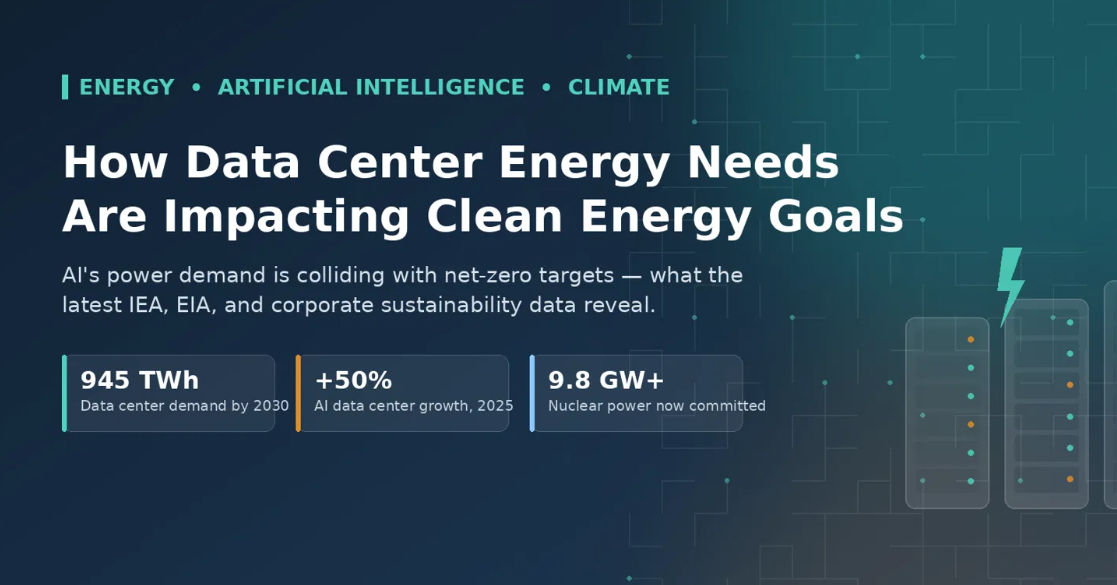
Let’s start with the numbers, because they tell the story better than any headline can. According to the International Energy Agency (IEA), one of the most authoritative sources tracking global energy trends, data centers consumed roughly 415 terawatt-hours (TWh) of electricity in 2024. That figure is projected to climb to around 945 TWh by 2030 – more than doubling in just six years, and outpacing the electricity consumption of most individual countries on Earth.
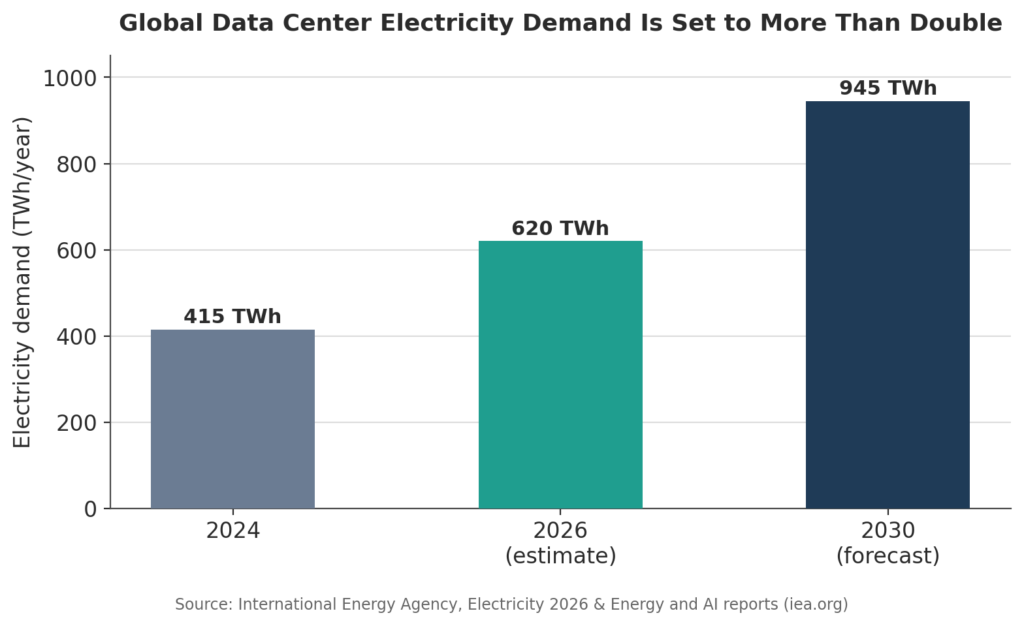
Figure 1: Global data center electricity demand is projected to more than double between 2024 and 2030, according to IEA analysis.
It isn’t just the total volume of electricity that matters – it’s the speed of the increase. The IEA’s 2026 analysis found that global electricity demand from data centers grew 17% in a single year (2025), while electricity demand specifically from AI-focused data centers surged by 50% over the same period. That gap between “data centers overall” and “AI data centers specifically” is the real story: artificial intelligence, not routine cloud computing or web hosting, is the primary engine behind this acceleration.
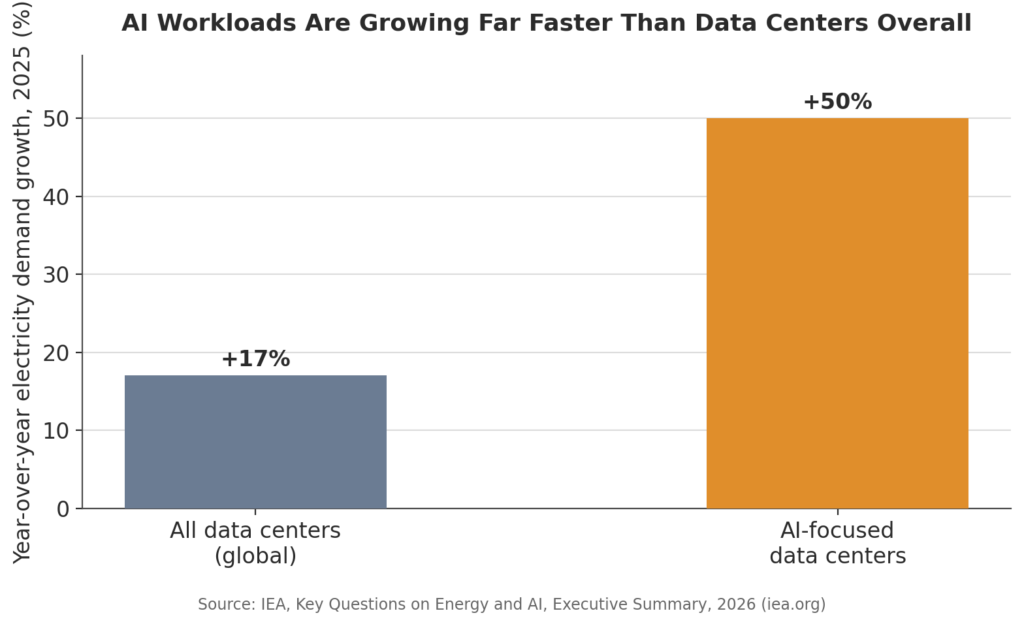
Figure 2: AI-focused data centers are growing electricity demand roughly three times faster than the data center sector as a whole.
To put that in human terms: the IEA has compared a typical Google search, which uses about 0.3 watt-hours of electricity, to a single ChatGPT query, which uses roughly 2.9 watt-hours – nearly ten times as much. Multiply that difference across billions of daily queries, and you start to understand why grid operators from Dublin to Dallas are sounding the alarm.
Why AI Is Such an Energy-Hungry Technology
Training large language models requires clusters of thousands of specialized graphics processing units (GPUs) running around the clock for weeks or months at a time. Once a model is trained, every single query – every chatbot response, every AI-generated image, every automated business workflow – requires additional computing power, known as “inference.” Unlike traditional web traffic, which ebbs and flows predictably, AI inference demand is compounding, because AI capabilities are being layered into search engines, productivity software, customer service systems, and industrial processes all at once.
Cooling adds another significant layer of demand. Modern AI chips generate enormous amounts of heat, and keeping server racks within safe operating temperatures can account for a large share of a facility’s total electricity draw. This has pushed the industry toward liquid and immersion cooling, which is more energy-efficient than traditional air cooling but still requires substantial water and power resources to operate at scale.
The Collision Course: Data Centers vs. Clean Energy Targets
Here’s where the story gets complicated. Major technology companies – Microsoft, Google, Amazon, and Meta – have made some of the most ambitious corporate climate pledges on record. Amazon has committed to net-zero emissions by 2040 under its self-founded Climate Pledge. Google set a target of net-zero emissions by 2030. Microsoft has pledged to be carbon negative by 2030. These commitments made these firms leaders in the corporate sustainability movement for years.
But the AI buildout is now straining those very commitments. In its 2026 Environmental Sustainability Report, Microsoft disclosed that its total greenhouse gas emissions rose 25% year-over-year, driven primarily by data center construction and expanded electricity use. The company’s Scope 2 emissions – those tied to purchased electricity – jumped from about 2% of its total footprint to 13% in a single fiscal year. Google reported a 25% increase in supply-chain-related emissions in its own 2026 sustainability disclosures, and Amazon logged a 34% rise in Scope 2 emissions in its 2025 environmental report.
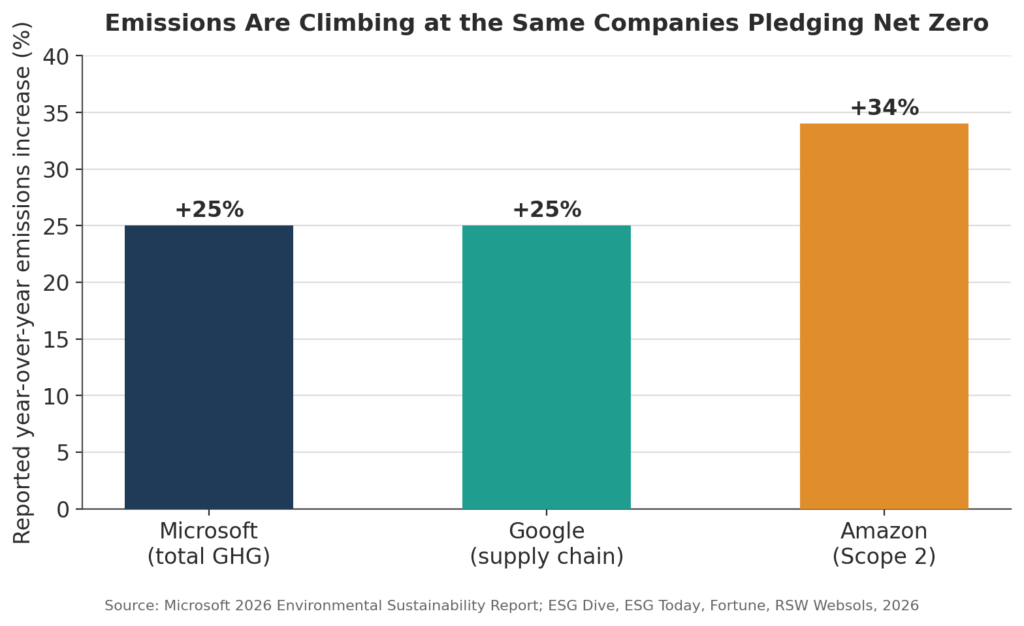
Figure 3: Reported emissions increases at three of the largest cloud and AI providers, driven largely by data center expansion.
“AI infrastructure is driving demand for energy, water, land and materials, though sustainability solutions are not scaling fast enough to meet demand.”
– Microsoft President Brad Smith and Chief Sustainability Officer Melanie Nakagawa, 2026 Environmental Sustainability Report
Part of this emissions rise reflects an accounting shift as much as a physical one. Microsoft, for example, stopped counting certain low-quality, “unbundled” renewable energy certificates (RECs) toward its clean energy goals – a type of credit that doesn’t necessarily fund new clean power generation. That change made the company’s reported emissions look worse on paper, even as it pushed the industry toward more meaningful clean energy investment. Still, the underlying trend is real: electricity demand from AI data centers is growing faster than the supply of new clean power that utilities and developers can bring online.
Fossil Fuels Are Getting a Second Life
Perhaps the most tangible way data centers are impacting clean energy goals is by keeping fossil fuel power plants running longer than planned. Across the United States, utilities facing surging data center demand have delayed or canceled dozens of coal plant retirements that were once considered settled decisions.
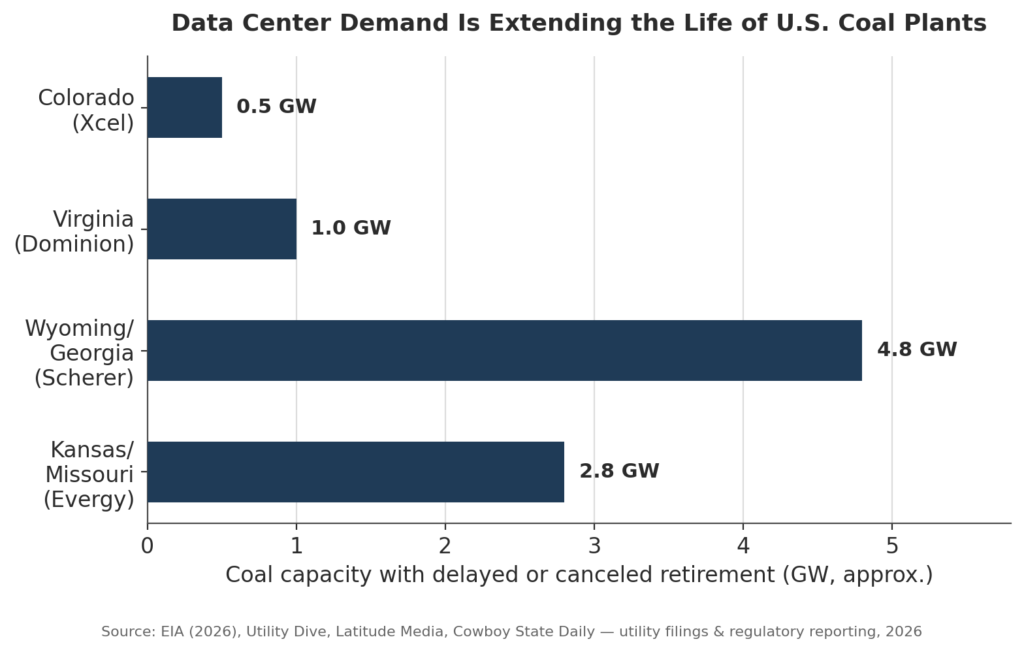
Figure 4: Selected examples of U.S. coal capacity with retirement dates delayed or canceled amid rising data center-driven demand.
In Kansas and Missouri, utility Evergy has asked regulators for permission to delay retiring or converting roughly 2.8 gigawatts of coal capacity by at least five years, citing data center growth in the state. In Wyoming and Georgia, aging units at plants like the Robert W. Scherer Electric Generating Plant – one of the largest coal-fired facilities in North America – have had retirement dates pushed back. According to the U.S. Energy Information Administration (EIA), utilities only retired 4.6 gigawatts of capacity in 2025 out of a planned 12.3 gigawatts – the smallest actual retirement total since 2008 – following federal emergency orders that kept several coal plants online to preserve grid reliability.
This isn’t a fringe trend. Analysts at Bank of America estimate that U.S. data centers could add roughly 125 gigawatts of electricity load between 2026 and 2030, pushing overall electricity demand growth to a compound annual rate of 4.1%. With large gas turbines largely sold out through the end of the decade, utilities are left with few options besides extending the lives of existing coal and gas plants, at least in the near term. Research from Lawrence Berkeley National Laboratory has also cautioned that some of this projected demand may be inflated by speculative interconnection requests – developers filing overlapping applications across multiple states – which makes precise long-term planning genuinely difficult for grid operators.
The Clean Energy Response: Nuclear, Renewables, and New Deals
To their credit, the largest technology companies are not simply defaulting to fossil fuels. Over the past two years, Microsoft, Google, Amazon, and Meta have collectively signed more new nuclear power agreements than the U.S. nuclear industry has seen in decades – a strategy aimed at securing firm, round-the-clock, carbon-free electricity that intermittent wind and solar alone cannot always provide.
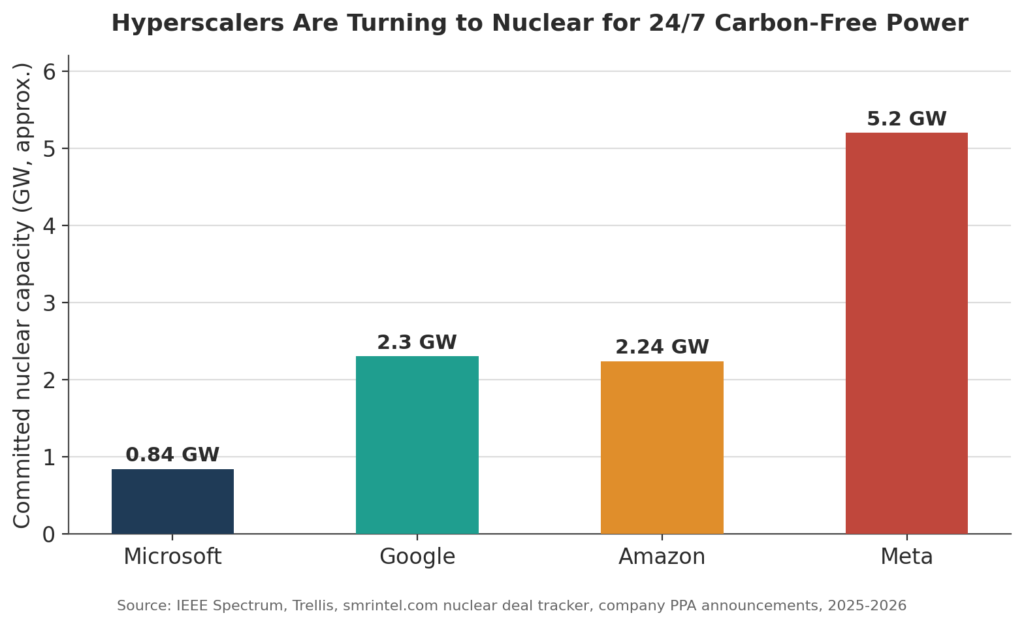
Figure 5: Approximate committed nuclear power capacity secured by major hyperscale cloud providers, 2024-2026.
Microsoft signed a 20-year power purchase agreement with Constellation Energy to restart Three Mile Island Unit 1 – now renamed the Crane Clean Energy Center – targeting a 2027-2028 return to service. Amazon expanded its nuclear offtake agreement with Talen Energy to 1.9 gigawatts through 2042, tied to the Susquehanna Steam Electric Station in Pennsylvania, and separately invested in X-energy’s small modular reactor (SMR) technology. Google signed a 500-megawatt agreement with SMR developer Kairos Power and a further 1.8-gigawatt deal with Elementl Power. Meta has assembled the largest overall commitment, with agreements across Vistra, Constellation, and emerging SMR developers totaling roughly 5 gigawatts.
Small modular reactors (SMRs) are drawing particular interest because they are factory-built, smaller in scale (roughly 50-300 megawatts per unit), and theoretically faster to construct than traditional nuclear plants. However, most of these SMR projects are not expected to deliver power until the 2030s, and current cost estimates for restarted nuclear plants run between $70 and $95 per megawatt-hour – meaning nuclear remains a medium-to-long-term solution rather than an immediate fix for today’s grid strain.
Renewables and Battery Storage Still Carry the Near-Term Load
Alongside nuclear, wind, solar, and battery storage remain the fastest-to-deploy clean energy sources available to data center operators today. The IEA’s Electricity 2026 report notes that renewables continue to expand rapidly even as gas generation also rises to meet data center demand, reflecting an “all of the above” approach many utilities are now taking simply to keep pace. Battery storage, in particular, is increasingly used to help data centers shift electricity use away from peak-demand hours and to firm up intermittent renewable generation – reducing strain on local grids without necessarily requiring new fossil generation.
The Human and Community Cost
Behind the terawatt-hours and gigawatt commitments are real communities dealing with real consequences. Data center growth has driven visible opposition in several U.S. states, with residents citing concerns about rising electricity prices, strained water supplies, noise, and land use. In Virginia – home to the largest concentration of data centers in the world, with more than 150 hyperscale facilities – utility Dominion Energy has cited data center demand as a reason to delay retiring the Clover Power Station, a coal-fired peaker plant located in a lower-income area of Halifax County, while also proposing new gas-fired generation in communities that already carry a disproportionate share of the region’s environmental burden.
A growing number of state utility regulators have started requiring that data center operators pay their fair share of new infrastructure costs, rather than shifting those costs onto residential ratepayers. This regulatory pushback reflects a broader recognition: the benefits of the AI boom – corporate profits, technological advancement, national competitiveness – are not always distributed the same way as its costs in electricity prices, emissions, and local environmental impact.
What This Means for Global Climate Goals
Zooming out, the IEA projects that global electricity demand will grow at an average annual rate of 3.6% between 2026 and 2030 – roughly 50% faster than the average growth rate of the previous decade – with data centers, electric vehicles, and air conditioning cited as the three biggest drivers. Because electricity demand is now outpacing overall energy demand growth for the first time in three decades outside of a crisis period, how that new electricity gets generated will heavily influence whether the world stays anywhere close to its climate targets.
There is a genuinely optimistic case here. Nuclear generation is expected to hit record highs through 2030, supported by reactor restarts, life-extensions, and new capacity in countries including China, India, France, and Japan. Deloitte’s analysis suggests nuclear energy alone could meet up to 10% of data center electricity demand by 2035. If hyperscalers follow through on their renewable and nuclear commitments at the scale they’ve announced, data centers could ultimately accelerate the clean energy transition by providing the long-term demand certainty that developers need to justify building new carbon-free power plants in the first place.
But there is an equally real risk on the other side. If grid capacity, permitting timelines, and transmission buildout can’t keep pace with AI demand, the path of least resistance for utilities will keep being the one we’re already seeing: extend the coal plant, build another gas turbine, delay the retirement date. The U.S. interconnection queue has swelled to more than 2,600 gigawatts of proposed projects awaiting grid connection, with average wait times around five years – a bottleneck that slows clean energy deployment just as fast as it slows fossil fuel retirements.
Frequently Asked Questions
How much electricity do data centers use worldwide?
Global data centers consumed approximately 415 TWh of electricity in 2024, according to the IEA, with that figure projected to reach roughly 945 TWh by 2030 as AI adoption accelerates – more than doubling in six years.
Are data centers slowing down the shift to clean energy?
In the near term, yes, in specific ways: rising electricity demand has led several U.S. utilities to delay coal plant retirements and build new natural gas capacity. At the same time, data center operators are also the single largest corporate buyers of new nuclear and renewable energy capacity, which could accelerate clean energy deployment over the long run.
Why are tech companies investing in nuclear power for data centers?
Nuclear power provides firm, 24/7, carbon-free electricity that intermittent renewables like wind and solar cannot always guarantee. Microsoft, Google, Amazon, and Meta have all signed nuclear power purchase agreements or invested directly in small modular reactor developers to secure reliable, low-carbon power for AI workloads.
Is AI electricity use really worse than a Google search?
According to IEA estimates, a typical ChatGPT query uses about 2.9 watt-hours of electricity, compared with roughly 0.3 watt-hours for a standard Google search – nearly ten times more per request, though efficiency improvements are ongoing.
Article Summary
Data centers are no longer a minor line item in the global energy conversation – they are one of its central characters. The AI boom has created a genuine tension between two forces that used to move in the same direction: the technology industry’s stated climate commitments, and its now-massive appetite for electricity. Whether data centers end up accelerating the clean energy transition or slowing it down will depend on decisions being made right now – by utility regulators approving (or delaying) power plant retirements, by tech companies choosing between speculative gas deals and long-term clean power investment, and by policymakers deciding who pays for the infrastructure this boom requires.
The next few years will be decisive. As the IEA puts it, we are entering an “Age of Electricity” – and how the world’s data centers get powered may end up being one of the biggest single factors in whether global clean energy goals are met, missed, or redefined altogether.
References & Sources
This article draws on primary research and reporting from the following authoritative organizations and publications:
1. International Energy Agency (IEA). “Electricity 2026 – Analysis.” https://www.iea.org/reports/electricity-2026
2. International Energy Agency (IEA). “Key Questions on Energy and AI – Executive Summary.” https://www.iea.org/reports/key-questions-on-energy-and-ai/executive-summary
3. International Energy Agency (IEA). “Data Centres & Networks.” https://www.iea.org/energy-system/buildings/data-centres-and-data-transmission-networks
4. U.S. Energy Information Administration (EIA). “Data center server energy use grows across the commercial building stock.” https://www.eia.gov/todayinenergy/detail.php?id=67704
5. U.S. Energy Information Administration (EIA). “Retirement delays of U.S. electric generating capacity may continue in 2026.” https://www.eia.gov/todayinenergy/detail.php?id=67206
6. Utility Dive. “Coal- and gas-fired power plants have a new best friend: data centers.” https://www.utilitydive.com/news/fossil-fuel-gas-coal-climate-data-centers/753565/
7. Utility Dive. “AI data center growth could force US utilities to rethink generation plans, BofA says.” https://www.utilitydive.com/news/ai-data-center-growth-utilities-generation-plans/825541/
8. Latitude Media. “In the Midwest, more coal power for data centers.” https://www.latitudemedia.com/news/in-the-midwest-more-coal-power-for-data-centers/
9. Industrial Info Resources. “U.S. Coal-Fired Power Plant Retirements Slowed in 2025, Future is Uncertain.” https://www.industrialinfo.com/iirenergy/industry-news/article/us-coal-fired-power-plant-retirements-slowed-in-2025-future-is-uncertain–357093
10. Cowboy State Daily. “Coal Plants Across Nation Get Second Life Due To Data Center Growth.” https://cowboystatedaily.com/2026/05/05/coal-plants-across-nation-get-second-life-due-to-data-center-growth/
11. IEEE Spectrum. “Big Tech Embraces Nuclear Power to Fuel AI and Data Centers.” https://spectrum.ieee.org/nuclear-powered-data-center
12. Trellis. “Amazon, Google, Meta and Microsoft go nuclear.” https://trellis.net/article/amazon-google-meta-and-microsoft-go-nuclear/
13. ESG Dive. “Microsoft’s data center expansion drove 25% emissions spike in 2025: report.” https://www.esgdive.com/news/microsofts-data-center-expansion-drove-25-emissions-spike-2025-environmental-sustainability-report/825082/
14. ESG Today. “Microsoft’s Carbon Footprint Jumps 25% as AI Buildout Challenges Climate Goals.” https://www.esgtoday.com/microsofts-carbon-footprint-jumps-25-as-ai-buildout-challenges-climate-goals/
15. Fortune. “Microsoft’s emissions surged 25% in 2025 during data center boom.” https://fortune.com/2026/07/09/microsoft-carbon-emissions-2025-data-centers/
16. Spotlight PA. “Data centers are slowing America’s shift away from coal.” https://www.spotlightpa.org/news/2026/08/data-center-coal-power-emissions-climate-change-study-environment/
Disclaimer: Figures in this article are drawn from publicly available reports, corporate disclosures, and reputable energy-sector journalism current as of August 2026. Data center energy projections vary by methodology and source, and figures may be revised as new reporting becomes available.