









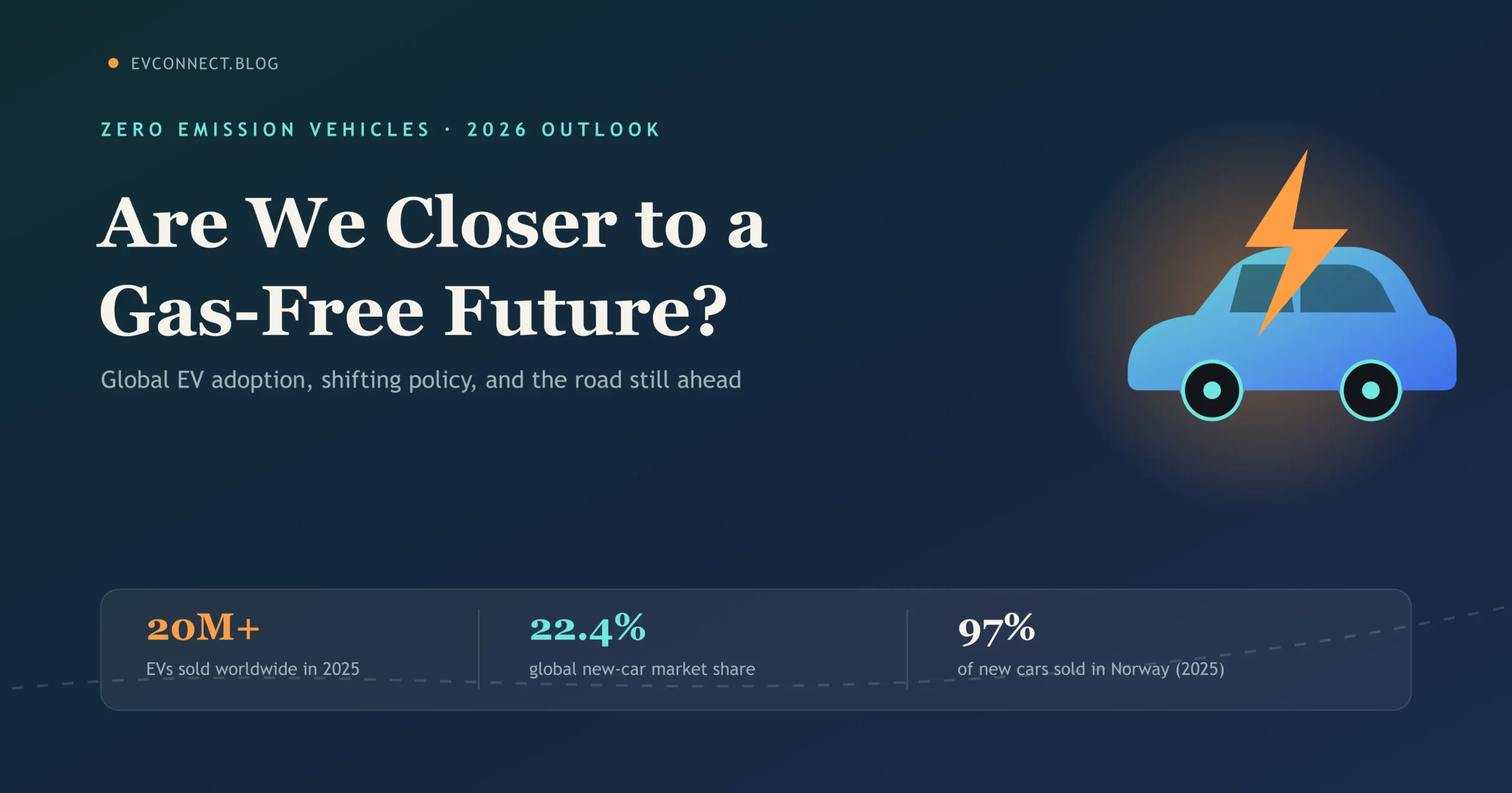
Ten years ago, an electric car was a novelty you spotted maybe once on your commute. Today, roughly one in every four new cars sold worldwide runs on a battery instead of a tank of gas. That’s not a small shift – it’s one of the fastest transportation transitions in modern history.
But “closer” isn’t the same as “there.” Zero emission vehicles (ZEVs) are booming in some countries and stalling in others. Charging infrastructure is expanding, yet still frustrates road-trippers. Incentives that once sweetened the deal are disappearing in places like the United States. So where do things actually stand in 2026, and what does the road to a truly gas-free future really look like?
This article breaks down the real numbers, the policies driving (or slowing) adoption, the technology making ZEVs practical, and the honest hurdles still in the way.
What Counts as a Zero Emission Vehicle?
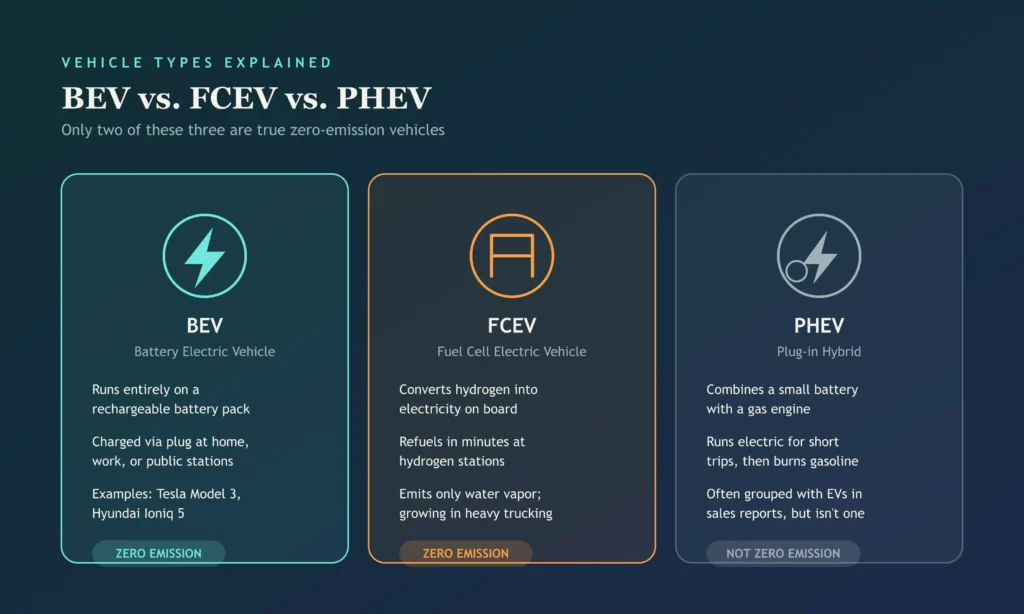
A zero emission vehicle is any vehicle that produces no tailpipe emissions during operation. The category includes:
- Battery Electric Vehicles (BEVs) – fully electric, powered by rechargeable battery packs (Tesla Model 3, Hyundai Ioniq 5, Chevrolet Equinox EV)
- Fuel Cell Electric Vehicles (FCEVs) – powered by hydrogen fuel cells that convert hydrogen into electricity, emitting only water vapor
- Zero-emission buses and trucks – increasingly common in public transit fleets and commercial freight
Plug-in hybrids (PHEVs) are often grouped alongside EVs in sales reports, but they don’t qualify as true zero-emission vehicles because they still burn gasoline once the battery is depleted.
The Global Numbers: How Big Is the Shift, Really?
The data from 2025 into 2026 tells a story of strong – if uneven – global momentum.
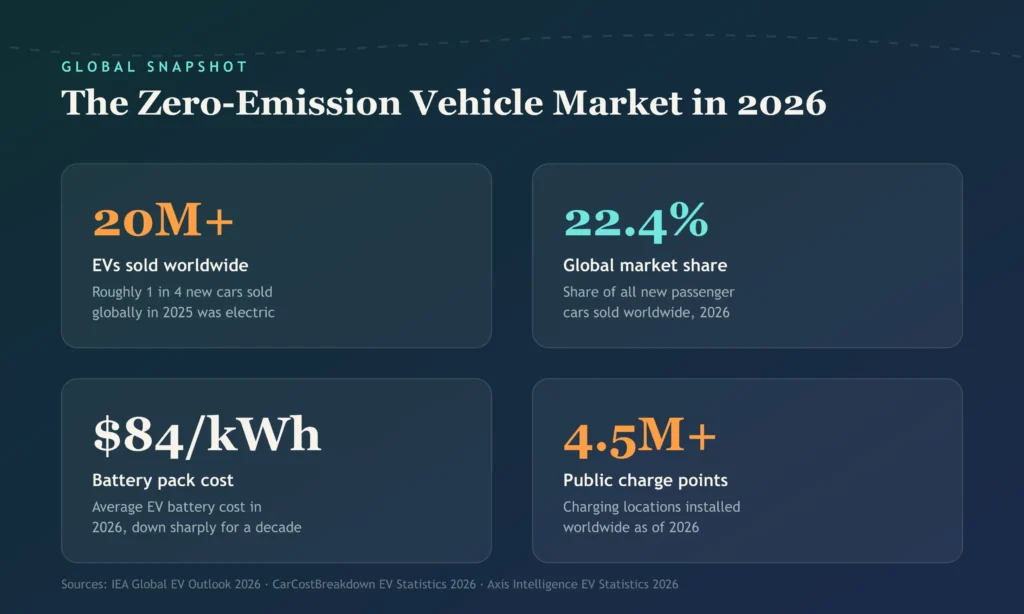
Worldwide EV sales crossed 20 million units in 2025, meaning roughly one in four new cars sold on the planet was electric, according to industry data compiled from IEA and market research sources. Market share estimates for 2026 put global electric vehicle penetration above 22%, with the global ZEV market itself valued in the hundreds of billions of dollars and projected to keep growing at a double-digit compound annual rate through the early 2030s.
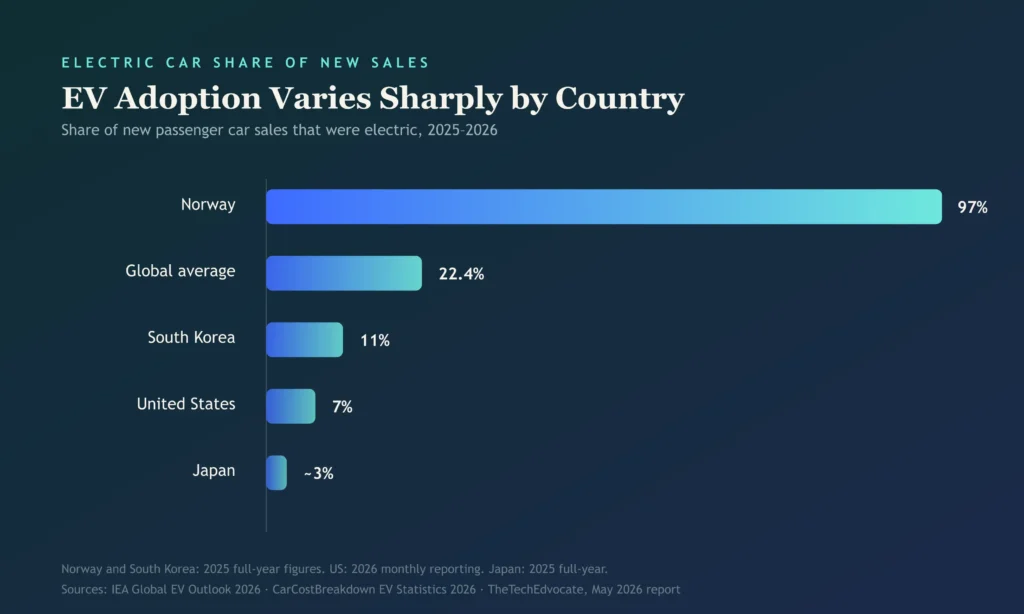
Regionally, the picture varies a lot:
- Norway remains the undisputed leader, with electric cars making up roughly 97% of new car sales in 2025 – the country is effectively phasing out new gas-car sales entirely.
- China continues to dominate on volume, powered by its New Energy Vehicle (NEV) credit system, which requires automakers to hit rising EV production quotas and is currently pushing toward 18% of total production, climbing to 28% by 2030.
- South Korea saw electric car sales jump about 65% year-over-year in 2025, pushing EV market share into double digits for the first time, aided by government purchase guidelines and a newly raised target of 50% ZEV sales by 2030.
- Europe is being pulled forward by the EU’s binding 2035 ban on new internal combustion engine (ICE) vehicle sales and tightening CO2 fleet targets, which now stand at 93.6 g/km – a steep drop from 118.5 g/km just five years earlier. Automakers face fines of roughly €95 per gram over the limit, per vehicle, which is a powerful financial incentive to keep electrifying lineups.
- Japan is the outlier among wealthy economies – EV sales have stayed flat for two years running, with conventional hybrids still outselling full EVs by a wide margin.
- The United States has had the rockiest 2026 so far, with EV sales share dipping to around 7% amid the withdrawal of federal incentives – more on that below. Canada, in contrast, saw zero-emission vehicle sales jump nearly 20% year-over-year in May 2026 alone.
Electric trucks are also having a breakout moment: global electric truck sales more than doubled in 2025 to top 400,000 units, now representing about 9% of all truck sales worldwide – a segment that’s often overlooked in the EV conversation but matters enormously for freight emissions.
Why the U.S. Market Just Hit a Speed Bump
If you’ve been researching electric vehicles in the U.S. this year, you’ve probably run into some conflicting information – and for good reason. The rules changed dramatically in 2025.
Under the One Big Beautiful Bill Act, signed into law on July 4, 2025, the federal EV tax credit landscape was rolled back well ahead of its original 2032 expiration:
- The $7,500 federal tax credit for new EVs (Section 30D) and the $4,000 credit for used EVs (Section 25E) ended for any vehicle acquired after September 30, 2025.
- There’s a narrow exception: buyers who had a binding written contract and made a qualifying payment on or before September 30, 2025 may still claim the credit even if they took delivery later.
- One incentive that survives (for now) is the Section 30C home EV charger credit – worth up to 30% of installation costs, up to $1,000 – but only for equipment placed in eligible census tracts before June 30, 2026.
- A new consolation prize appeared in the same law: a federal deduction of up to $10,000 per year in auto loan interest for U.S.-assembled vehicles, EVs included, running through 2028.
The practical effect has been a cooling of U.S. EV demand relative to the rest of the world, with several 2026 reports pointing to a notable pullback in new EV sales share after the credit’s removal. That said, the picture isn’t uniformly bleak: states like California, Colorado, New York, and Oregon are running their own rebate programs independent of federal policy, and some have expanded them specifically to offset the loss of the federal credit. Automakers, meanwhile, have leaned harder into lease deals, since commercial and leased vehicles can sometimes still access credits that direct buyers can’t.
The bottom line for American shoppers in 2026: the federal purchase incentive that fueled the last few years of EV growth is gone for most buyers, and state-level programs, EV loan-interest deductions, and manufacturer lease deals are now doing the heavy lifting.
What’s Actually Making Zero Emission Vehicles More Viable
Policy explains a lot of the regional variation, but three underlying trends are what make a gas-free future even plausible in the first place.
1. Battery Costs Keep Falling
Battery pack costs – historically the single biggest reason EVs cost more than gas cars – have dropped to around $84 per kWh in 2026, continuing a decade-long decline. Cheaper batteries are the single biggest lever for closing the price gap between EVs and internal combustion vehicles, and most industry analysts still treat price parity as the tipping point for mass-market adoption.
2. Charging Infrastructure Is Expanding, But Unevenly
Global public charging infrastructure has passed 4.5 million charge points, but availability is wildly inconsistent. Dense urban corridors in China, Europe, and coastal U.S. states have robust networks; rural areas and long-distance highway corridors lag well behind. In the U.S., federal charging infrastructure spending under the NEVI program has rolled out more slowly than originally promised, which has tempered confidence among buyers who do a lot of rural or long-distance driving – even as urban and suburban adoption keeps climbing.
3. Regulatory Pressure Is Forcing Automakers’ Hands
Whether it’s the EU’s 2035 ICE sales ban, China’s NEV credit quotas, South Korea’s 50%-by-2030 target, or California’s Advanced Clean Cars II rules, regulators worldwide are setting hard deadlines that automakers can’t easily ignore. These mandates function as a backstop even when consumer incentives fade, because manufacturers face fines or lost market access if they don’t keep electrifying their lineups.
The Real Barriers to a Gas-Free Future
It would be dishonest to say the road ahead is smooth. A few structural challenges remain:
- Charging anxiety, not just range anxiety. Modern EVs often have 250+ miles of range, but the bigger friction point now is charging speed and reliability on long trips, especially outside major metro areas.
- Upfront cost, even with falling battery prices. Without federal purchase incentives in markets like the U.S., sticker price remains a real barrier for middle-income buyers, even though total cost of ownership (fuel plus maintenance) usually favors EVs over time.
- Grid capacity and electricity mix. A “zero emission” vehicle is only as clean as the power grid charging it. Countries still heavily reliant on coal power get a smaller emissions benefit per EV than countries with cleaner grids.
- Battery supply chains. Lithium, cobalt, and nickel sourcing raises its own environmental and geopolitical questions, and scaling battery recycling infrastructure is still a work in progress.
- Hydrogen’s narrower lane. Fuel cell vehicles remain a small niche compared to battery EVs, held back by limited refueling infrastructure – hydrogen is gaining more traction in trucking and heavy transport than in passenger cars.
So, Are We Closer to a Gas-Free Future?
Yes – measurably closer than five years ago, but the timeline isn’t the same everywhere. In Norway, the gas-powered car is already close to extinct. In China and Europe, policy and market forces are moving in the same direction, reinforcing each other. In the U.S., the path forward is currently more dependent on state policy, falling battery costs, and manufacturer incentives than on federal support.
If the current trajectory holds, the IEA and most industry analysts expect global EV sales share to keep climbing through the rest of this decade, with electric trucks and buses adding meaningful emissions reductions on top of passenger car gains. A fully gas-free global fleet is still a long way off – passenger vehicles alone take 15-plus years to fully turn over – but the direction of travel is no longer in serious doubt. What’s genuinely uncertain now isn’t whether the shift happens, but how fast, and which regions lead versus lag along the way.
Frequently Asked Questions
What is the difference between an EV and a zero emission vehicle?
All zero emission vehicles include battery electric and hydrogen fuel cell vehicles, since neither produces tailpipe emissions. “EV” is sometimes used more loosely to include plug-in hybrids, which still burn gasoline and therefore aren’t fully zero-emission.
Is the federal EV tax credit still available in 2026?
No. The $7,500 federal credit for new EVs and $4,000 credit for used EVs ended for vehicles acquired after September 30, 2025, under the One Big Beautiful Bill Act. A narrow exception applies to buyers with a binding contract and payment made before that date. State and utility incentives may still apply.
Which country has the highest EV adoption rate?
Norway leads globally, with electric cars accounting for roughly 97% of new car sales in 2025 – the closest any major market has come to a fully gas-free new-car market.
Are electric vehicles actually better for the environment?
Yes, even accounting for battery production and electricity generation, life-cycle studies consistently show EVs produce fewer total emissions than gas cars over their lifespan – and the gap widens as electricity grids get cleaner.
Will gas cars eventually be banned?
Some regions have set firm deadlines, most notably the European Union’s 2035 ban on new internal combustion engine car sales. Other regions, including most of the U.S., currently rely on market incentives and state-level rules rather than an outright ban.
References and Sources
- International Energy Agency (IEA) – Global EV Outlook 2026: Trends in Electric Cars
- Statistics Canada / Global News – Zero-Emission Vehicle Sales Data, May 2026
- Axis Intelligence – Electric Vehicle Statistics 2026 Update
- CarCostBreakdown – Global Report of Electric Vehicle Statistics 2026
- Coherent Market Insights – Zero Emission Vehicles Market Size and Growth Forecast 2026–2033
- Custom Market Insights – Global Zero Emission Vehicle (ZEV) Market Report
- Coltura – The Federal EV Tax Credit and Other EV Incentives in 2026
- Caribou – EV Tax Credit 2026: What Changed + State Incentives Still Available
- Clean Energy Calculator Blog – EV Tax Credits in 2026: What Expired, the Deadline, and What’s Still Available
- Recharged – EV Sales Statistics 2026: Global & U.S. Market Trends
Note: EV policy and incentive details change quickly. Figures in this article reflect data available as of July 2026 – always confirm current federal, state, and local incentive eligibility before making a purchase decision.