





Global warming used to be a line on a graph. It is now a lived reality for nearly every ecosystem on the planet. Coral reefs are bleaching on a near-annual basis, cold-water fish are relocating toward the poles, alpine plants are climbing uphill in search of cooler air, and Arctic permafrost that has stayed frozen for millennia is starting to thaw. Rising global temperatures are no longer a future risk to ecosystems – they are actively reshaping them right now, and the pace of change is outrunning the ability of many species to adapt.
This article breaks down what the most recent climate data from NASA, NOAA, the World Meteorological Organization (WMO), and the Intergovernmental Panel on Climate Change (IPCC) reveal about how a warmer world is transforming coral reefs, forests, oceans, and polar landscapes – and why the effects of climate change on ecosystems ripple outward to touch food security, economies, and public health.
| KEY TAKEAWAYS Global surface temperature in 2025 was about 1.44°C above pre-industrial levels, and the 2023–2025 three-year average has likely crossed the symbolic 1.5°C threshold for the first time. The fourth global coral bleaching event (2023–2025) affected roughly 84% of the world’s coral reef area – the most extensive bleaching event ever recorded. More than 12,000 marine and terrestrial species have been documented shifting their ranges, generally poleward or to higher elevations, in response to warming. The Arctic is warming roughly four times faster than the global average, accelerating permafrost thaw and the release of long-stored carbon. Scientists warn that continued warming risks pushing some ecosystems past tipping points – thresholds beyond which change becomes difficult or impossible to reverse. |
The Numbers Behind the Warming: Where the Planet Stands in 2026
Every ecosystem story starts with the same baseline number: how much has the planet actually warmed? According to the World Meteorological Organization’s consolidated analysis of eight independent temperature datasets – including NASA GISTEMP, NOAA GlobalTemp, and the Copernicus Climate Change Service – 2025 was one of the three warmest years on record, with global average surface temperature about 1.44°C above the 1850–1900 pre-industrial baseline. The 2023–2025 three-year average now sits at roughly 1.48°C above pre-industrial levels, and the past eleven years, 2015 through 2025, are the eleven warmest years ever measured.
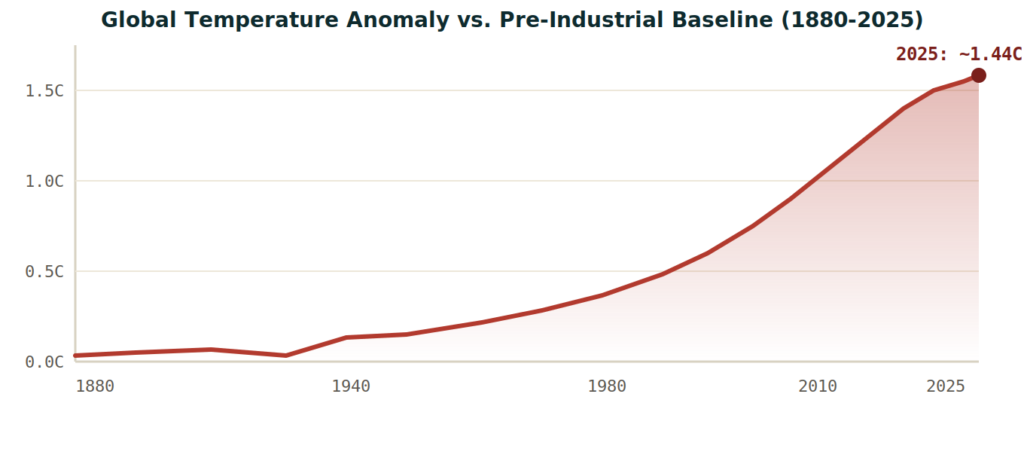
Source: WMO consolidated 8-dataset analysis; NASA GISTEMP; NOAA NCEI, 2025–2026.
| 1.44°C Global average surface temperature above pre-industrial levels in 2025 (WMO) | 11 of 11 The years 2015–2025 are the eleven warmest ever recorded | >90% Share of excess planetary heat absorbed by the oceans |
Two things matter for ecosystems specifically. First, the rate of warming is unusual by geological standards – most species and ecological communities have far less time to adjust than they’ve had during past natural climate shifts. Second, warming isn’t uniform: land is heating faster than oceans, high latitudes are heating faster than the tropics, and the ocean has absorbed the overwhelming majority of the extra heat trapped by greenhouse gases, setting a new record for ocean heat content in 2025.
Coral Reefs: Ecosystems on the Front Line of Ocean Warming
No ecosystem illustrates the effects of climate change more starkly than coral reefs. Corals live within a narrow thermal comfort zone; when ocean water stays too warm for too long, corals expel the symbiotic algae that give them color and much of their energy, a process known as coral bleaching. Prolonged bleaching starves and often kills the coral colony.
Between January 2023 and mid-2025, NOAA’s Coral Reef Watch program confirmed the fourth global coral bleaching event in recorded history – and by far the most severe. Heat stress capable of triggering bleaching affected roughly 84% of the world’s coral reef area across all three tropical ocean basins, with mass bleaching confirmed in at least 83 countries and territories.
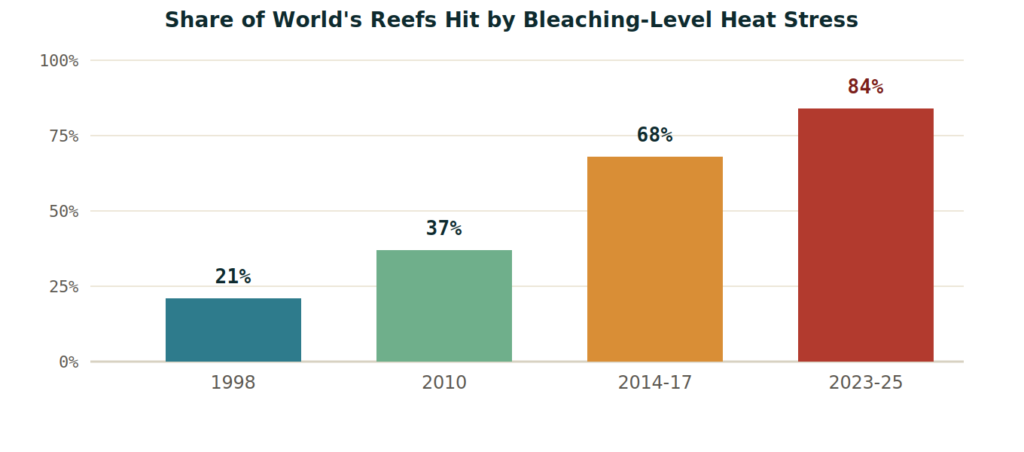
Source: NOAA Coral Reef Watch; International Coral Reef Initiative (ICRI), 2025.
What makes this trend especially concerning to marine scientists is the shrinking gap between events. The first global bleaching event, in 1998, was considered a rare shock. The most recent one overlapped so closely with the previous cycle that peer-reviewed research published in Coral Reefs now describes an almost uninterrupted period of global coral heat stress running from 2018 through 2025. NOAA’s own coordinator for Coral Reef Watch has said the world may now be entering an era where reefs bleach on a near-annual basis, which makes the reef ecosystem’s ability to recover between events increasingly uncertain.
Coral reefs cover less than 1% of the ocean floor but support an estimated 25% of all marine species at some point in their life cycle, along with the fisheries and tourism economies of dozens of coastal nations. Losing reef structure doesn’t just remove coral – it removes the physical habitat, nursery grounds, and storm buffer that entire marine food webs depend on.
Species on the Move: How Warming Redraws the Map of Life
Animals and plants don’t experience “climate change” as an abstraction – they experience a place getting too hot, too dry, or too unpredictable for their biology to handle. The most measurable ecological response to this has been range shifts: species relocating toward the poles or to higher, cooler elevations in search of the conditions they evolved for.
Research synthesized across marine and terrestrial systems has now documented more than 12,000 species shifting their geographic ranges in patterns consistent with a warming climate. Marine species have shown some of the fastest and clearest movements, since ocean temperature gradients are often smoother and easier to track than fragmented land habitats. A long-running set of studies on European butterflies found that of 35 non-migratory species examined, 63% had shifted their ranges northward by 35 to 240 kilometers over the past century, while only 3% moved south.
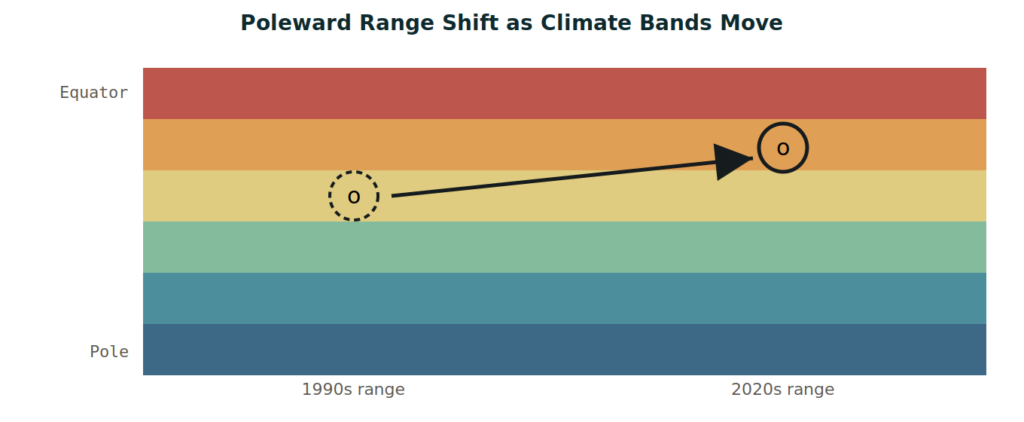
Source: pattern synthesized from Lenoir et al. range-shift research and BirdLife International poleward shift data, 2025–2026.
Birds are among the clearest indicators
Bird distribution surveys offer some of the longest continuous datasets available. Comparing UK breeding bird atlases from 1988–91 and 2008–11, researchers found that southern bird species had shifted their northern range boundary by an average of 0.68 kilometers per year, while northern species showed no corresponding southward retreat – a pattern that points specifically to warming, rather than land-use change, as the driver. Similar poleward shifts have been documented in Scandinavian boreal bird communities.
Not every species can simply move
Range shifts are not evenly distributed or guaranteed. Recent analysis published in PNAS shows that many species’ observed range shifts are outpacing what climate models predict, while other research finds limited evidence of poleward movement in tropical species – instead, tropical lowland species may simply be disappearing locally rather than relocating, a pattern researchers call “biotic attrition.” Species with highly specific soil, elevation, or dispersal requirements – including many baobab and alpine plant species – often cannot track shifting climate bands at all, leaving them stranded in conditions that are steadily becoming unsuitable.
The Arctic Meltdown: Permafrost, Carbon, and Tipping Points
The Arctic is the planet’s most visible warming hotspot. Due to a feedback process called Arctic amplification – driven largely by shrinking sea ice and snow cover, which reflect less sunlight back to space as they disappear – the Arctic is warming roughly four times faster than the global average. In NOAA’s 2025 climate assessment, the Arctic region ranked among its second-warmest years on record, and both Arctic and Antarctic sea ice extent ranked among the three lowest on record.
That accelerated warming is thawing permafrost – ground that has remained frozen for thousands of years – across enormous areas of Siberia, Alaska, and northern Canada. Permafrost soils store an immense reservoir of ancient organic carbon. As it thaws, microbes break that carbon down and release it as carbon dioxide and methane, both potent greenhouse gases, creating a feedback loop that can further accelerate warming.
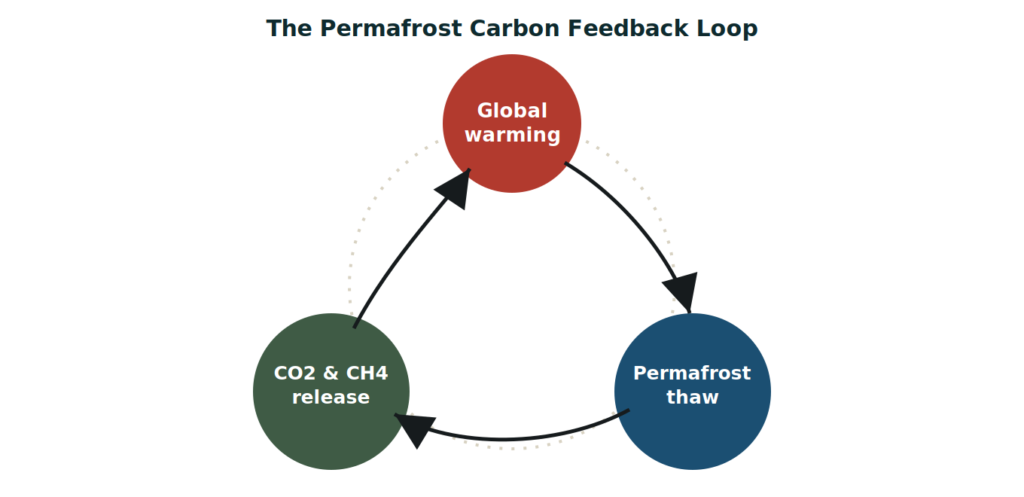
Source: Brovkin et al., “Permafrost and Freshwater Systems in the Arctic as Tipping Elements,” Surveys in Geophysics, 2025 (Max Planck Institute for Meteorology).
Whether permafrost thaw constitutes a true climate “tipping point” is still an active area of research. A 2025 review from the Max Planck Institute for Meteorology, published in Surveys in Geophysics, concluded that permafrost carbon loss is gradual and largely irreversible at the global scale, but can be abrupt at the local scale – for example, through thermokarst collapse, where ground literally caves in as ice-rich soil melts, as seen at Siberia’s rapidly growing Batagaika Crater. Separate 2026 research on old carbon loss suggests some tundra ecosystems could cross a threshold, within roughly 2–4°C of additional warming, where they flip from being a net carbon sink to a net carbon source.
| WHY THIS MATTERS BEYOND THE ARCTIC Arctic and boreal ecosystems have relatively little buffering capacity, so warming translates into faster, more visible ecological change there than almost anywhere else – shifting the timing of snowmelt, expanding shrub cover into former tundra, and altering habitat for species from caribou to migratory shorebirds. |
Forests and Land Ecosystems in Transition
Forest ecosystems are also on the move, just more slowly than animals or ocean plankton. Tree species have specific temperature and moisture requirements for growth and reproduction, and as those thermal zones shift poleward and upslope, forest composition shifts with them. Research drawing on Lawrence Berkeley National Laboratory’s historical vegetation data shows that tree and plant ranges moved poleward during past 20th-century warming phases (1930–1945 and 1975–1999) and retreated during a mid-century cooling period – a natural experiment confirming that vegetation reliably tracks temperature over time.
Today’s warming is layering on top of other stressors: longer fire seasons, more frequent drought, and pest outbreaks (such as bark beetles, whose populations are no longer reliably controlled by cold winters) are compounding heat stress in forests from the American West to Siberia. The result in many regions is not just a shift in species range but a change in forest structure itself – from denser, mixed-species stands to more fire-adapted or drought-tolerant vegetation.
Ocean Ecosystems Beyond Coral: Acidification and Marine Heatwaves
Oceans have absorbed more than 90% of the excess heat trapped by rising greenhouse gas concentrations, and 2025 set a new record for global ocean heat content. That heat doesn’t stay evenly distributed – it increasingly arrives in marine heatwaves, prolonged periods of anomalously warm ocean water. According to the 2025 update of the Indicators of Global Climate Change report, the number of days per year experiencing marine heatwave conditions has more than tripled between 1991 and 2025.
Marine heatwaves stress kelp forests, seagrass meadows, and fish spawning grounds in much the same way heat waves stress land ecosystems, while the ocean’s absorption of excess atmospheric carbon dioxide is also driving ocean acidification, which makes it harder for shellfish, corals, and some plankton species to build their calcium carbonate shells and skeletons. Together, warming and acidification are compounding stressors on the base of the marine food web.
Why Ecosystem Disruption Matters for People
Ecosystem change is not only a story about wildlife – healthy ecosystems underpin food security, clean water, coastal protection, and regional economies. The IPCC’s Working Group II assessment on Impacts, Adaptation and Vulnerability describes climate change as already causing dangerous disruption to nature that is affecting billions of people. Coastal fisheries dependent on coral reefs, farming communities relying on stable growing seasons, and Indigenous and local communities whose livelihoods are tied to specific ecosystems are all exposed to these shifts well before most of the wider public notices them.
“Natural ecosystems are strongly affected, with an unprecedented collapse in biodiversity… the rate of species extinction across the globe is tens to hundreds of times higher than the average rate over the past 10 million years, and is accelerating.” – Summary of findings referenced in IPCC and IPBES global assessments
Can Ecosystems Adapt? Resilience, Limits, and Tipping Points
Ecosystems and species are not passive. Range shifts, changes in breeding timing, and even rapid genetic adaptation are all real, documented responses to warming. Some ecosystems show meaningful resilience – reef sites that have been through repeated heat stress sometimes show partial recovery between events, and some tree and bird populations have adjusted their ranges quickly enough to track shifting climate zones.
But adaptation has limits. Three factors determine whether a species or ecosystem can keep pace with rising global temperatures:
1. Speed of change
The current rate of warming is unusually fast by geological standards, leaving many species with little evolutionary or behavioral time to respond.
2. Ability to move
Mobile species – many birds, fish, and flying insects – can track shifting climate zones. Slow-dispersing species, including many trees, amphibians, and soil-dependent plants, often cannot relocate fast enough.
3. Availability of somewhere to go
A species can only shift its range if suitable habitat exists at the new location – something increasingly complicated by human land use, fragmented habitats, and the simple fact that species already living near mountaintops or polar regions eventually run out of “up” or “north” to go.
When these limits are exceeded, scientists warn ecosystems can cross tipping points – thresholds beyond which a system shifts into a fundamentally different, often self-reinforcing state that is difficult or impossible to reverse on human timescales. Near-annual coral bleaching, permafrost carbon release, and large-scale forest dieback are all discussed in current research as candidate examples of this kind of abrupt, hard-to-reverse ecological change.
| ABOUT THIS ARTICLE This article synthesizes findings from primary sources including NASA’s Goddard Institute for Space Studies, NOAA’s National Centers for Environmental Information and Coral Reef Watch program, the World Meteorological Organization, the Intergovernmental Panel on Climate Change, and peer-reviewed research published in journals including Nature Climate Change, PNAS, Coral Reefs, and Surveys in Geophysics. All statistics are linked to their original source in the references below. Last fact-checked against source data in August 2026. |
Frequently Asked Questions
How much has the Earth’s temperature actually risen?
Global average surface temperature in 2025 was about 1.44°C above the 1850–1900 pre-industrial baseline, based on the World Meteorological Organization’s consolidated analysis of eight independent datasets, including NASA, NOAA, and Copernicus. The three-year average for 2023–2025 was approximately 1.48°C above pre-industrial levels, and 2015–2025 contains the eleven warmest years ever recorded.
Which ecosystems are most affected by rising temperatures?
Coral reefs, Arctic and polar ecosystems, mountain and alpine habitats, and boreal forests are among the most affected. Coral reefs are especially vulnerable because even small, sustained increases in ocean temperature can trigger mass bleaching, while Arctic ecosystems face outsized change because that region is warming roughly four times faster than the global average.
Are species actually migrating because of climate change?
Yes. Researchers have documented more than 12,000 marine and terrestrial species shifting their ranges, generally toward the poles or to higher elevations, as they track the climate conditions they’re adapted to. Marine species and birds tend to show the clearest and fastest shifts, while many tropical and low-mobility species face greater risk because they have less room to move.
Can ecosystems adapt to rising global temperatures?
Some species and ecosystems can adapt through range shifts, behavioral changes, or genetic adaptation, but the current pace of warming is outrunning what many species can track. Once warming pushes an ecosystem past a critical threshold – such as repeated annual coral bleaching or widespread permafrost thaw – the resulting change can become an ecological tipping point that is difficult or impossible to reverse.
The Bottom Line
Rising global temperatures are not a distant threat to ecosystems – they are an active, measurable, and accelerating force reshaping coral reefs, forests, oceans, and polar landscapes right now. The data from NASA, NOAA, WMO, and the IPCC tell a consistent story: warming is unevenly distributed, its ecological effects are compounding, and the window for many species to adapt is narrowing. Understanding how climate change is reshaping ecosystems isn’t just a scientific exercise – it’s foundational to protecting the food systems, coastlines, and biodiversity that human societies depend on.
Sources & References
- World Meteorological Organization (WMO). WMO Confirms 2025 Was One of Warmest Years on Record, 2026. https://wmo.int/news/media-centre/wmo-confirms-2025-was-one-of-warmest-years-record
- NASA Goddard Institute for Space Studies (GISS). Global Temperature – Earth Indicator, GISTEMP v4, 2026. https://science.nasa.gov/earth/explore/earth-indicators/global-temperature/
- NOAA National Centers for Environmental Information. Assessing the Global Climate in 2025, 2026. https://www.ncei.noaa.gov/news/global-climate-202513
- NOAA Coral Reef Watch. Current Global Bleaching: Status Update, 2026. https://coralreefwatch.noaa.gov/satellite/research/coral_bleaching_report.php
- NOAA NESDIS. World’s Fourth Mass Coral Bleaching Event Likely Ended in 2025. https://www.nesdis.noaa.gov/news/worlds-fourth-mass-coral-bleaching-event-likely-ended-2025
- International Coral Reef Initiative (ICRI). 84% of the World’s Coral Reefs Impacted in the Most Intense Global Coral Bleaching Event Ever, 2025. https://icriforum.org/4gbe-2025/
- Springer Nature, Coral Reefs journal. The 4th Global Coral Bleaching Event: Ushering in an Era of Near-Annual Bleaching, 2026. https://link.springer.com/article/10.1007/s00338-025-02810-x
- BirdLife International. Climate Change Is Driving Poleward Shifts in the Distributions of Species. https://datazone.birdlife.org/sowb/casestudy/climate-change-is-driving-poleward-shifts-in-the-distributions-of-species
- Poleward Bound: Adapting to Climate-Driven Species Redistribution. PMC. https://pmc.ncbi.nlm.nih.gov/articles/PMC8006506/
- Species Range Shifts Often Speed Ahead of Their Modeled Climatic Niches. PNAS, 2026. https://www.pnas.org/doi/10.1073/pnas.2515903123
- Brovkin, V., Bartsch, A., Hugelius, G. et al. Permafrost and Freshwater Systems in the Arctic as Tipping Elements of the Climate System. Surveys in Geophysics, Max Planck Institute for Meteorology, 2025. https://link.springer.com/article/10.1007/s10712-025-09885-9
- Permafrost Tipping Point Triggered by Warming-Driven Loss of Old Carbon, 2026. https://eco-news.space/2026/ecology/permafrost-tipping-point-triggered-by-warming-driven-loss-of-old-carbon/
- Copernicus/ESSD. Indicators of Global Climate Change 2025: Annual Update of Key Indicators of the State of the Climate System. https://essd.copernicus.org/articles/18/3889/2026/
- Intergovernmental Panel on Climate Change (IPCC). Official reports and assessment cycle updates. https://www.ipcc.ch/2025/
- Climate Change Academy. Climate Change and the Poleward Shift of Forest Vegetation, citing Lawrence Berkeley National Laboratory research, 2026. https://climatechange.academy/impacts-of-climate-change/climate-change-poleward-shift-forest-vegetation/
- Carbon Brief. State of the Climate: 2025 in Top-Three Hottest Years on Record as Ocean Heat Surges, 2026. https://www.carbonbrief.org/state-of-the-climate-2025-in-top-three-hottest-years-on-record-as-ocean-heat-surges/
Data current as of August 2026. Figures and trend lines are simplified, source-linked illustrations created for this article, not raw agency datasets – consult primary sources above for full-resolution data.