









When most people picture a zero-emission car, they picture a Tesla plugged into a wall charger overnight. That mental shortcut is fair – battery electric vehicles (BEVs) have won the mainstream conversation. But there is a second, quieter zero-emission technology that has been on public roads since 2015 and is now scaling fast in trucking, buses, and rail: the hydrogen fuel cell vehicle (FCEV).
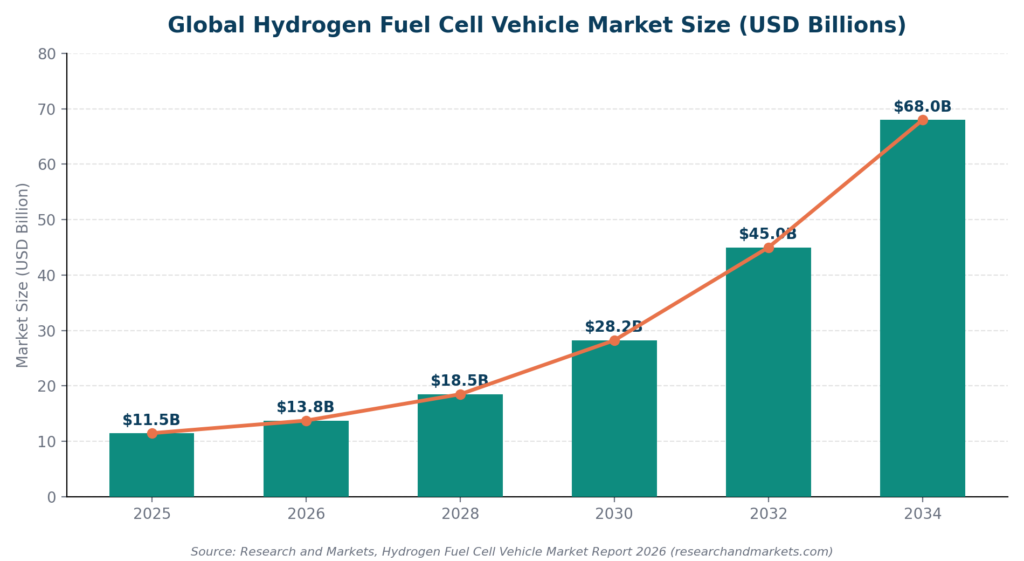
A hydrogen fuel cell vehicle doesn’t burn fuel and doesn’t plug in. Instead, it carries compressed hydrogen gas in an onboard tank, converts that hydrogen into electricity on the fly through a fuel cell stack, and uses that electricity to power an electric motor – emitting nothing but warm air and water vapor from the tailpipe. The global hydrogen fuel cell vehicle market is projected to grow from roughly $11.5 billion in 2025 to $28.2 billion by 2030, a compound annual growth rate near 20%, according to industry analysis from Research and Markets. This guide breaks down exactly how the technology works, how it stacks up against battery EVs, and whether hydrogen deserves a place in your next-vehicle shortlist.
What Is a Hydrogen Fuel Cell Vehicle?
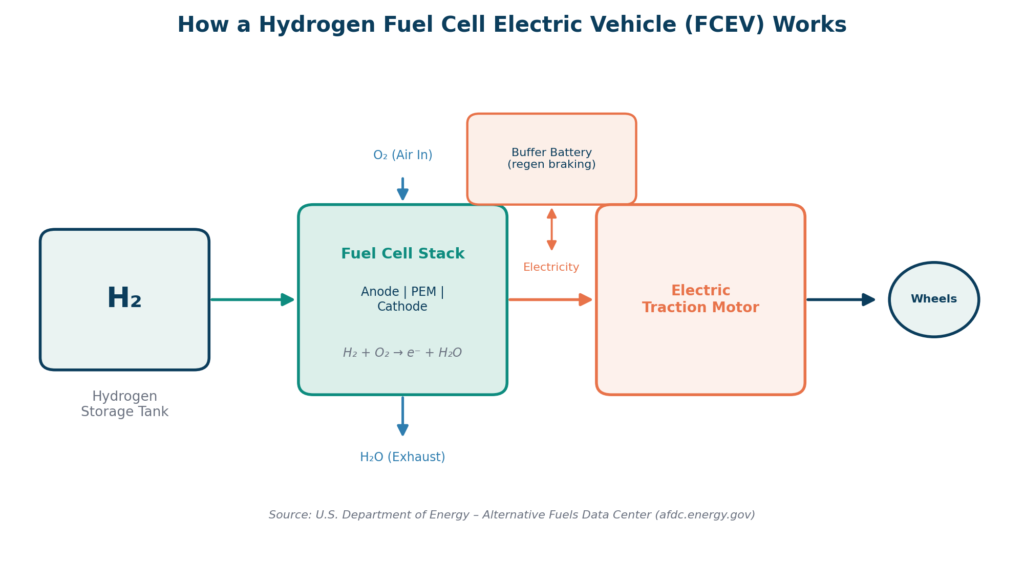
A hydrogen fuel cell electric vehicle (FCEV) is an electric vehicle that generates its own electricity onboard using hydrogen, rather than storing that electricity in a large battery pack the way a BEV does. According to the U.S. Department of Energy’s Alternative Fuels Data Center (AFDC), FCEVs use a propulsion system similar to that of all-electric vehicles, but they produce electricity using a fuel cell powered by hydrogen instead of drawing it solely from a battery.
Inside the fuel cell stack, hydrogen from the tank meets oxygen pulled from the surrounding air across a proton exchange membrane (PEM). This electrochemical reaction strips electrons from hydrogen atoms, forcing them through an external circuit to power the electric motor before recombining with protons and oxygen to form the only byproduct: water. A small buffer battery, similar in concept to a hybrid car’s battery, captures energy from regenerative braking and smooths out power delivery, but it is not meant to be plugged in or charged directly on most current models.
Fuel Cell Vehicles vs. Battery Electric Vehicles vs. Hybrids
It helps to place FCEVs on a spectrum of electrified vehicles. A conventional hybrid still burns gasoline and simply uses a small battery to assist the engine. A plug-in hybrid adds an external charging port but keeps the gas engine as backup. A battery electric vehicle removes the engine entirely and relies on a large lithium-ion pack charged from the grid. A hydrogen fuel cell vehicle also removes the engine, but instead of a large plug-in battery, it manufactures its own electricity onboard from compressed hydrogen – which is why the U.S. Department of Energy and the California Air Resources Board (CARB) both classify FCEVs as true zero-emission vehicles (ZEVs), on equal regulatory footing with BEVs.
How Big Is the Hydrogen Vehicle Market Right Now?
Hydrogen mobility is still a small slice of the overall zero-emission vehicle market, but it is growing quickly from that small base. Market research firm Research and Markets values the global hydrogen fuel cell vehicle market at approximately $13.75 billion in 2026, up from $11.48 billion in 2025, and forecasts it will reach $28.23 billion by 2030 – a compound annual growth rate of roughly 19.7%. Longer-range forecasts from Precedence Research put the market as high as $205 billion by 2035, driven heavily by commercial and heavy-duty vehicle adoption rather than passenger cars.
Asia-Pacific currently dominates hydrogen vehicle adoption. Japan, South Korea, and China have each made hydrogen a pillar of national industrial and energy-security policy, and the region accounted for roughly half of global FCEV market share in recent industry assessments. In the United States, the Bipartisan Infrastructure Law earmarked about $9.5 billion for hydrogen initiatives, including $7 billion for regional Clean Hydrogen Hubs intended to build out production and distribution infrastructure.
Key Benefits of Hydrogen Fuel Cell Vehicles
1. Fast Refueling, Comparable to Gasoline
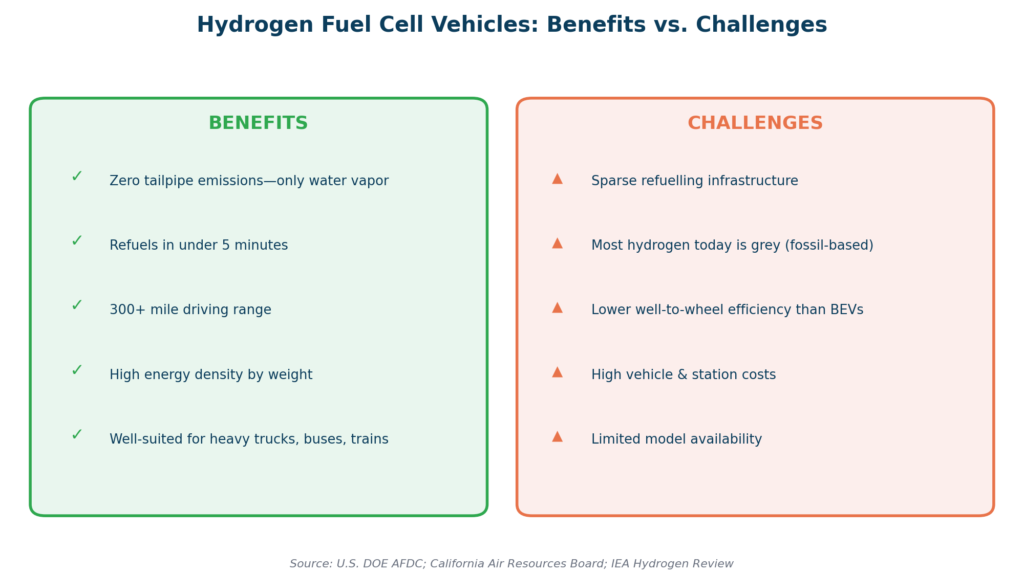
This is the single biggest practical advantage FCEVs hold over battery EVs. According to the Department of Energy, drivers can refuel an FCEV in less than five minutes at a hydrogen dispenser that looks and operates much like a gasoline pump, aside from the high-pressure gaseous connection. That is a dramatic difference from even the fastest DC fast chargers, which typically need 20–40 minutes to add meaningful range to a battery EV.
2. Long Driving Range With No Weight Penalty
FCEVs commonly deliver more than 300 miles of range per tank, and because hydrogen carries far more energy per kilogram than a lithium-ion battery, adding range doesn’t require adding hundreds of pounds of battery cells. That makes hydrogen fuel cells particularly attractive for heavy-duty and long-haul applications, such as freight trucks, where battery weight competes directly with cargo capacity.
3. Genuinely Zero Tailpipe Emissions
An FCEV’s only tailpipe output is water vapor and warm air. There is no combustion, and no CO2, particulate matter, or nitrogen oxide leaves the vehicle. This is why hydrogen vehicles qualify for the same zero-emission vehicle (ZEV) credits and incentives as battery EVs in markets like California.
4. A Natural Fit for Heavy Transport
While passenger hydrogen cars remain niche, fuel cell electric trucks are gaining real traction. Market research from Coherent Market Insights shows fuel cell electric trucks holding an estimated 65.8% share of the hydrogen trucks market in 2026, with heavy-duty trucks over 16 tons and long-haul routes as the leading use cases – precisely the segment where battery weight and charging downtime hurt BEVs the most.
Hydrogen Fuel Cell vs. Battery Electric: The Efficiency Question
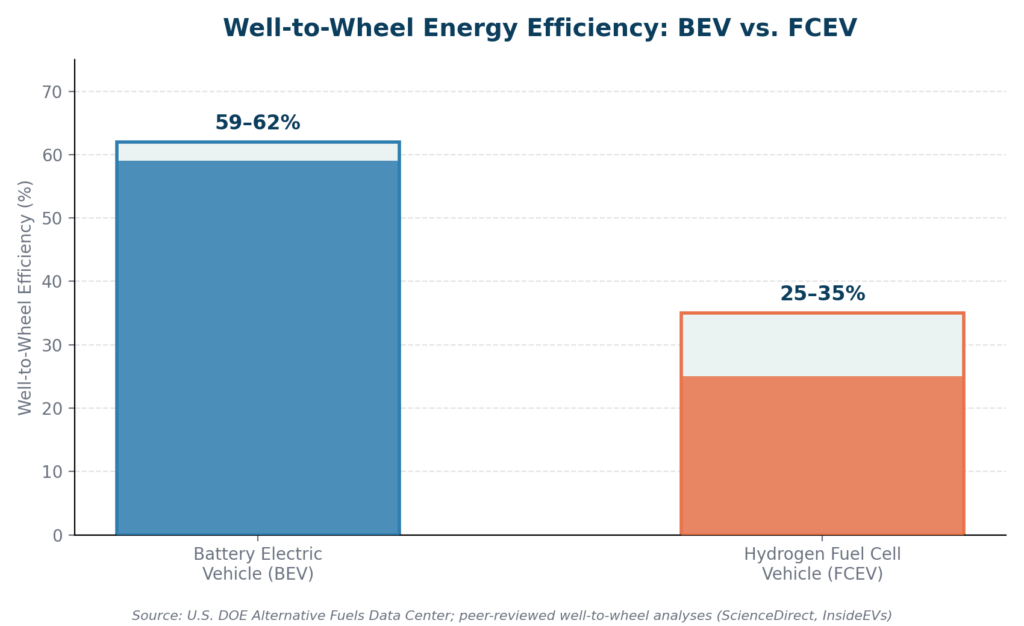
The most important, and most debated, comparison in the zero-emission vehicle conversation is energy efficiency – how much of the original energy input actually reaches the wheels. Here, battery electric vehicles hold a clear and well-documented advantage. According to the DOE’s Alternative Fuels Data Center and multiple peer-reviewed well-to-wheel studies, BEVs convert roughly 59–62% of grid electricity into motion at the wheels. FCEVs, by contrast, typically convert only 25–35% of the original energy input, once you account for the electrolysis, compression, transport, and fuel-cell conversion losses along the way.
In practical terms, this means it currently takes two to three times more renewable electricity to move a hydrogen car one mile than it does to move a comparable battery EV the same distance. That efficiency gap is the central reason most energy analysts, including researchers cited by Interesting Engineering and InsideEVs, expect battery power to remain dominant for passenger cars, while hydrogen carves out a role in applications where refueling speed and range matter more than raw efficiency – long-haul trucking, buses, trains, shipping, and aviation.
Where Hydrogen Still Wins
- Refueling time: under 5 minutes vs. 20+ minutes for DC fast charging
- Range per fill for heavy vehicles without adding battery weight
- Cold-weather performance, since fuel cells are less sensitive to temperature-driven range loss than lithium-ion batteries
- Duty cycles with limited downtime, such as long-haul freight, transit buses, and forklifts
Not All Hydrogen Is Equally Clean
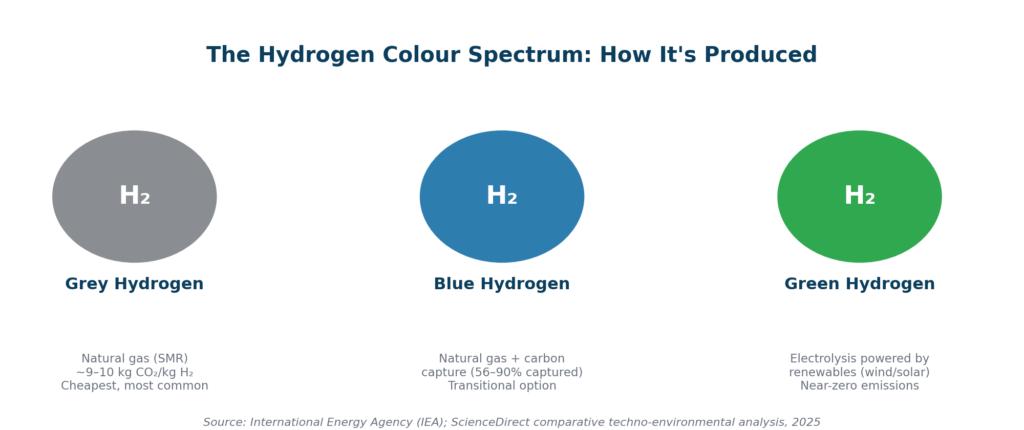
A hydrogen fuel cell vehicle’s real-world climate benefit depends entirely on how the hydrogen in its tank was produced. The industry describes this using a color-coding system. Grey hydrogen, made from natural gas through steam methane reforming, is the cheapest and most common form today but releases roughly 9–10 kg of CO2 for every kilogram of hydrogen produced, according to industry emissions analysis. Blue hydrogen uses the same natural-gas process but captures a portion of that CO2 – typically 56% to 90%, per a 2025 ScienceDirect techno-environmental comparison – making it a transitional but still fossil-dependent option. Green hydrogen, produced by splitting water via electrolysis powered by renewable electricity, is the only pathway that is genuinely near-zero-emission across its full production cycle.
The catch is availability and cost. Green hydrogen production has historically cost around $4–$8 per kilogram, well above grey hydrogen, although falling solar and wind electricity prices – in some cases below $20 per megawatt-hour in the best resource locations – are pushing green hydrogen production costs down toward $2–$3 per kilogram in the most favorable regions. Until green hydrogen scales up and becomes cost-competitive, the lifecycle emissions advantage of driving an FCEV over a modern gasoline hybrid is smaller than many buyers assume.
Hydrogen Refueling Infrastructure: The Real Bottleneck
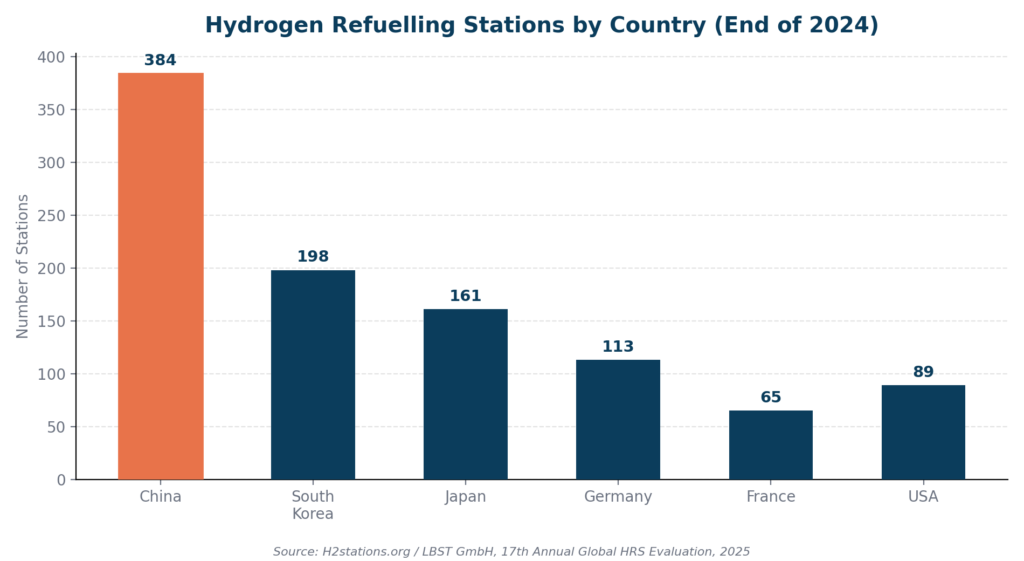
Vehicle technology isn’t the limiting factor for hydrogen adoption – infrastructure is. According to H2stations.org, an information service run by LBST GmbH that has tracked the industry for 17 consecutive years, the world crossed a milestone of roughly 1,160 operating hydrogen refueling stations by the end of 2024, spread across 45 countries. That sounds like meaningful progress until you compare it with the more than 80,000 DC fast-charging ports and well over a million charging connectors of all types installed worldwide for battery EVs.
The distribution is also extremely concentrated. Just five countries – China, South Korea, Japan, France, and Germany – account for roughly 79% of all hydrogen stations globally, per Interact Analysis research. China alone operates 384 stations, South Korea 198, and Japan 161. In the United States, the picture is starker still: only 89 stations were operating at the end of 2024, and the vast majority of those are concentrated in California, with the network effectively nonexistent elsewhere in the country.
Why This Matters for Buyers
If you don’t live within easy driving distance of a hydrogen station, an FCEV simply isn’t a workable daily vehicle today – there’s no equivalent of a home Level 2 charger for hydrogen. This is the single biggest practical reason hydrogen passenger cars remain a regional product, sold almost exclusively in and around California, Japan, South Korea, and parts of Europe, rather than a nationwide option the way BEVs increasingly are.
Benefits and Challenges at a Glance
Which Hydrogen Fuel Cell Vehicles Can You Actually Buy?
The passenger FCEV lineup remains small compared with battery EVs, but a handful of established models are commercially available in select markets:
- Toyota Mirai – Toyota’s second-generation hydrogen sedan, rated for roughly 400+ miles of range on some trims, sold primarily in California, Japan, and parts of Europe.
- Hyundai Nexo – A hydrogen-powered crossover SUV with roughly 380 miles of EPA-estimated range, one of the longest-range zero-emission vehicles sold in the U.S. in either battery or hydrogen form.
- Honda CR-V e:FCEV – A plug-in hybrid/hydrogen hybrid crossover that combines a fuel cell with a plug-in battery, offered in limited U.S. and Japanese markets.
Beyond passenger cars, the more active commercial rollout is happening in buses, refuse trucks, forklifts, and long-haul freight trucks from manufacturers including Hyundai, Toyota, Daimler Truck, and Hyzon, where hydrogen’s fast refueling and weight advantages matter most.
Is Hydrogen Safe?
Hydrogen’s flammability understandably raises questions, but production FCEVs are engineered with multiple redundant safety systems. Hydrogen tanks are made from carbon-fiber-reinforced composite material designed to withstand extreme impacts, and vehicles undergo the same crash-testing standards as any other car sold in their market. Because hydrogen is the lightest element and disperses upward rapidly in open air rather than pooling like gasoline vapor, safety researchers generally consider leaks in open environments to dissipate quickly. As with any energy-dense fuel, professional installation and maintenance of fueling infrastructure remain essential, which is part of why station rollout has been deliberately gradual.
Frequently Asked Questions
Are hydrogen fuel cell vehicles better than electric cars?
Neither is universally “better” – they solve different problems. Battery EVs are more energy-efficient and benefit from a much larger charging network, making them the stronger choice for most daily passenger driving. FCEVs refuel faster and handle long range without added weight, which makes them more competitive for heavy-duty trucking, buses, and other high-utilization commercial applications.
How much does it cost to fuel a hydrogen car?
Retail hydrogen prices have varied significantly by region and have at times exceeded $12–$16 per kilogram in California, though industry roadmaps and expanding green hydrogen production aim to bring delivered station prices down toward $4–$6 per kilogram by 2030 under favorable infrastructure investment scenarios.
Do hydrogen cars pollute the environment?
The vehicle itself emits only water vapor. However, if the hydrogen used to fuel it was produced from natural gas (grey hydrogen) without carbon capture, the production process upstream still generates significant CO2. The vehicle’s true lifecycle footprint depends on the hydrogen’s source, not just the tailpipe.
Why aren’t there more hydrogen fueling stations?
Building a hydrogen station is capital-intensive – industry estimates put the cost of a single hydrogen refueling station in the range of roughly $1.5–2 million, compared with tens of thousands of dollars for a DC fast charger. That cost gap, combined with lower vehicle volumes, has slowed the network’s growth relative to EV charging.
The Road Ahead for Hydrogen Mobility
Most credible energy-sector forecasts, including analysis referenced by the International Energy Agency, converge on a similar conclusion: battery electric vehicles will likely remain the dominant zero-emission technology for passenger cars, while hydrogen fuel cells find their strongest long-term role in long-haul trucking, buses, trains, maritime shipping, and aviation – use cases where fast refueling and weight-free range outweigh the efficiency penalty. That doesn’t make hydrogen a dead end; it makes it a complementary technology rather than a head-to-head competitor to the BEV.
For everyday drivers, the practical decision usually comes down to geography and infrastructure. If you live near an established hydrogen refueling network – realistically, parts of California, Japan, South Korea, or a handful of European countries – an FCEV can offer a gasoline-like ownership experience with genuinely zero tailpipe emissions. Everywhere else, battery electric vehicles remain the far more practical zero-emission choice today, at least until the hydrogen refueling map fills in.
References and Sources
1. U.S. Department of Energy, Alternative Fuels Data Center. “Fuel Cell Electric Vehicles.” https://afdc.energy.gov/vehicles/fuel-cell
2. U.S. Department of Energy, Alternative Fuels Data Center. “How Do Fuel Cell Electric Cars Work Using Hydrogen?” https://afdc.energy.gov/vehicles/how-do-fuel-cell-electric-cars-work
3. U.S. Department of Energy. “Energy By The Numbers: Fuel Cell Electric Vehicles.” https://www.energy.gov/cmei/fuels/articles/energy-numbers-fuel-cell-electric-vehicles
4. California Air Resources Board. “Hydrogen Fuel Cell Electric Vehicle 101,” ZEV TruckStop. https://ww2.arb.ca.gov/our-work/programs/truckstop-resources/zev-truckstop/zev-101/hydrogen-fuel-cell-electric-vehicle-101
5. Research and Markets. “Hydrogen Fuel Cell Vehicle Market Report 2026.” https://www.researchandmarkets.com/reports/5785493/hydrogen-fuel-cell-vehicle-market-report
6. Precedence Research. “Hydrogen Fuel Cell Vehicle Market Size to Hit USD 205.5 Billion by 2035.” https://www.precedenceresearch.com/hydrogen-fuel-cell-vehicle-market
7. Coherent Market Insights. “Hydrogen Trucks Market Trends, Share and Forecast, 2026–2033.” https://www.coherentmarketinsights.com/industry-reports/hydrogen-trucks-market
8. H2stations.org / LBST GmbH. “Milestone Reached: Over 1,000 Hydrogen Refuelling Stations in Operation Worldwide in 2024.” https://www.h2stations.org/press-release-2025-milestone-reached-over-1000-hydrogen-refuelling-stations-in-op-eration-worldwide-in-2024/
9. Interact Analysis. “Nearly 80% of Global Hydrogen Refueling Stations Are Located in Just Five Countries.” https://interactanalysis.com/insight/80-of-global-hydrogen-refueling-stations-are-located-in-just-five-countries/
10. ScienceDirect. “Comparative Techno-Environmental Analysis of Grey, Blue, Green/Yellow and Pale-Blue Hydrogen Production.” https://www.sciencedirect.com/science/article/pii/S0360319925011991
11. Interesting Engineering. “Electric Cars vs Hydrogen Cars: The Real Winner Is Becoming Clear.” https://interestingengineering.com/transportation/electric-cars-vs-hydrogen-cars
12. InsideEVs. “Battery Electric vs Hydrogen Fuel Cell: Efficiency Comparison.” https://insideevs.com/news/406676/battery-electric-hydrogen-fuel-cell-efficiency-comparison/
13. arXiv. “Techno-Economic Analysis of Hydrogen Production: Costs, Policies, and Scalability in the Transition to Net-Zero.” https://arxiv.org/pdf/2502.12211
This article is for general informational purposes and reflects publicly available data as of August 2026. Vehicle pricing, incentives, and station counts change frequently – verify current figures with manufacturers and local hydrogen infrastructure authorities before making a purchase decision.