







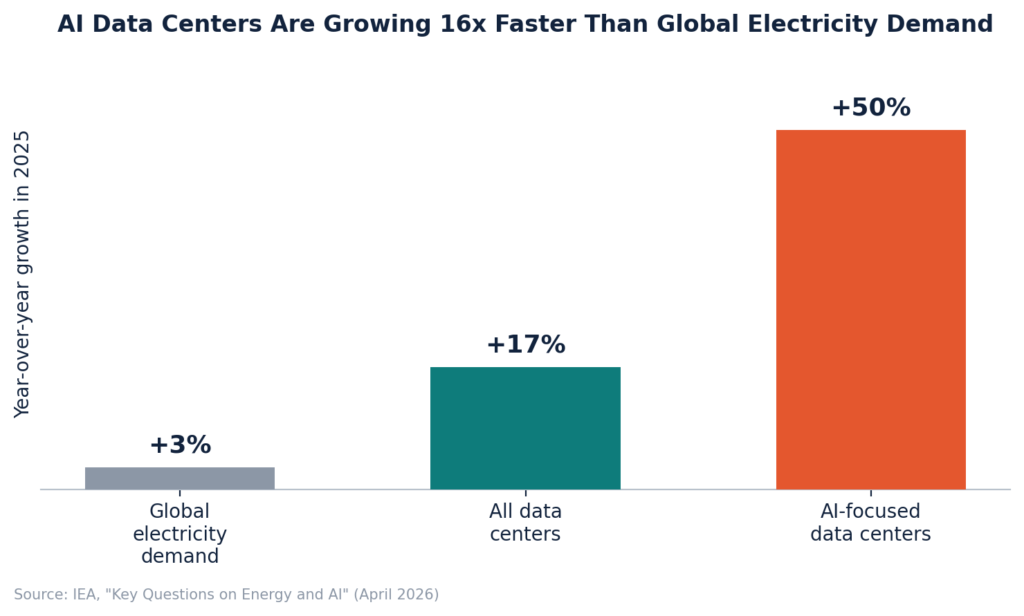
Every ChatGPT reply, every Gemini image, every AI agent quietly working through a spreadsheet draws real electricity from a real power plant somewhere. In 2025 alone, electricity use at AI-focused data centers jumped 50% – sixteen times faster than global electricity demand grew overall. At the same time, the machine learning models running inside those buildings are being used to forecast hurricanes ten days out in under a minute, cut data center cooling bills by 40%, and help grid operators fold more wind and solar onto the grid without blackouts.
So which is it – is artificial intelligence the thing that finally breaks an already-strained power grid, or the tool that helps decarbonize it fast enough to matter? The honest answer, backed by the latest data from the International Energy Agency (IEA), Lawrence Berkeley National Laboratory (LBNL), and Google DeepMind, is: both, at the same time, in the same buildings. This article breaks down the real numbers behind AI’s data center energy consumption, the concrete ways machine learning is being used to fight climate change, and whether efficiency gains can plausibly outrun the demand AI itself is creating.
The Numbers Behind the Headline: How Big Is the Data Center Energy Problem?
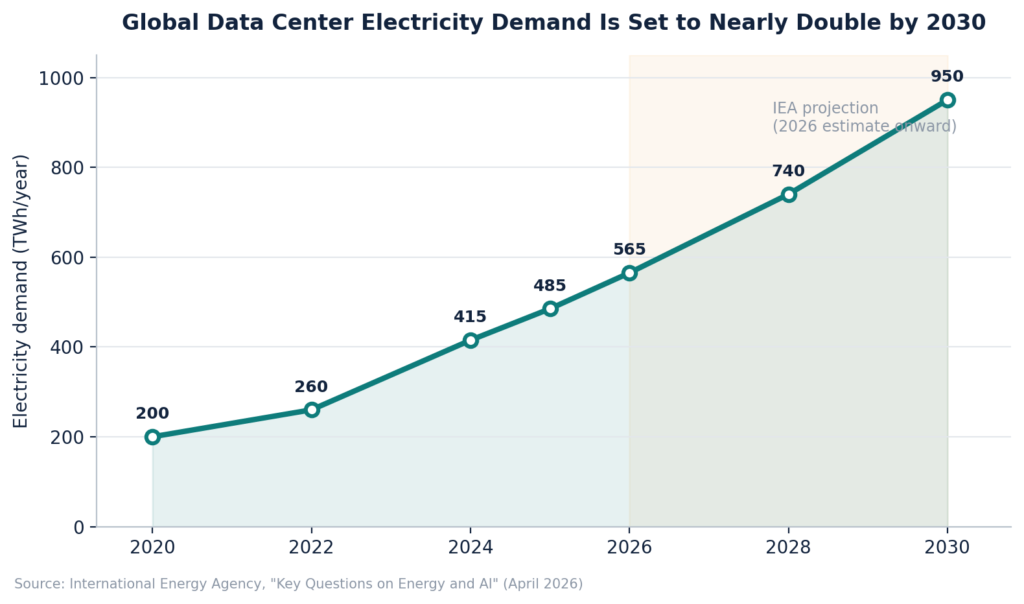
Data center electricity demand is not a fringe concern anymore – it is a mainstream grid-planning problem. According to the IEA’s April 2026 report, Key Questions on Energy and AI, global data center electricity demand grew 17% in 2025 to roughly 485 terawatt-hours (TWh), and the agency now projects that figure will nearly double to about 950 TWh by 2030 – a level of consumption comparable to the current electricity demand of an entire industrialized country like Japan.
What is driving that growth is not data centers in general – it is AI specifically. AI-optimized data centers grew their electricity consumption by 50% in 2025 alone, according to the IEA, and AI-focused facilities are expected to triple in number by 2030. In the United States, data centers consumed about 176 TWh in 2023 (4.4% of total U.S. electricity), and Lawrence Berkeley National Laboratory projects that share could climb to between 6.7% and 12% by 2028 as AI workloads scale.
Put another way: AI data centers are not just adding to electricity demand, they are reshaping the growth curve of global power consumption itself.
Why AI Workloads Hit the Grid Differently
Training and running large language models is not like running a traditional office server rack. Between 2020 and 2025, AI server power density increased roughly elevenfold, and the IEA expects a further fourfold jump by 2027 – meaning a single refrigerator-sized server rack can now draw as much power as 65 households combined. Newer accelerator hardware only intensifies this: a single Nvidia Blackwell-class rack can draw 120–140 kilowatts, which is why direct liquid cooling has effectively become mandatory rather than optional for next-generation AI facilities.
Power isn’t the only resource under strain. Data centers also consume enormous volumes of water for cooling – a single large facility can use millions of gallons a day, according to the Environmental and Energy Study Institute (EESI), and the number of U.S. data centers has more than quintupled since 2018, from roughly 1,000 facilities to over 5,400 by early 2025. Local grid operators from Northern Virginia to Ireland (where data centers already account for more than a fifth of national electricity demand) are now openly warning about interconnection queues stretching five to eight years and wholesale power prices near hyperscale campuses rising as much as 267% since 2020.
“The speed of the AI revolution is increasingly contrasting with the speed of the physical, social and economic systems that underpin it.” – International Energy Agency, Key Questions on Energy and AI (2026)
The Case for Optimism: How Machine Learning Is Already Fighting Climate Change
Here is the part of the story that rarely makes the headlines: the same machine learning techniques that are straining the grid are simultaneously among the most promising tools available for decarbonizing it, forecasting climate risk, and squeezing waste out of energy systems that have run inefficiently for decades.
1. Smarter Cooling Slashes a Data Center’s Own Energy Bill
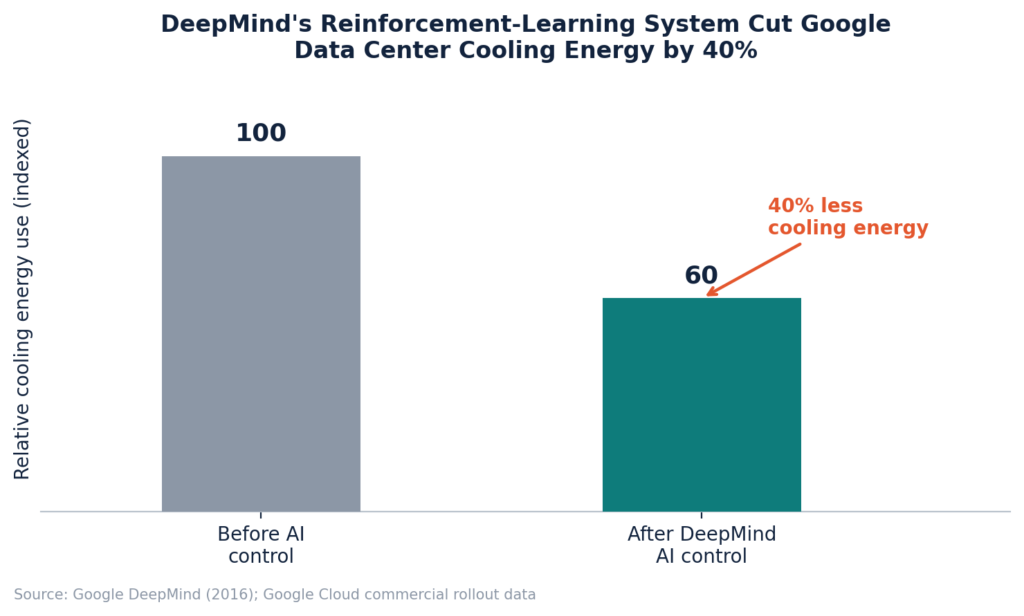
The most famous example remains Google DeepMind’s 2016 project, in which a deep reinforcement learning system was trained on historical sensor data – temperatures, power draw, pump speeds – to control Google’s data center cooling systems automatically. The result was a 40% reduction in the energy used for cooling and a 15% reduction in total facility energy overhead. Google Cloud has since commercialized the underlying approach for other industrial and commercial cooling clients, and academic follow-up work (including ‘AI Chiller’ research and Siemens’ AI-powered thermal optimization services) has extended similar techniques to HVAC systems well beyond the data center industry.
2. AI Weather Models Are Making Climate Forecasting Radically Faster
Google DeepMind’s GraphCast, published in Science in 2023, uses a graph neural network trained on four decades of atmospheric reanalysis data to generate a full 10-day global weather forecast covering hundreds of variables at 0.25-degree resolution – in under one minute on a single TPU. Independently verified benchmarks found GraphCast outperformed the world’s leading physics-based forecasting system (the ECMWF’s HRES model) on about 90% of more than 1,380 verification targets, with particular strength in predicting tropical cyclone tracks, atmospheric rivers, and extreme heat events. Newer models – FourCastNet, Pangu-Weather, GenCast, and FuXi – are pushing accuracy and speed further still, and several are now being trialed operationally by national weather agencies including the ECMWF.
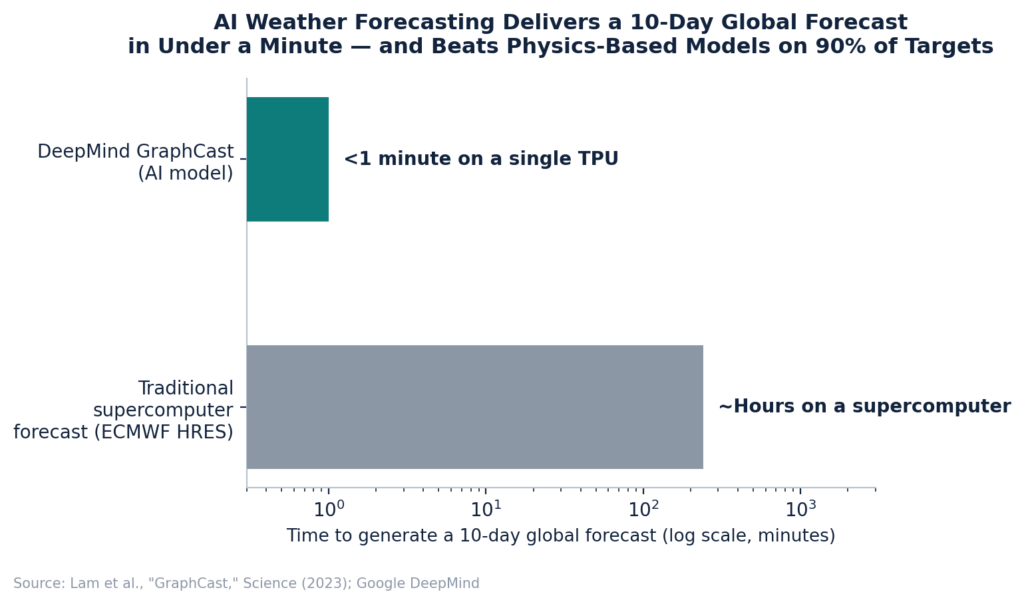
This matters for the climate conversation directly: faster, more accurate storm and heatwave forecasting means earlier evacuations, better renewable-energy output predictions, and more resilient infrastructure planning in a warming world where extreme weather is becoming more frequent.
3. Machine Learning Is Helping Renewable-Heavy Grids Stay Stable
One of the hardest problems in decarbonizing electricity is that wind and solar are intermittent, while grid operators must balance supply and demand in near real time. DeepMind’s collaboration with Google to forecast wind power output 36 hours in advance using neural networks made wind energy meaningfully more predictable and valuable to grid operators. China’s national grid now uses machine-learning-based intelligent dispatch systems to balance supply and demand while minimizing reliance on fossil-fuel ‘peaker’ plants, and recent NeurIPS-published research (2025) shows that models trained to solve AC optimal power-flow problems can cut wasted electricity generation by a margin that far outweighs the carbon cost of training the model in the first place.
4. Satellites and AI Are Hunting Methane Leaks From Orbit
Historically, greenhouse gas accounting has relied heavily on self-reported national and corporate estimates – slow, inconsistent, and easy to get wrong. Satellite missions like the European Space Agency’s Sentinel-5P and the nonprofit-backed MethaneSAT now use machine learning to detect methane leaks from individual oil and gas facilities directly from orbit. That matters because methane traps roughly 80 times more heat than carbon dioxide over a 20-year period, making rapid leak detection one of the highest-leverage climate interventions available today.
The Catch: Can Efficiency Gains Actually Outrun AI Demand?
This is where the optimistic story runs into a well-known problem in economics called the Jevons paradox: when a technology becomes more efficient, the resulting drop in cost per use often drives total consumption up faster than the efficiency gain, so overall resource use rises rather than falls. The IEA’s own data shows this pattern playing out in real time – the energy required per AI task is falling by roughly an order of magnitude annually, an efficiency curve the agency calls unprecedented in energy history – yet total data center electricity demand is still climbing steeply, because the number and complexity of AI queries is growing even faster than the per-task savings.
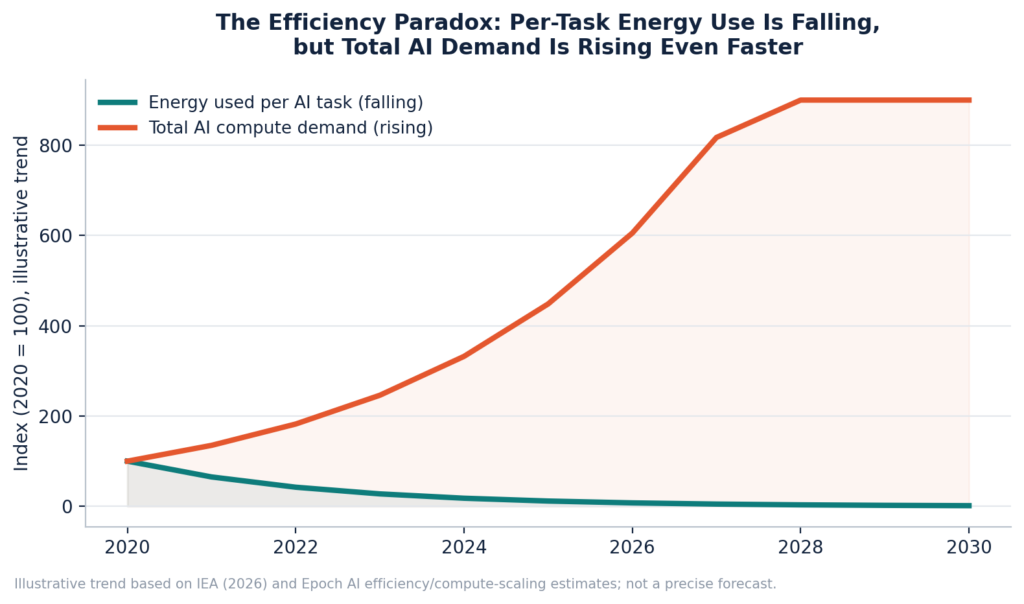
The workload mix compounds the problem. A simple AI text query might use roughly 0.3 watt-hours, but a long agentic task that involves multi-step reasoning can consume around 50 watt-hours – over 150 times more, according to IEA and Epoch AI estimates. As AI shifts from short chatbot replies toward video generation, autonomous agents, and long reasoning chains, average energy-per-query is heading up even as the underlying hardware and models keep getting more efficient. Researchers at Harvard and Meta have also found that embodied carbon – emissions locked into a data center’s construction, servers, and networking hardware – makes up 20% to 30% of a hyperscale facility’s lifetime carbon footprint, a share that is only growing as electricity grids get cleaner.
Powering AI Without Melting the Grid: The Clean-Energy and Nuclear Pivot
Facing multi-year interconnection queues on public grids, hyperscalers have started acting less like utility customers and more like power producers in their own right. Microsoft has signed a deal to restart the Three Mile Island nuclear plant and is investing in Helion’s fusion technology; Amazon has taken a stake in the Susquehanna nuclear plant (1.92 GW) and signed small modular reactor (SMR) agreements with X-energy; Google has partnered with Kairos Power on SMRs; and Meta has lined up as much as 6.6 GW of nuclear capacity across partners including Vistra, Oklo, and TerraPower.
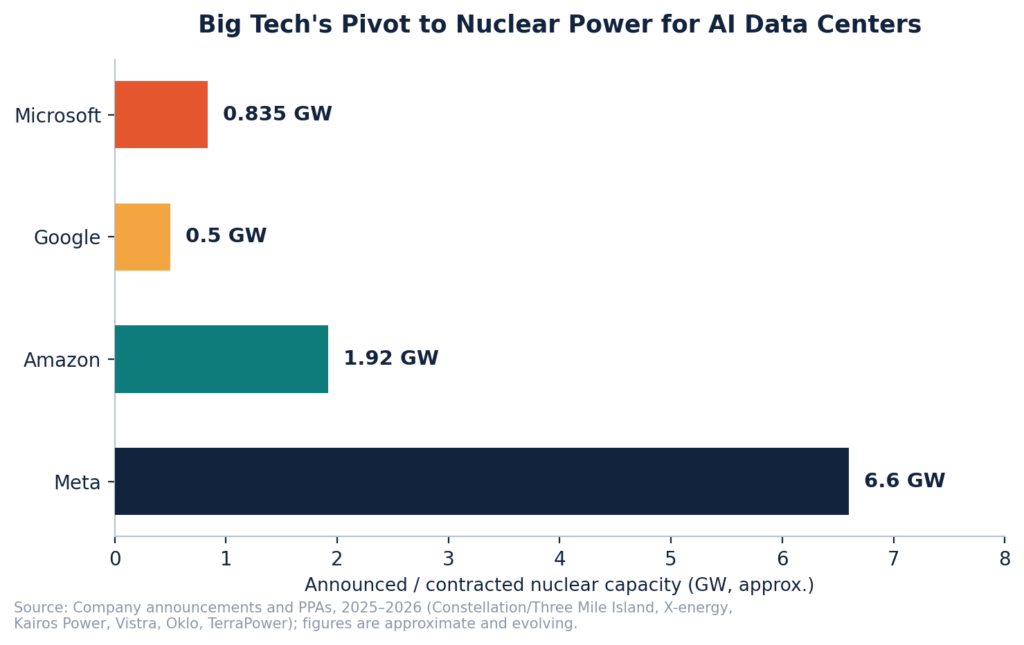
Nuclear power is attractive here because it offers a capacity factor above 90% with zero direct operating emissions – something intermittent wind and solar cannot match for the always-on, gigawatt-scale loads that modern AI training clusters require. The tradeoff is cost and speed: first-of-a-kind SMR electricity currently runs $100–$180 per megawatt-hour, well above existing nuclear ($30–$60) or renewables ($20–$50), and SMR projects still take five to ten years from permitting to operation. In the meantime, natural gas turbines remain the fastest deployable option (12–18 months), which is why many hyperscalers are using gas as a bridge while pursuing longer-term nuclear and renewable power purchase agreements – alongside more prosaic but effective steps like Microsoft’s purchase of 3.5 million carbon credits to offset AI-related operational emissions.
So, Can Machine Learning Save the Planet Before Data Centers Melt the Grid?
The most defensible, evidence-based answer is a qualified yes – but only if efficiency, clean power procurement, and smarter grid management scale as fast as AI adoption itself does. Machine learning is already delivering measurable climate wins: a real 40% cut in data center cooling energy, weather forecasts that are faster and more accurate than physics-based supercomputer models, grid-dispatch systems that reduce fossil-fuel peaker reliance, and satellite-based methane detection that closes a major gap in global emissions accounting. None of that is speculative – it is deployed, peer-reviewed, and in some cases already commercialized.
At the same time, none of it yet fully offsets the growth curve. Global data center electricity demand is genuinely on track to nearly double by 2030, and the IEA is explicit that the pace of AI adoption is outrunning the pace at which grids, permitting systems, and clean-power supply chains can realistically expand. The most credible near-term outcome is not a clean ‘AI saves the planet’ story or a clean ‘AI melts the grid’ story – it is a race between two curves, with the outcome depending heavily on policy choices (transparent energy and water reporting, grid-interconnection reform), corporate choices (procuring genuinely additional clean power rather than just efficiency PR), and technical choices (smaller, more efficient models and demand-response-enabled data centers) made over the next few years.
Key Takeaways
- Global data center electricity demand is projected to nearly double from about 485 TWh in 2025 to roughly 950 TWh by 2030, according to the IEA (2026).
- AI-focused data centers grew electricity consumption by 50% in 2025 – about 16 times faster than overall global electricity demand growth of 3%.
- DeepMind’s AI cooling-control system cut Google data center cooling energy by 40%, and the approach has since been commercialized for other industries.
- AI weather models like GraphCast generate 10-day global forecasts in under a minute and beat traditional supercomputer forecasts on about 90% of accuracy benchmarks.
- Energy use per AI task is falling roughly an order of magnitude per year, but total AI compute demand is rising even faster – a textbook Jevons paradox.
- Hyperscalers including Microsoft, Amazon, Google, and Meta are now signing nuclear and SMR power deals to secure carbon-free, always-on electricity outside constrained public grids.
Frequently Asked Questions
Do AI data centers really use that much electricity?
Yes. According to the IEA’s 2026 report, AI-focused data centers’ electricity consumption grew 50% in 2025 alone, and global data center demand overall is projected to nearly double by 2030 to roughly 950 TWh – about 3% of global electricity demand.
Can machine learning actually reduce carbon emissions?
Yes, in specific, measurable ways: AI-driven cooling control has cut data center cooling energy by up to 40% (Google DeepMind), AI weather forecasting improves renewable energy integration and disaster preparedness, and AI-based grid dispatch systems help utilities rely less on fossil-fuel peaker plants.
What is the Jevons paradox in the context of AI?
It describes how making a technology more efficient can lower its cost per use enough that total usage – and total energy consumption – rises rather than falls. AI shows this pattern: per-task energy use is dropping quickly, but total AI usage is growing even faster, so overall electricity demand keeps climbing.
Why are tech companies building nuclear power plants for AI?
Because AI training clusters need continuous, gigawatt-scale power that intermittent renewables can’t reliably provide alone, and public grid interconnection can take five to eight years. Nuclear offers a capacity factor above 90% with zero direct operating emissions, making it attractive for always-on AI workloads despite higher upfront costs than renewables or gas.
Will AI energy efficiency improvements be enough to offset rising demand?
Not on current trends. The IEA notes that AI hardware and software efficiency is improving by roughly an order of magnitude per year – an unprecedented pace in energy history – but total electricity demand from data centers is still projected to nearly double by 2030 because usage is growing even faster than efficiency.
References
1. Key Questions on Energy and AI – International Energy Agency (IEA), April 2026. https://www.iea.org/reports/key-questions-on-energy-and-ai/executive-summary
2. How much energy do data centers and artificial intelligence use? – Our World in Data. https://ourworldindata.org/how-much-energy-do-data-centers-and-artificial-intelligence-use
3. AI and data centre electricity use continues to surge – IEA, via Enlit World. https://www.enlit.world/library/ai-and-data-centre-electricity-use-continue-to-surge-iea-finds
4. Data Center Energy Needs Could Upend Power Grids and Threaten the Climate – Environmental and Energy Study Institute (EESI). https://www.eesi.org/articles/view/data-center-energy-needs-are-upending-power-grids-and-threatening-the-climate
5. DeepMind AI Reduces Google Data Centre Cooling Bill by 40% – Google DeepMind, 2016. https://deepmind.google/blog/deepmind-ai-reduces-google-data-centre-cooling-bill-by-40/
6. GraphCast: AI model for faster and more accurate global weather forecasting – Google DeepMind. https://deepmind.google/blog/graphcast-ai-model-for-faster-and-more-accurate-global-weather-forecasting/
7. Learning skillful medium-range global weather forecasting (GraphCast) – Lam et al., Science, 2023. https://www.science.org/doi/10.1126/science.adi2336
8. AI-driven Grid Optimization Can Reduce Emissions – Climate Change AI, NeurIPS 2025. https://www.climatechange.ai/papers/neurips2025/9
9. Leveraging Machine Learning in Next-Generation Climate Change Adaptation Efforts – MDPI Energies, 2025. https://www.mdpi.com/1996-1073/18/13/3315
10. Data Centers Go Nuclear: Why AI Giants Are Investing in SMRs – IDTechEx Research, 2026. https://www.idtechex.com/en/research-article/data-centers-go-nuclear-why-ai-giants-are-investing-in-smrs/34846
11. AI Data Centers Hit Grid Wall: Big Tech Pivots to Nuclear in 2026 – informed, clearly. https://informedclearly.com/en/ai/53909/ai-data-centers-nuclear-power-2026
12. Data Story: Data Center Energy, Water, and Carbon Trends – Sustainable Atlas, 2026. https://sustainableatlas.org/post/data-story-data-center-energy-consumption-water-carbon-trends-1624
13. What Happens When AI Meets Climate Change – Artificial Intelligence in Plain English, 2026. https://ai.plainenglish.io/what-happens-when-ai-meets-climate-change-db613a55ad99
Editorial note: Figures in this article reflect the most recent publicly available estimates as of August 2026 from the IEA, LBNL, Google DeepMind, and peer-reviewed literature. AI energy statistics are an actively evolving field – always check the primary source link for the latest published figures.