






Seven months into 2026 and the world’s cities have already lived through a preview of what climate scientists have been warning about for a decade: extreme weather that arrives faster, hits harder, and breaks records that were supposed to last generations. A summer town in South Australia hit 49.5°C. Snow drifts in northern Japan buried rooftops under record-breaking totals. Mozambique’s capital, Maputo, watched entire neighborhoods disappear under floodwater. Victoria, Australia, lost more than 400,000 hectares to bushfires larger than Singapore itself.
These are not isolated tragedies. They are data points in a much larger story: urban disaster preparedness, as cities have practiced it for the last fifty years, is no longer fit for purpose. City halls, emergency managers, insurers, and infrastructure planners around the world are now in the middle of the most significant rewrite of disaster playbooks since the creation of modern emergency management itself. This article breaks down exactly what is changing, why it’s happening now, and what it means for the people who live in these cities.
2026’s Extreme Weather Reality Check: The New Normal Is Already Here
According to the World Meteorological Organization (WMO), January 2026 was the fifth-warmest January on record globally, continuing a run in which 2025 closed out as the third-hottest year ever measured. But the headline numbers only tell part of the story – it’s the compounding, simultaneous nature of 2026’s disasters that has forced a rethink among city planners.
In the first three months of the year alone, the world saw a brutal cross-section of climate extremes: catastrophic snowfall across Japan’s Sea of Japan coastline that buried some regions under more than 175 centimeters of snow (more than double the seasonal average), record-shattering heat exceeding 45°C across large parts of Australia, and flooding in Mozambique that affected over 650,000 people and destroyed or damaged at least 30,000 homes, according to Mozambique’s National Disasters Management Institute. A World Weather Attribution study linked the Southern Africa flooding to a ‘perfect storm’ combination of climate change and La Niña conditions.
On the financial side, the numbers are just as stark. Aon’s 2026 Climate and Catastrophe Insight report found that the Palisades and Eaton wildfires alone caused $41 billion in insured losses – the costliest wildfires on record globally – while severe convective storms caused $61 billion in insured losses worldwide, the third-highest total in history. Extreme heat contributed to at least 25,000 fatalities globally in 2025.
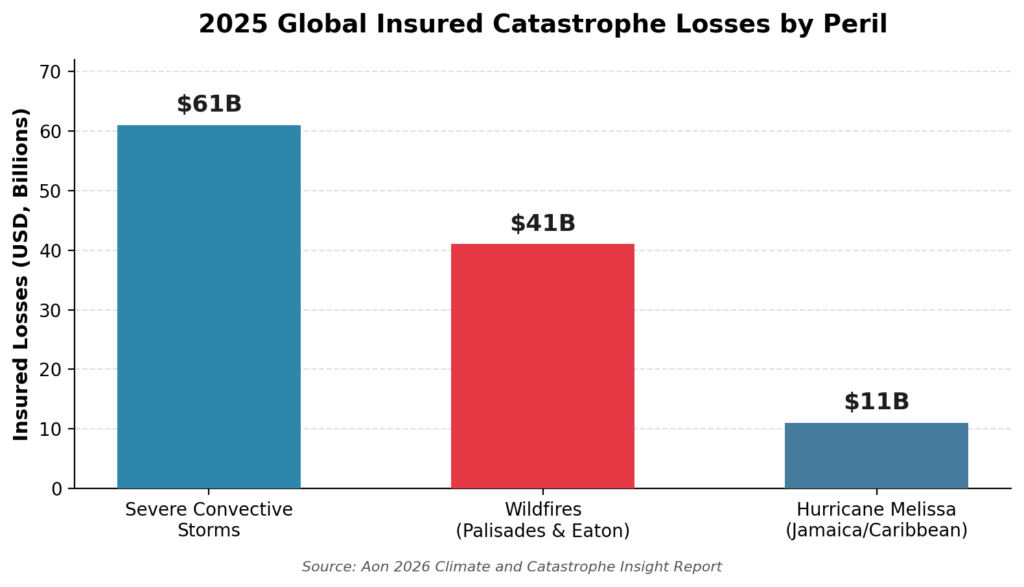
2025 global insured catastrophe losses by peril. Source: Aon 2026 Climate and Catastrophe Insight Report.
This is the backdrop against which cities are now operating: disasters that used to be once-in-a-generation events are becoming annual line items in municipal budgets, and old disaster playbooks – built around single-hazard, single-season assumptions – are being torn up and rewritten in real time.
Why Cities’ Old Disaster Playbooks No Longer Work
For most of the 20th century, urban disaster planning followed a fairly predictable formula: identify the region’s primary hazard (hurricanes, earthquakes, wildfire), build codes and response plans around that single risk, and update the plan every five to ten years. That model is now failing for three structural reasons.
1. Compound and Cascading Disasters
Modern climate risk rarely arrives one hazard at a time. Heatwaves strain power grids just as wildfire smoke worsens air quality; flooding contaminates water supplies while displacing the same populations that need emergency shelter from extreme heat. Emergency managers now describe this as ‘compound risk,’ and it renders single-hazard playbooks obsolete almost by design.
2. Infrastructure Built for a Climate That No Longer Exists
Stormwater systems, road networks, and cooling infrastructure in most major cities were engineered using historical rainfall and temperature data – data that, in a warming climate, systematically understates present-day risk. A drainage system designed for a ‘100-year flood’ may now see that same volume of rain every five to ten years in some regions.
3. A Widening Gap Between Federal Support and Local Need
In the United States particularly, local officials say they must now build community-based resilience networks largely on their own, as federal disaster support becomes less predictable, according to reporting from Smart Cities Dive’s National League of Cities coverage. That gap is pushing states and municipalities to self-fund and self-design much of the new resilience architecture.
Pillar One: AI-Powered Early Warning Systems Are Becoming the New Backbone
If there is one technology reshaping urban disaster response faster than any other in 2026, it’s artificial intelligence applied to early warning systems (EWS). The United Nations’ ‘Early Warnings for All’ initiative aims to extend early warning coverage to 100% of the global population by 2027, and AI is central to hitting that target.
The economic case is compelling. Research compiled for climate finance institutions shows that every $1 invested in early warning systems can save up to $10 in avoided disaster losses, and a warning issued just 24 hours ahead of an extreme event can cut resulting damage by roughly 30%, according to WMO-cited research. An estimated $800 million investment in early warning infrastructure in developing countries could avert between $3 billion and $16 billion in losses annually.
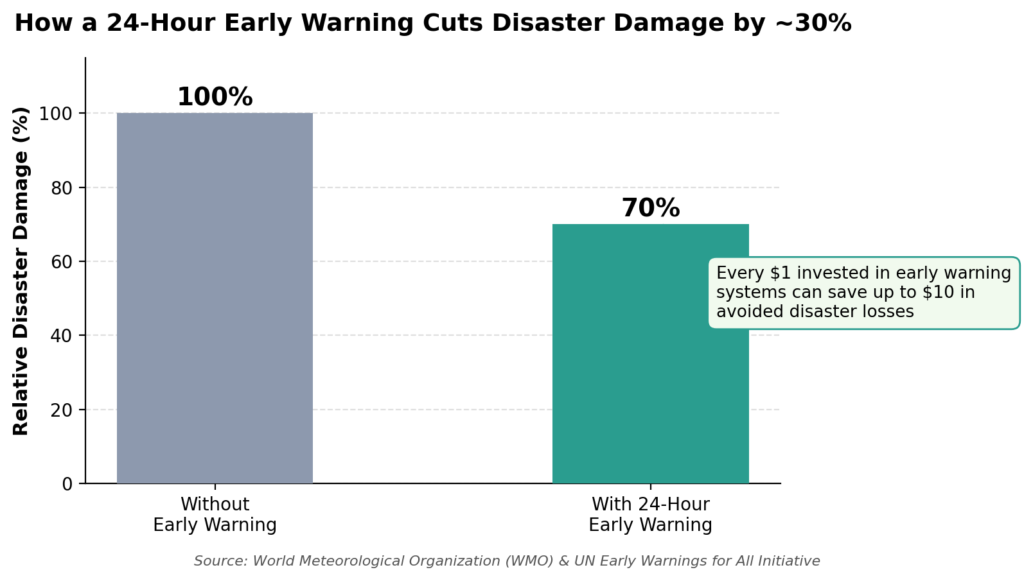
The financial case for AI-enhanced early warning systems. Source: WMO and UN Early Warnings for All Initiative.
Real deployments are already underway. Tech companies including Google, Nvidia, and Huawei are partnering with European weather forecasters on AI-driven models that can generate medium-term forecasts thousands of times faster than traditional numerical models while using far less computing power, according to reporting from TIME. In Mexico, the start-up SeismicAI is working with civil protection agencies in Guerrero and Jalisco to deploy AI-enhanced earthquake sensor networks. The U.S. National Weather Service has also partnered with AI translation firm Lilt to cut the time needed to translate hurricane warnings into Spanish and simplified Chinese from an hour down to about ten minutes.
Still, experts caution against treating AI as a replacement for institutional knowledge. Celeste Saulo, Secretary-General of the WMO, has emphasized that AI should enhance – not replace – the risk understanding that national meteorological services have built over decades, and that investment needs to flow into country-level forecasting infrastructure, not just algorithms.
Pillar Two: Sponge Cities and Water-Sensitive Urban Design
As flash flooding overwhelms conventional storm drains, more cities are turning to a nature-based concept known as the ‘sponge city’: urban environments engineered to absorb, store, and slowly release rainwater rather than funneling it straight into overloaded pipes. China pioneered the approach in 2014 and has since invested more than $140 billion across 90 pilot cities, integrating permeable pavement, rain gardens, and constructed wetlands with traditional grey infrastructure like storage tunnels.
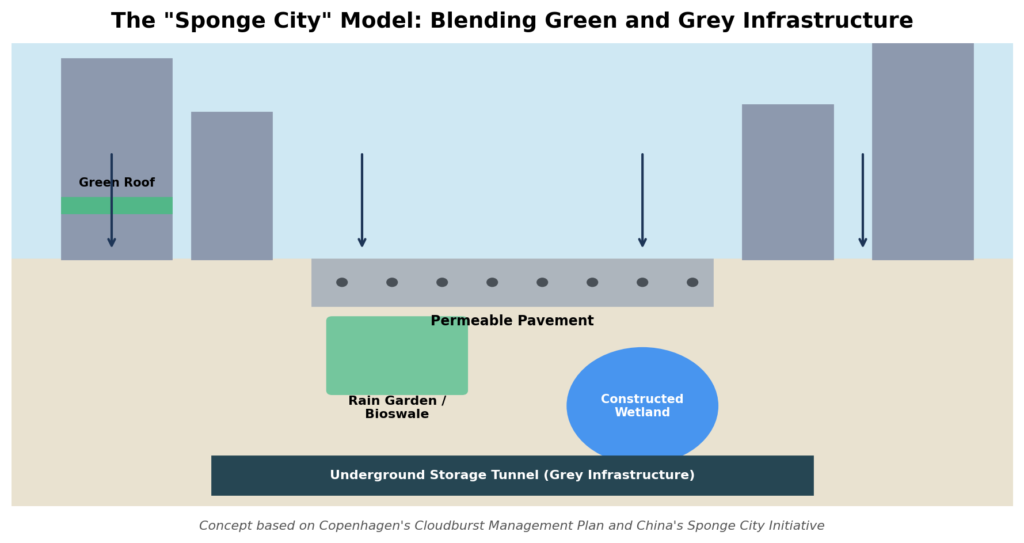
How a sponge city layers green infrastructure (rain gardens, wetlands, permeable pavement) with underground grey infrastructure to manage stormwater.
Copenhagen offers one of the most cited global models. After a catastrophic 2011 flood, the city launched its Cloudburst Management Plan, combining water-retaining parks like Enghave Park and permeable public squares such as Karen Blixens Square with large subterranean tunnels that store and redirect storm runoff, according to the World Economic Forum. The hybrid green-and-grey approach has since influenced flood planning in cities from Bangkok to Berlin to Jakarta.
The approach isn’t without setbacks. Severe flooding in China’s Hebei, Fujian, and Guangdong provinces in 2023 and 2024 showed that even well-funded sponge city programs can be outpaced by the speed of climate-driven risk, particularly where construction quality is inconsistent or where interventions are treated as isolated ‘showcase’ projects rather than citywide systems, according to analysis from the Asia Society Policy Institute. A 2026 case study of Shenzhen’s sponge city pilot similarly found that flood-resilience gains depend heavily on the spatial, institutional, and governance conditions surrounding implementation – not just the presence of green infrastructure itself.
Pillar Three: Cities Are Building a Formal Governance Structure for Heat
Extreme heat kills more people in the United States than any other weather hazard, and 2026 has brought a wave of new institutional responses. Arizona’s Executive Order 2025-09 created a Workplace Heat Safety Task Force tasked with drafting employer heat guidelines ahead of summer 2026, building on the state’s 2024 Extreme Heat Preparedness Plan, according to the Pew Charitable Trusts. California, meanwhile, is updating its statewide Extreme Heat Action Plan for the first time since 2022, as required under SB 306, with the revised plan set to directly inform the state’s 2027 Climate Adaptation Strategy.
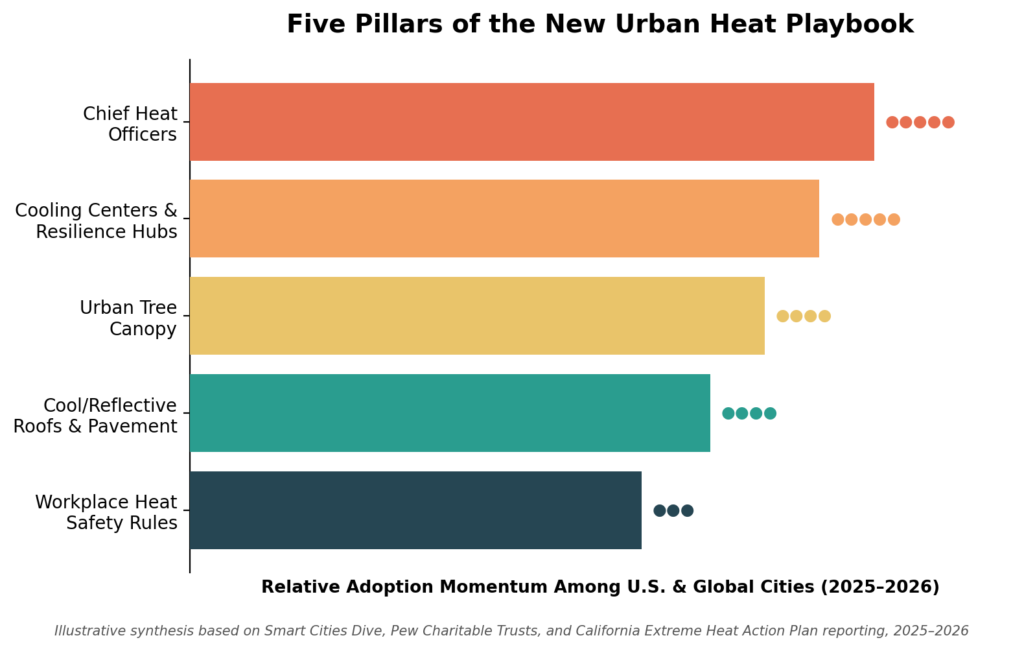
Five pillars of the emerging urban heat governance model being adopted across U.S. and global cities.
At the city level, Philadelphia is overhauling its climate resilience plan to include citywide heat and flood vulnerability assessments, grid-impact analysis, and structured resident input on where cooling investments should go, according to Smart Cities Dive. Because heat crosses departmental lines – affecting public health, the electric grid, air quality, and housing simultaneously – Philadelphia’s Office of Sustainability now coordinates across multiple agencies rather than assigning heat response to a single office.
Phoenix has become a frequently cited model for this kind of integrated approach, pairing natural cooling investments with structured community engagement in its heat action plan, according to the Center for Climate and Energy Solutions (C2ES). The broader trend among U.S. and global cities includes appointing dedicated Chief Heat Officers, deploying heat-mapping tools to target cooling resources to the most vulnerable neighborhoods, and treating heat as a recurring seasonal budget item rather than an occasional emergency.
Pillar Four: The Insurance Retreat Is Rewriting Where – and How – Cities Can Grow
Perhaps the most consequential shift in 2026 isn’t happening in emergency operations centers at all – it’s happening in insurance underwriting departments. U.S. insured catastrophe losses reached $112.7 billion in 2024, a 36% increase over the prior year, according to the Center for American Progress. In response, several major insurers have stopped writing new policies in high-risk states like California and Florida, pushing homeowners onto expensive, state-backed ‘insurers of last resort’ such as the California FAIR Plan or Florida Citizens.
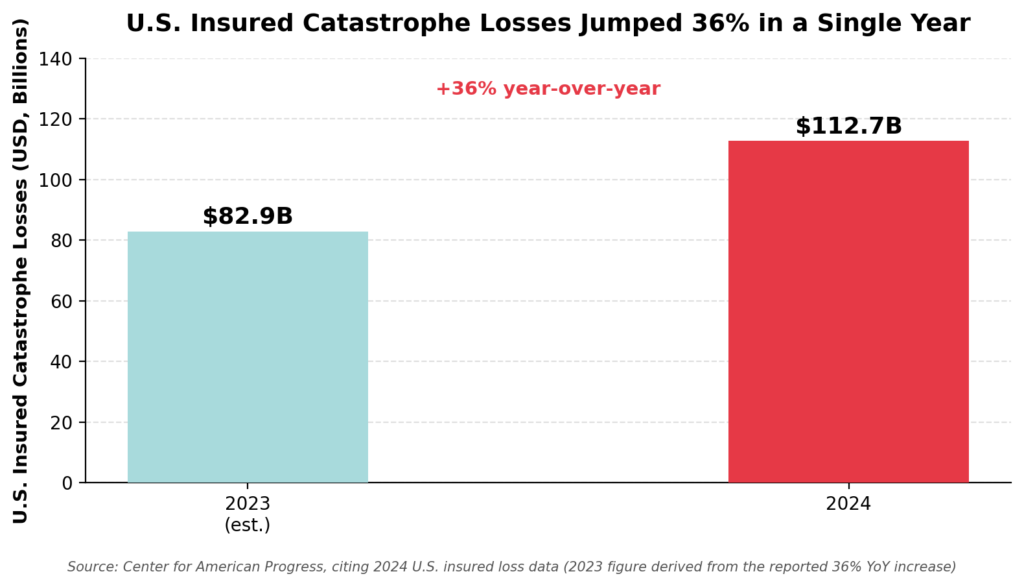
U.S. insured catastrophe losses rose sharply in a single year, accelerating insurer retreat from high-risk markets. Source: Center for American Progress.
This ‘insurance retreat’ is quietly becoming one of the most powerful forces shaping urban disaster policy, because it changes the economics of where people can afford to live and build. Research published in Nature’s npj Climate Action journal describes this as a fundamental shift in the financial security of homeowners and renters, with implications that extend to property values, mortgage access, and local government budgets.
It’s also accelerating conversations that were once politically untouchable, including managed retreat – the coordinated, purposeful relocation of people and infrastructure away from the highest-risk floodplains and coastlines. A 2026 academic review published on arXiv notes that although managed retreat is logistically and politically difficult, linking public insurance programs with structured buyout schemes can help break the expensive cycle of rebuilding in the same vulnerable locations after every disaster.
Pillar Five: Resilience Hubs Are Turning Community Centers Into Disaster Infrastructure
Not every part of the new disaster playbook is high-tech. Cities including Baltimore and Minneapolis have implemented ‘Resilience Hubs’ – trusted, everyday community facilities such as libraries, recreation centers, and places of worship that are equipped to double as resource centers during floods, heatwaves, and other hazard events, according to C2ES. Because these buildings are already woven into the daily life of a neighborhood, they tend to see far higher uptake during emergencies than purpose-built, unfamiliar shelters.
This community-first approach reflects a broader lesson emergency planners have drawn from the last several years of disasters: technology and infrastructure investments only work if the people they’re meant to protect trust and know how to use them. The WMO-affiliated research on AI-based early warning systems similarly emphasizes that a warning’s effectiveness depends as much on whether it is understood and acted upon as on its technical accuracy.
What This Rewrite Means for Residents, Businesses, and City Leaders
The shift underway in 2026 isn’t abstract policy – it has direct, practical implications for anyone living or investing in a city today.
- Homeowners and renters should expect insurance premiums tied more directly to hyperlocal climate risk, and should check whether their property sits in an area insurers are actively retreating from.
- City residents in flood- or heat-prone neighborhoods should locate their nearest designated resilience hub or cooling center before an emergency, not during one.
- Businesses, especially those with outdoor or physically demanding workforces, should track emerging state-level workplace heat safety rules, several of which are being finalized for 2026 and 2027.
- Property investors and developers should factor ‘resilience scores’ – verified flood, wind, and fire hardening – into underwriting decisions, as this is increasingly becoming a baseline requirement for insurability rather than an optional upgrade.
- Local officials without dedicated climate resilience staff should look to interagency coordination models, like Philadelphia’s cross-departmental heat approach, rather than assuming one office can own the problem alone.
Frequently Asked Questions
Why are cities changing their disaster plans in 2026 specifically?
2026 opened with a dense cluster of record-breaking events – extreme heat in Australia, record snowfall in Japan, and catastrophic flooding in Southern Africa – arriving within the same three-month window. Combined with 2025 being the third-hottest year on record and insured catastrophe losses hitting new highs, cities are responding to clear evidence that historical risk models built for past decades no longer reflect present-day hazard levels.
What is a ‘sponge city’ and does it actually work?
A sponge city uses nature-based infrastructure – permeable pavement, rain gardens, wetlands, and green roofs – alongside traditional storm drains and tunnels to absorb and slow down rainwater instead of overwhelming pipes. Cities like Copenhagen and Shenzhen have shown measurable flood-resilience gains, but researchers note results depend heavily on construction quality and whether the approach is applied citywide rather than as isolated showcase projects.
How much can early warning systems really reduce disaster damage?
According to WMO-cited research, a warning issued 24 hours before a hazardous event can reduce resulting damage by approximately 30%, and every $1 spent on early warning infrastructure can save up to $10 in avoided losses.
Why are insurance companies pulling out of high-risk cities?
Rising catastrophe losses – U.S. insured losses jumped 36% between 2023 and 2024 alone – have made some markets unprofitable for private insurers at current premium levels. Rather than raise prices to unaffordable levels, several major carriers have simply stopped writing new policies in the highest-risk parts of California, Florida, and other exposed states.
What can an individual resident do to prepare for this new era of extreme weather?
Identify your city’s nearest resilience hub or official cooling/warming center, sign up for local AI-enhanced early warning alerts where available, review your home insurance coverage annually against updated flood and fire risk maps, and support local policy efforts – like tree canopy expansion or permeable pavement programs – that reduce neighborhood-level risk.
The Bottom Line
The disaster playbooks cities relied on for the last half-century were built for a climate that no longer exists. What’s replacing them in 2026 is not a single strategy but a portfolio: AI-driven forecasting that buys precious hours of warning, sponge city infrastructure that gives water somewhere to go, formal heat governance that treats extreme temperatures as a chronic risk rather than a passing emergency, an insurance market that is quietly redrawing the map of where it’s financially viable to live, and community resilience hubs that keep neighbors connected to help when it matters most.
None of these measures alone is sufficient. Together, they represent the most significant transformation in urban disaster management in a generation – and cities that move fastest to adopt them are likely to be the ones that keep their residents safest as extreme weather continues to intensify.
Sources & References
1. Anadolu Agency (Greenline) – World, Türkiye enter year 2026 under impact of extreme weather events – https://www.aa.com.tr/en/greenline/climate-change/world-turkiye-enter-year-2026-under-impact-of-extreme-weather-events/1829164
2. Greenpeace International – Climate emergencies photos of 2026 so far – https://www.greenpeace.org/international/story/82686/climate-emergencies-photos-of-2026-so-far/
3. World Meteorological Organization – Extreme heat, cold, precipitation and fires mark start of 2026 – https://wmo.int/media/news/extreme-heat-cold-precipitation-and-fires-mark-start-of-2026
4. Climate Central – 2025 in Review: U.S. Billion-Dollar Disasters – https://www.climatecentral.org/climate-matters/2025-in-review
5. Aon – 2026 Climate and Catastrophe Insight Report – https://www.aon.com/en/insights/reports/climate-and-catastrophe-report
6. Pew Charitable Trusts – 11 States That Stepped Up on Disaster Resilience in 2025 – https://www.pew.org/en/research-and-analysis/articles/2025/12/16/11-states-that-stepped-up-on-disaster-resilience-in-2025
7. Smart Cities Dive – Extreme heat is here. Here’s how 2 cities plan to deal with it – https://www.smartcitiesdive.com/news/extreme-heat-cities-philadelphia-miami-dade-county/815850/
8. Smart Cities Dive – Extreme heat road map urges cities to rethink resilience – https://www.smartcitiesdive.com/news/heat-road-map-cities-rethink-resilience/824703/
9. California Natural Resources Agency – DRAFT Extreme Heat Action Plan (2026) – https://resources.ca.gov/-/media/CNRA-Website/Files/Initiatives/Climate-Resilience/DRAFT_Extreme_Heat_Action_Plan_2026.pdf
10. World Bank Blogs – Nature-based solutions in China: Financing sponge cities – https://blogs.worldbank.org/en/eastasiapacific/nature-based-solutions-china-financing-sponge-cities-integrated-urban-flood
11. MDPI – From Concept to Practice: Sponge City Implementation in Shenzhen, China – https://www.mdpi.com/2413-8851/10/3/135
12. Asia Society Policy Institute – Satellite and Sponge Cities for Vulnerable World Metropolises – https://asiasociety.org/policy-institute/satellite-and-sponge-cities-vulnerable-world-metropolises-renewed-urban-climate-adaptation
13. World Economic Forum – How ‘sponge cities’ can help protect against flooding – https://www.weforum.org/stories/2025/08/flood-climate-change-sponge-cities/
14. Columbia National Center for Disaster Preparedness – AI for Early Warning Systems and Anticipatory Action – https://ncdp.columbia.edu/ncdp-perspectives/ai-for-early-warning-systems-and-anticipatory-action/
15. International Telecommunication Union – AI for Good: Intelligence enhancing disaster resilience – https://www.itu.int/hub/2026/07/ai-for-good-intelligence-enhancing-disaster-resilience/
16. arXiv – AI for Climate Finance: Early Warning System Investments – https://arxiv.org/pdf/2504.05104
17. World Meteorological Organization – Fostering global cooperation on AI for early warning systems – https://wmo.int/resources/meteoworld/meteoworld-april-2026/fostering-global-cooperation-ai-early-warning-systems
18. TIME – How AI Is Being Used to Respond to Natural Disasters in Cities – https://time.com/7171445/ai-natural-disaster-cities/
19. Kukun – The Insurance Fortress: 2026 Climate Risk Real Estate – https://mykukun.com/blog/climate-risk-data-to-protect-your-portfolio-yields
20. Center for American Progress – Managing the Climate Change-Fueled Property Insurance Crisis – https://www.americanprogress.org/article/managing-the-climate-change-fueled-property-insurance-crisis/
21. Brookings Institution – How is climate change impacting home insurance markets? – https://www.brookings.edu/articles/how-is-climate-change-impacting-home-insurance-markets/
22. npj Climate Action (Nature) – The growing void in the U.S. homeowners insurance market – https://www.nature.com/articles/s44168-025-00231-8
23. Center for Climate and Energy Solutions (C2ES) – Climate Resilience Portal – https://www.c2es.org/content/climate-resilience-overview/
24. IOPscience – Advancing early warning systems: AI applications, challenges and emerging insights – https://iopscience.iop.org/article/10.1088/1748-9326/ae5f7f
Editorial note: This article synthesizes reporting and data from meteorological agencies (WMO), UN bodies, peer-reviewed journals, and established climate and insurance research organizations current as of August 2026. Figures reflect the most recent data available from cited sources at time of publication and may be updated as agencies release revised statistics.