








Lessons from the Ganges Basin
A researched look at 9,000 years of agricultural innovation on the Gangetic plain – from wild-rice gathering at Lahuradewa to the water wisdom of the Arthashastra
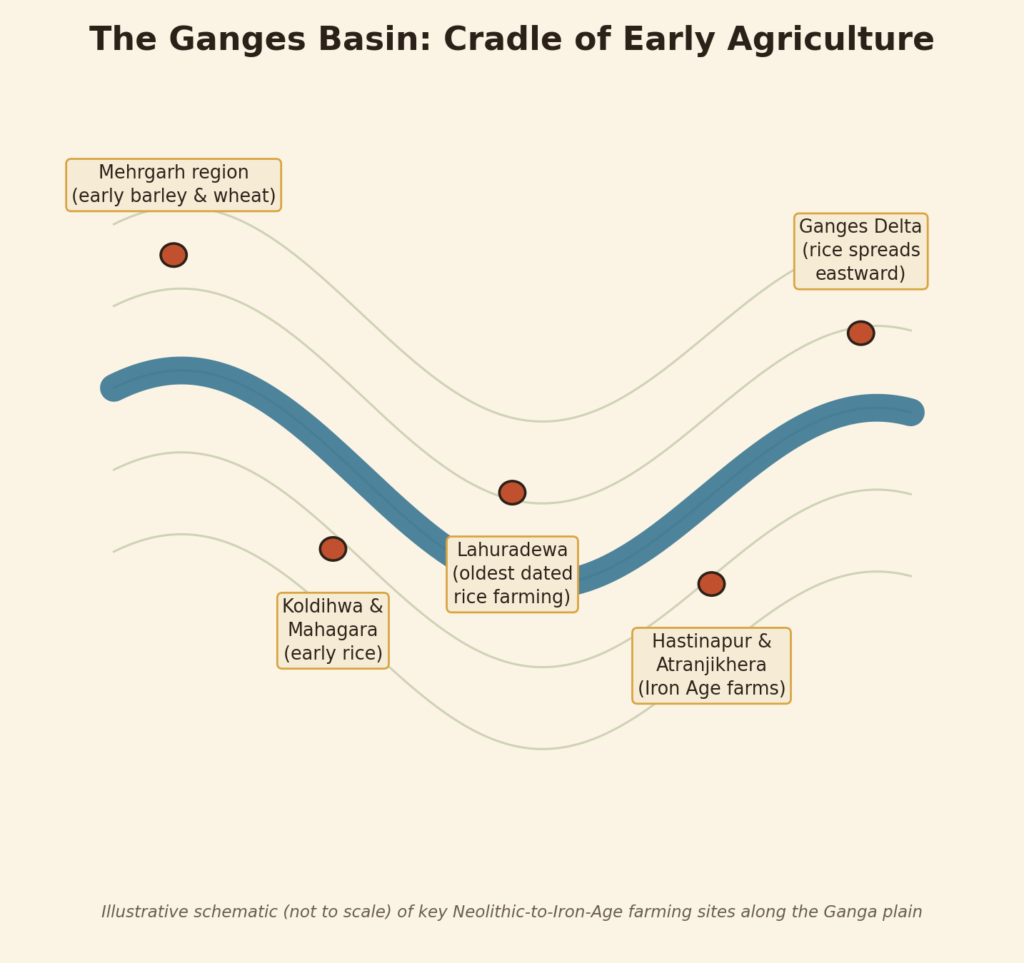
The Ganges Basin has been continuously farmed for roughly nine millennia, making it one of the world’s oldest living agricultural landscapes.
Long before tractors, diesel pumps, or chemical fertiliser existed anywhere on Earth, farmers on the banks of the Ganges were already feeding dense, settled populations. They did it with fire-hardened wooden ploughs, hand-woven baskets, sun-dried mud tanks, and an intimate, generations-deep reading of the monsoon. This is the story of ancient Indian agriculture in the Ganges basin – how early Indian farmers, working entirely without modern machinery, built one of the most resilient food-growing systems in world history, and why archaeologists, agronomists, and climate scientists are still studying their methods today.
Quick answer: Ancient Indians in the Ganges basin farmed using wooden and later iron-tipped ploughs, hand tools like sickles and hoes, monsoon-timed sowing cycles (Kharif and Rabi), and low-cost water management systems – wells (kupa), tanks (tataka), and canals (kulya) – described in Vedic texts and the Arthashastra. Archaeobotanical evidence from the site of Lahuradewa in Uttar Pradesh places rice cultivation in the Middle Ganga basin as early as 6400 BCE, making it one of the world’s independent centres of rice domestication.
The Fertile Cradle: Why the Ganges Basin Became an Agricultural Powerhouse
The Ganges (Ganga) basin is one of the largest and most densely populated river systems on the planet, and it has supported continuous human settlement since the early Holocene. Every monsoon, the river and its tributaries deposited a fresh layer of nutrient-rich alluvial silt across the floodplain, naturally replenishing the soil without any human intervention. This annual renewal meant ancient farmers rarely needed to abandon land the way slash-and-burn cultivators elsewhere did – they could farm the same fields, generation after generation, for thousands of years.
Geographically, the region offered a rare combination: flat, low-relief land that was easy to till by hand, reliable seasonal rainfall of 500 to 1,500 millimetres a year, and dense forest and wetland resources for hunting, fishing, and foraging while agriculture slowly took hold. Archaeological surveys of the Ganga plain have recorded hundreds of Mesolithic and Neolithic sites concentrated in exactly these high-rainfall, low-relief zones, which shows that early communities were deliberately choosing locations suited to farming rather than settling at random.
Lahuradewa and the Dawn of Rice Cultivation (c. 7000–6000 BCE)
If any single site anchors the story of ancient Indian agriculture, it is Lahuradewa, a small village beside a horseshoe lake in the Sant Kabir Nagar district of Uttar Pradesh. Excavations led by archaeologist Rakesh Tewari and colleagues uncovered carbonised rice grains and husks radiocarbon-dated to roughly 6409 BCE, alongside pottery that ranks among the oldest found anywhere in South Asia. Wild rice use at the site may stretch back even further, into the Mesolithic.
The significance of Lahuradewa is that it suggests rice farming in the Ganges valley developed independently, rather than being imported wholesale from China or elsewhere. Researchers describe the Middle Ganga basin as a plausible, independent centre of early rice cultivation, alongside similar early rice-farming societies emerging separately in the Yangtze valley of China. Nearby Neolithic sites – Koldihwa, Mahagara, and Chopani-Mando, all on the upper reaches of the Ganges drainage system – add further, if occasionally debated, evidence for a gradual, homegrown shift from gathering wild rice to deliberately sowing and harvesting it.
It is worth noting that scholars still debate exactly when ‘gathering’ tipped into true ‘domestication’ at these sites – archaeobotanist Dorian Fuller and others have argued some of the earliest Lahuradewa grains look more like managed wild rice than a fully domesticated crop. Even so, the consensus is clear on one point: by the third millennium BCE, organised rice agriculture was well established across the Gangetic plain, and it later spread eastward down the valley into Bengal and beyond into Southeast Asia.
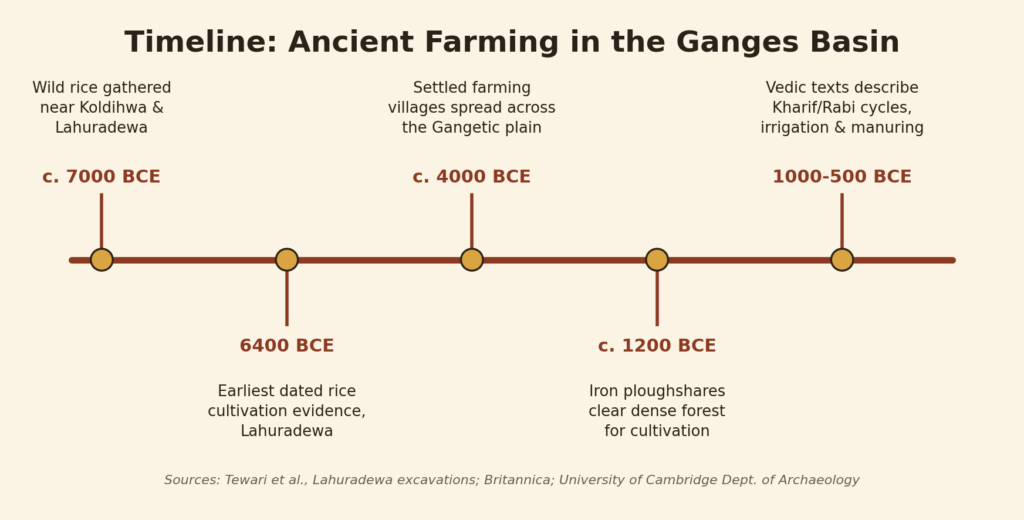
Key milestones in the archaeological record of farming across the Ganges basin, from wild-rice gathering to Vedic-era field management.
Farming Without Machines: Ancient Tools and Techniques
With no metal tools available for thousands of years, the earliest Gangetic farmers relied on stone blades, ground-stone axes, bone implements, and fire-hardened wooden digging sticks to clear scrub, break soil, and harvest grain. Woven reed and cane baskets were used to carry harvested rice, and simple hand-querns of stone ground it into edible form. It was slow, physically demanding work – but it was precise, low-impact, and required no fuel beyond human and animal muscle.
The Wooden Plough and the Iron Revolution
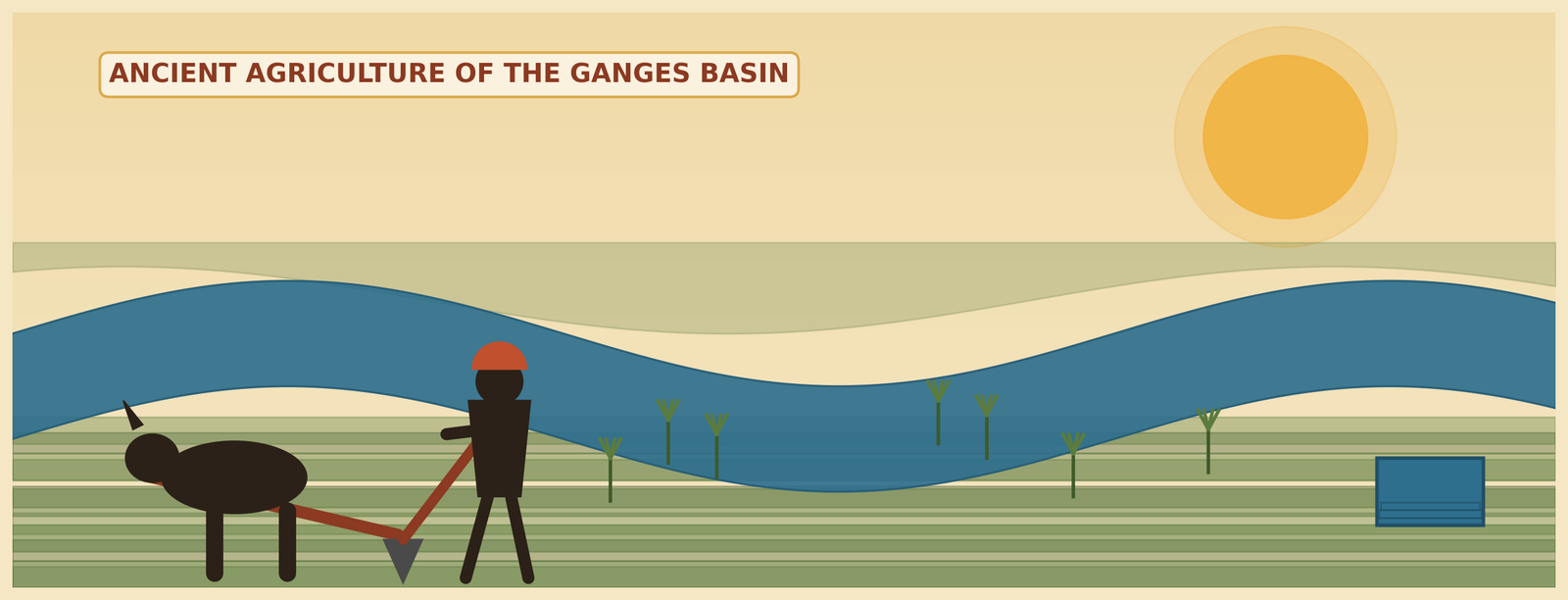
The plough (referred to in the Rigveda as being harnessed to yokes so that ‘the womb of the earth’ could receive seed) was one of ancient India’s most important agricultural technologies. Early ploughs were simple wooden ards, essentially a shaped branch dragged through soft floodplain soil by oxen. They worked well on light, silty land but struggled against the dense forests and heavier clay soils that covered much of the Gangetic interior.
That changed with the introduction of iron around 1200 BCE. Iron-tipped ploughshares – called krishna-ayas or shyama-ayas, literally ‘black metal’, in Vedic texts – could finally cut through hard, forested ground. This single innovation allowed farmers to clear vast new tracts of the Ganga-Yamuna doab for cultivation, triggering a documented expansion in rice production, population growth, and the founding of new agrarian settlements throughout the later Vedic period.
Sickles, Hoes, and Seed Broadcasting
For harvesting, farmers used curved sickles to cut grain stalks close to the ground, a technique still recognisable in rural India today. Hoes and mattocks were used for weeding and preparing seed beds by hand. Later Vedic-period texts describe farmers ploughing fields multiple times before sowing, then broadcasting seed by hand across the loosened soil – a method that, while labour-intensive, allowed for surprisingly even germination across large plots without any mechanical seed drill.
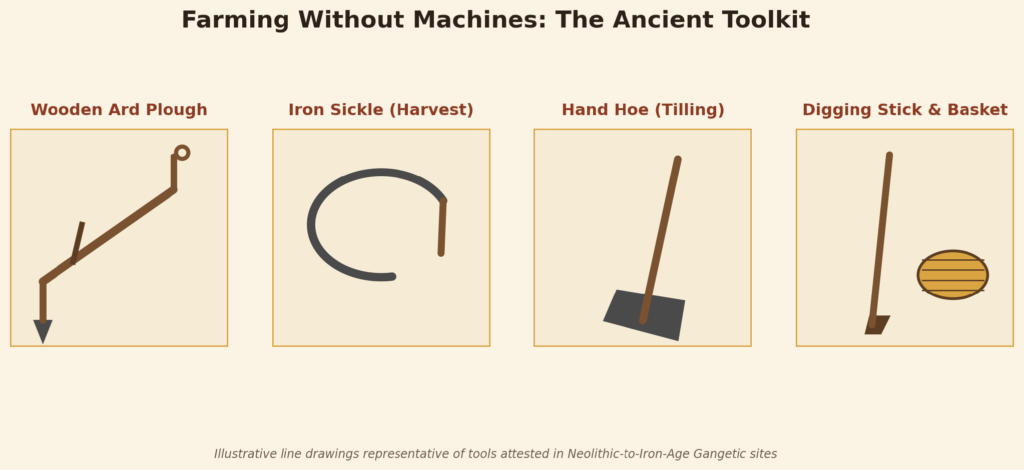
The ancient Gangetic farmer’s essential toolkit – wooden and iron ploughs, sickles, hoes, and digging tools – required skill, not fuel or electricity.
Reading the Sky: Monsoon Wisdom and the Kharif–Rabi Cycle
Perhaps the most sophisticated ‘technology’ ancient Gangetic farmers possessed was not a tool at all, but a body of accumulated ecological knowledge: an intimate understanding of the monsoon. Without satellites or forecasts, farmers learned to time their entire agricultural calendar around two seasonal rainfall systems, dividing the farming year into two complementary cropping seasons that are still used across India today.
The Kharif season ran with the summer monsoon, roughly June to October, and was used to sow moisture-loving crops such as rice, cotton, and various pulses. The Rabi season followed in the cooler, drier winter months, from around October to March, and was dedicated to wheat, barley, and mustard, crops that need less water and cooler temperatures to mature. This two-season rhythm meant land in the Ganges basin rarely lay idle, and it built in a natural form of risk management: if one monsoon failed or underperformed, the following season’s different crop mix offered a second chance at a harvest.
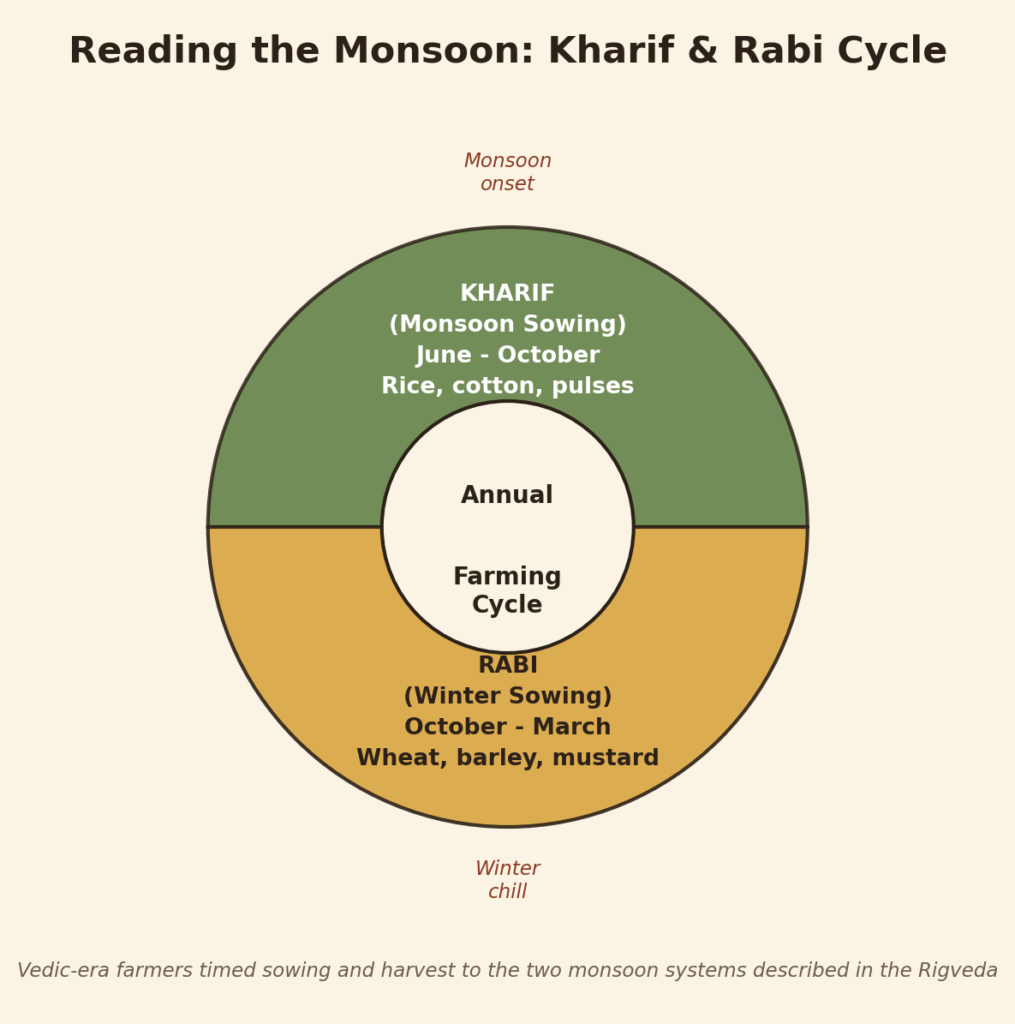
The Kharif–Rabi agricultural calendar allowed Gangetic farmers to keep land continuously productive by matching crop choice to seasonal rainfall.
Ancient Water Management: Wells, Tanks, and Canals
Rainfall in the Ganges basin, though reliable by global standards, is highly seasonal – most of it falls in a few monsoon months. Ancient Indian farmers responded by building an entire, low-tech infrastructure for capturing and storing water for the dry season. Vedic and later classical texts, including the Arthashastra, describe three complementary systems: the kupa (well), the tataka (tank or reservoir), and the kulya (canal).
Wells tapped groundwater directly and could be dug and lined by hand using timber, brick, or stone; elaborate stepwells such as Gujarat’s Rani ki Vav later turned this simple concept into genuine architectural achievements. Tanks were artificial reservoirs that captured monsoon runoff across the wet season and released it gradually through the dry months, an early form of water storage still visible in thousands of village tanks across India. Canals distributed water from rivers or tanks directly into fields, letting farmers irrigate on their own schedule rather than relying entirely on rainfall timing.
This was not a uniquely Gangetic invention – the Indus Valley Civilisation to the west had already developed sophisticated rainwater harvesting reservoirs and irrigation channels by around 4500 BCE, and that engineering tradition likely influenced practices further east. But in the Ganges basin, this three-tier water system became deeply embedded in agrarian life, and later administrative texts describe the state actively monitoring and taxing irrigated land, a sign of just how central water management had become to the ancient Indian economy.
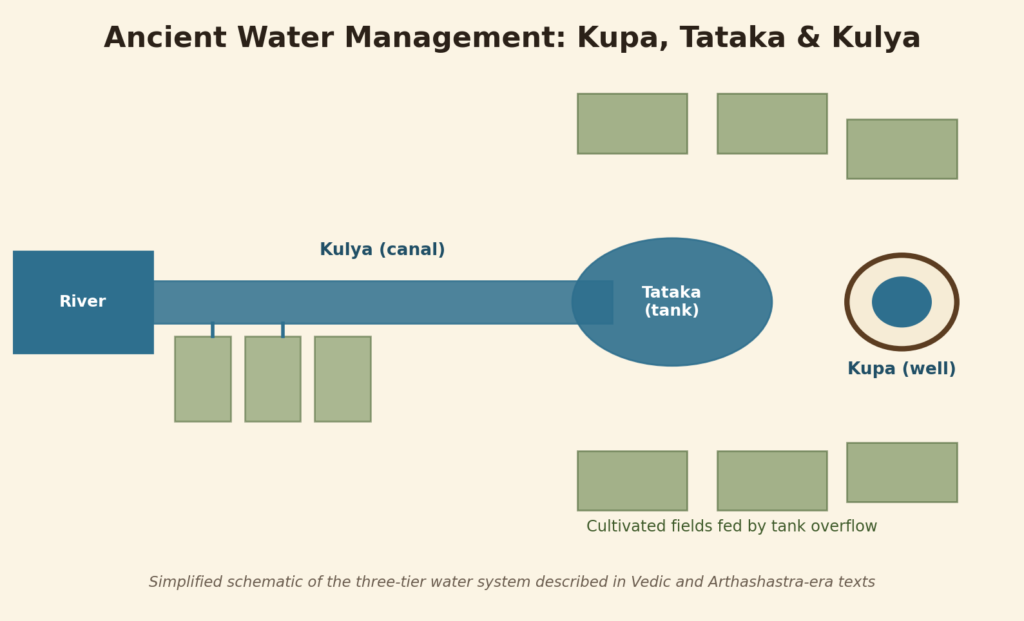
A simplified view of the well–tank–canal water system: rainwater captured in tanks and channelled through canals kept fields productive through the dry season.
Soil, Silt, and Sustainable Fertility
Ancient Gangetic agriculture was, by necessity, a closed-loop system. Farmers had no synthetic fertiliser, so soil fertility depended on natural processes: the river’s own annual silt deposits, the recycling of crop residue back into the field, and – critically – the systematic use of cattle dung as manure, a practice explicitly referenced in later Vedic agricultural texts. Fallowing, or resting a field for a season, was also practised to let soil nutrients recover naturally.
Mixed animal husbandry reinforced this cycle. Cattle, water buffalo, sheep, goats, and pigs were kept alongside crops, meaning manure, draught power for ploughing, and dairy products all came from the same integrated farm system, with very little waste and no external chemical inputs of any kind.
Crop Diversity: What Grew in the Ancient Gangetic Fields
Archaeobotanical studies of Ganga Plain sites spanning the Neolithic through the early historic period (roughly 2500 to 200 BCE) show a strikingly diverse crop package. Rice (Oryza sativa) and barley (Hordeum vulgare) were dominant, alongside wheat (Triticum aestivum), millets such as ragi and sorghum, pulses like mung bean, and fibre and oil crops including cotton and sesame. Vegetables native to the region, such as cucumber, snake gourd, and bitter gourd, rounded out the diet, along with fish and game from the surrounding wetlands and forests.
This diversity mattered enormously for food security. A farmer growing several different crops across two cropping seasons was insulated against the failure of any single one – an ancient, homegrown version of what modern agronomists now call climate-resilient, diversified farming.
Ancient Texts as Agricultural Science
Ancient Indians did not just farm skilfully – they wrote their knowledge down, turning oral and practical wisdom into something close to an early agricultural science. The Rigveda contains hymns describing the yoking of ploughs and the sowing of seed. Later Vedic literature catalogues iron tools, irrigation practices, and animal husbandry in detail. By the Mauryan period, the statecraft treatise the Arthashastra goes further still, offering administrative guidance on classifying land, managing irrigation infrastructure, and even setting expectations for agricultural output – evidence of a state apparatus that treated farming as a subject worthy of systematic policy, not just tradition.
What Modern Agriculture Can Learn From Ancient India
Interest in ancient Indian farming is not merely historical curiosity. As modern agriculture confronts climate change, water scarcity, and soil degradation from decades of intensive chemical use, researchers are increasingly revisiting these low-input, climate-adapted methods for practical ideas. Traditional tank irrigation is being restored in several Indian states as a cheap, decentralised alternative to energy-intensive groundwater pumping. Organic manuring and crop rotation, once simply the only option available, are now actively promoted as sustainable alternatives to synthetic fertiliser. And the Kharif-Rabi diversified cropping calendar remains, essentially unchanged, the backbone of Indian agricultural planning today.
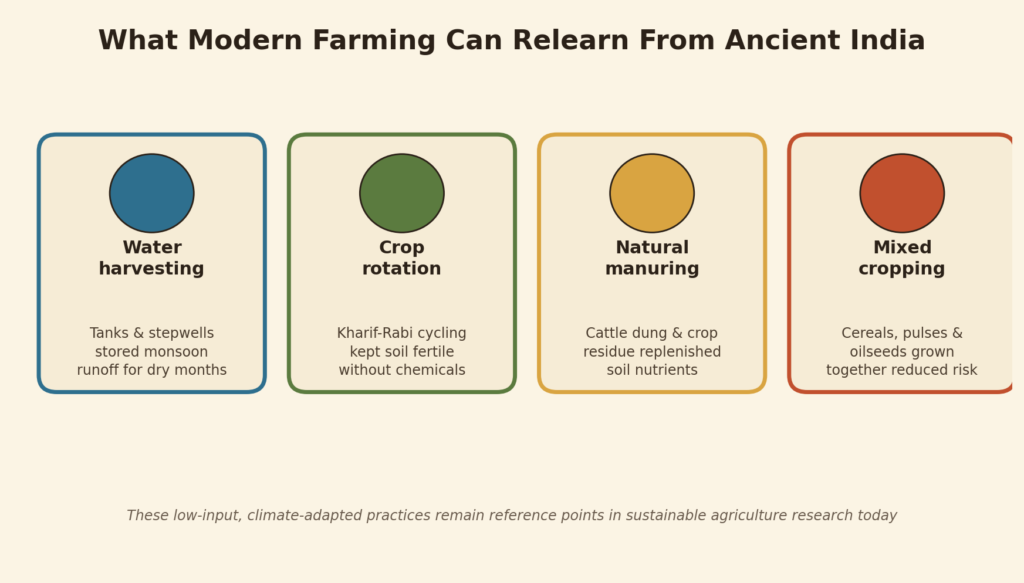
Water harvesting, crop rotation, natural manuring, and mixed cropping – ancient Gangetic practices that inform sustainable farming research today.
None of this is to romanticise a hard, physically demanding way of life. Ancient farmers dealt with unpredictable famine years, and archaeological evidence shows they were affected by real climate shocks, such as the well-documented aridification event around 4,200 years ago. What is remarkable is how much resilience they nonetheless built into their systems using nothing but wood, stone, iron, earth, and an accumulated, multi-generational understanding of their environment – proof that sound agricultural science does not require modern machinery, only careful observation and the willingness to pass hard-won knowledge down the generations.
Frequently Asked Questions
What is the oldest evidence of farming in the Ganges basin?
The oldest well-dated evidence comes from Lahuradewa in Uttar Pradesh, where carbonised rice remains have been radiocarbon-dated to around 6400 BCE, with possible wild-rice use stretching back even earlier into the Mesolithic period.
What tools did ancient Indian farmers use before iron?
Before iron became widely available around 1200 BCE, farmers used wooden ards (simple ploughs), stone blades and axes, bone tools, fire-hardened digging sticks, and hand-woven baskets for harvesting and carrying grain.
How did ancient Indians irrigate their fields without pumps?
They built a three-part gravity-fed system: kupa (wells) for groundwater, tataka (tanks) to store monsoon runoff, and kulya (canals) to channel water from rivers or tanks directly into fields, all described in Vedic and Arthashastra-era texts.
What is the Kharif and Rabi cropping system?
Kharif crops (rice, cotton, pulses) are sown with the summer monsoon between June and October; Rabi crops (wheat, barley, mustard) are sown in the cooler, drier winter between October and March. This two-season cycle, developed in ancient times, is still the foundation of Indian agriculture today.
Was rice domesticated independently in India?
Most researchers agree the Ganges basin represents an independent centre of early rice cultivation, separate from the Yangtze valley in China, based on the early and continuous archaeobotanical sequence found at sites such as Lahuradewa, Koldihwa, and Mahagara – though the precise timing of full domestication versus long-term wild-rice management is still actively debated among archaeobotanists.
References and Further Reading
This article draws on peer-reviewed archaeological research, university publications, and standard academic reference works, including:
– Tewari, R. et al. – “Early Farming at Lahuradewa” (Pragdhara / ResearchGate) – https://www.researchgate.net/publication/284499845_Early_farming_at_Lahuradewa
– University of Cambridge, Division of Archaeology – “Rice farming in India much older than thought” – https://www.cam.ac.uk/research/news/rice-farming-in-india-much-older-than-thought-used-as-summer-crop-by-indus-civilisation
– Encyclopaedia Britannica – “India: Developments in the Ganges Basin” – https://www.britannica.com/place/India/Developments-in-the-Ganges-basin
– Encyclopaedia Britannica – “Origins of Agriculture: The Indian Subcontinent” – https://www.britannica.com/topic/agriculture/The-Indian-subcontinent
– ScienceDirect – “Neolithic−Early historic plant use: The archaeobotany of Ganga Plain, India” – https://www.sciencedirect.com/science/article/abs/pii/S1040618216303317
– ScienceDirect – “Late Quaternary human-environment relationship in the Ganga Plain, India” – https://www.sciencedirect.com/science/article/pii/S1040618224000028
– Frontiers in Ecology and Evolution – “The Fits and Starts of Indian Rice Domestication” – https://www.frontiersin.org/journals/ecology-and-evolution/articles/10.3389/fevo.2022.924977/full
– Current Anthropology – “Finding Plant Domestication in the Indian Subcontinent” – https://www.journals.uchicago.edu/doi/10.1086/658900
– Wiley Online Library – “Ancient Agriculture in the Indian Subcontinent” (A Companion to Ancient Agriculture) – https://onlinelibrary.wiley.com/doi/10.1002/9781118970959.ch28
Note: Radiocarbon dates and domestication timelines for early Gangetic rice remain an active area of academic debate; figures above reflect the ranges most commonly cited across the cited peer-reviewed sources as of 2026.